 Add to Chrome
 Add to Firefox
 Add to Edge
JMedEthicBench: A Multi-Turn Conversational Benchmark for Evaluating Medical Safety in Japanese Large Language Models
Jan 04, 2026
As Large Language Models (LLMs) are increasingly deployed in healthcare field, it becomes essential to carefully evaluate their medical safety before clinical use. However, existing safety benchmarks remain predominantly English-centric, and test with only single-turn prompts despite multi-turn clinical consultations. To address these gaps, we introduce JMedEthicBench, the first multi-turn conversational benchmark for evaluating medical safety of LLMs for Japanese healthcare. Our benchmark is based on 67 guidelines from the Japan Medical Association and contains over 50,000 adversarial conversations generated using seven automatically discovered jailbreak strategies. Using a dual-LLM scoring protocol, we evaluate 27 models and find that commercial models maintain robust safety while medical-specialized models exhibit increased vulnerability. Furthermore, safety scores decline significantly across conversation turns (median: 9.5 to 5.0, $p < 0.001$). Cross-lingual evaluation on both Japanese and English versions of our benchmark reveals that medical model vulnerabilities persist across languages, indicating inherent alignment limitations rather than language-specific factors. These findings suggest that domain-specific fine-tuning may accidentally weaken safety mechanisms and that multi-turn interactions represent a distinct threat surface requiring dedicated alignment strategies.

ADAgent: LLM Agent for Alzheimer's Disease Analysis with Collaborative Coordinator
Jun 16, 2025Alzheimer's disease (AD) is a progressive and irreversible neurodegenerative disease. Early and precise diagnosis of AD is crucial for timely intervention and treatment planning to alleviate the progressive neurodegeneration. However, most existing methods rely on single-modality data, which contrasts with the multifaceted approach used by medical experts. While some deep learning approaches process multi-modal data, they are limited to specific tasks with a small set of input modalities and cannot handle arbitrary combinations. This highlights the need for a system that can address diverse AD-related tasks, process multi-modal or missing input, and integrate multiple advanced methods for improved performance. In this paper, we propose ADAgent, the first specialized AI agent for AD analysis, built on a large language model (LLM) to address user queries and support decision-making. ADAgent integrates a reasoning engine, specialized medical tools, and a collaborative outcome coordinator to facilitate multi-modal diagnosis and prognosis tasks in AD. Extensive experiments demonstrate that ADAgent outperforms SOTA methods, achieving significant improvements in accuracy, including a 2.7% increase in multi-modal diagnosis, a 0.7% improvement in multi-modal prognosis, and enhancements in MRI and PET diagnosis tasks.
Modification Takes Courage: Seamless Image Stitching via Reference-Driven Inpainting
Nov 15, 2024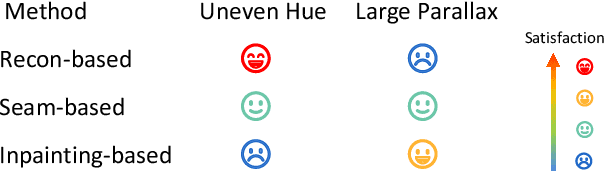
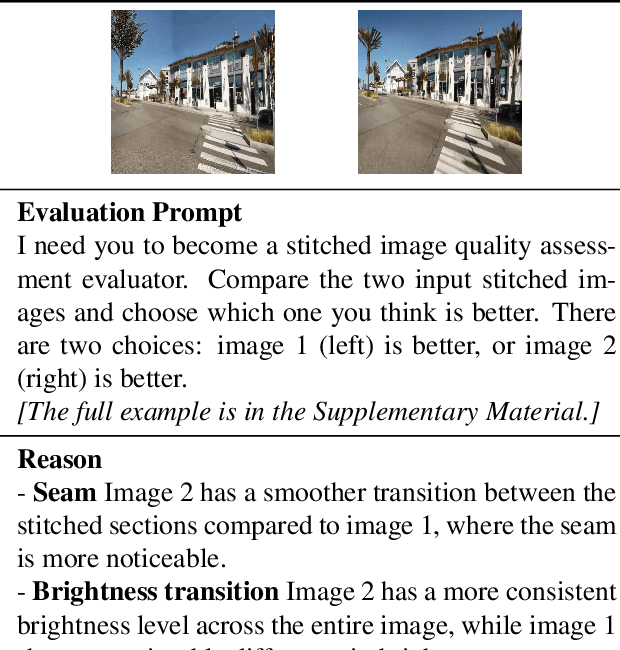
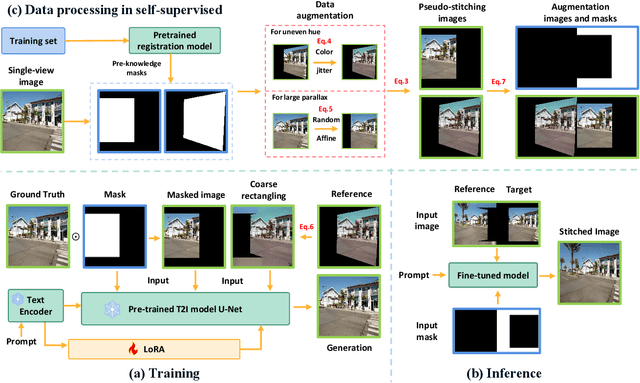
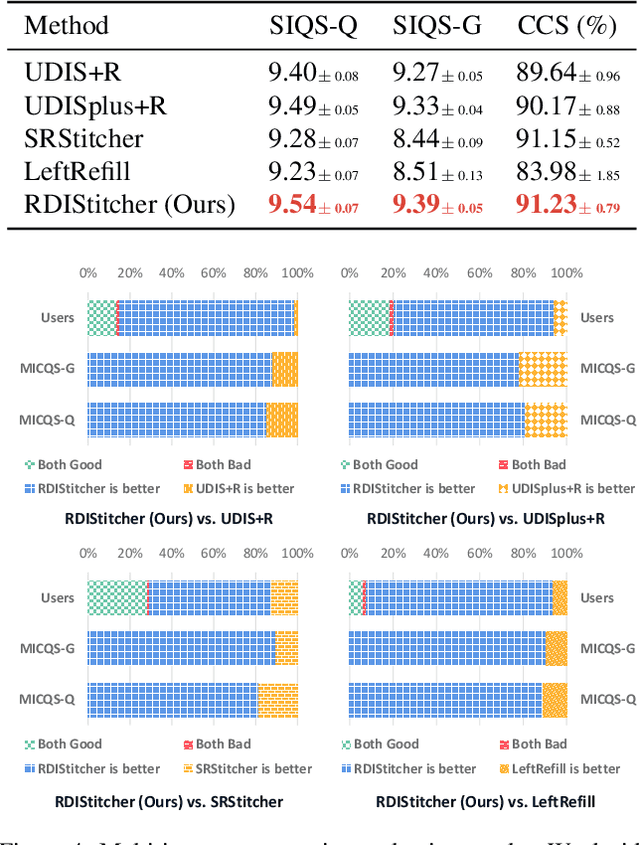
Current image stitching methods often produce noticeable seams in challenging scenarios such as uneven hue and large parallax. To tackle this problem, we propose the Reference-Driven Inpainting Stitcher (RDIStitcher), which reformulates the image fusion and rectangling as a reference-based inpainting model, incorporating a larger modification fusion area and stronger modification intensity than previous methods. Furthermore, we introduce a self-supervised model training method, which enables the implementation of RDIStitcher without requiring labeled data by fine-tuning a Text-to-Image (T2I) diffusion model. Recognizing difficulties in assessing the quality of stitched images, we present the Multimodal Large Language Models (MLLMs)-based metrics, offering a new perspective on evaluating stitched image quality. Compared to the state-of-the-art (SOTA) method, extensive experiments demonstrate that our method significantly enhances content coherence and seamless transitions in the stitched images. Especially in the zero-shot experiments, our method exhibits strong generalization capabilities. Code: https://github.com/yayoyo66/RDIStitcher