 Add to Chrome
 Add to Firefox
 Add to Edge
Pilots and Other Predictable Elements of the Starlink Ku-Band Downlink
Feb 02, 2026
We identify and characterize dedicated pilot symbols and other predictable elements embedded within the Starlink Ku-band downlink waveform. Exploitation of these predictable elements enables precise opportunistic positioning, navigation, and timing using compact, low-gain receivers by maximizing the signal processing gain available for signal acquisition and time-of-arrival (TOA) estimation. We develop an acquisition and demodulation framework to decode Starlink frames and disclose the explicit sequences of the edge pilots -- bands of 4QAM symbols located at both edges of each Starlink channel that apparently repeat identically across all frames, beams, channels, and satellites. We further reveal that the great majority of QPSK-modulated symbols do not carry high-entropy user data but instead follow a regular tessellated structure superimposed on a constant reference template. We demonstrate that exploiting frame-level predictable elements yields a processing gain of approximately 48 dB, thereby enabling low-cost, compact receivers to extract precise TOA measurements even from low-SNR Starlink side beams.

Timing Properties of the Starlink Ku-Band Downlink
Jan 09, 2025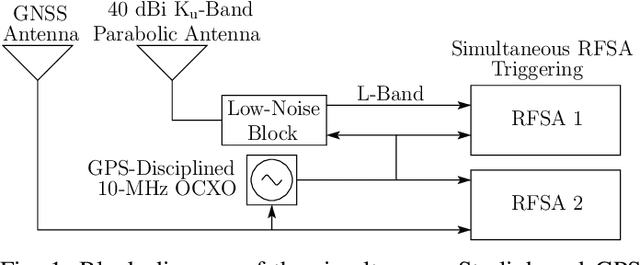
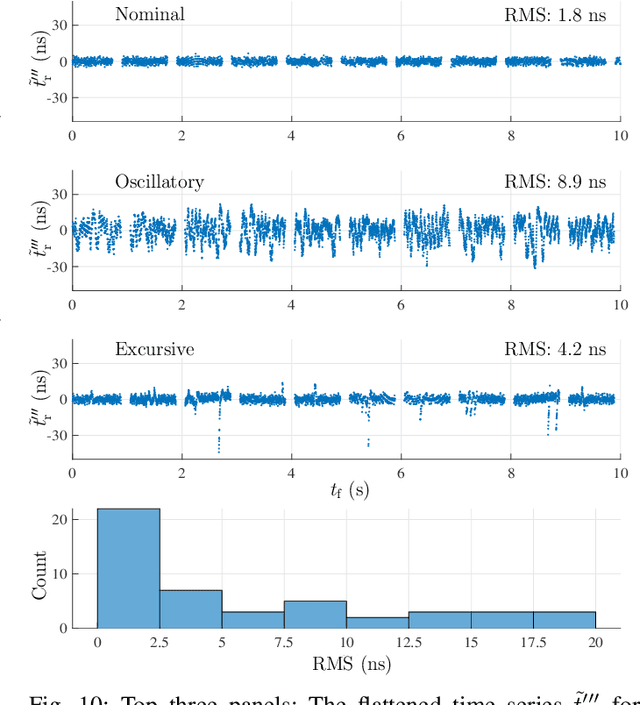
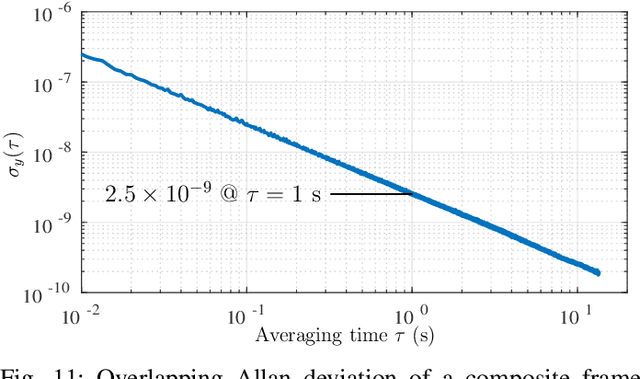
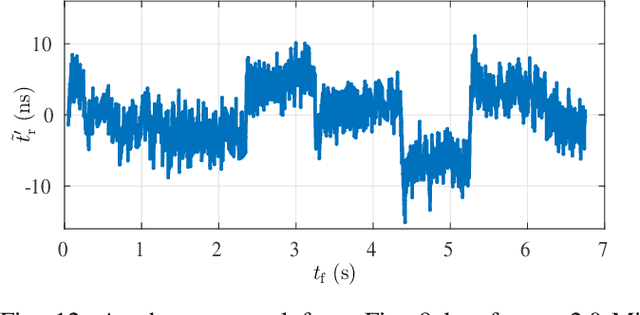
We develop signal capture and analysis techniques for precisely extracting and characterizing the frame timing of the Starlink constellation's Ku-band downlink transmissions. The aim of this work is to determine whether Starlink frame timing has sufficient short-term stability to support pseudorange-based opportunistic positioning, navigation, and timing (PNT). A second goal is to determine whether frame timing is disciplined to a common time scale such as GPS time. Our analysis reveals several timing characteristics not previously known that carry strong implications for PNT. On the favorable side, periods of ns-level jitter in frame arrival times across all satellite versions indicate that Starlink hardware is fundamentally capable of the short-term stability required to support GPS-like PNT. But there are several unfavorable characteristics that, if not addressed, will make GPS-like PNT impractical: (1) The v1.0 and v1.5 Starlink satellites exhibit once-per-second abrupt frame timing adjustments whose magnitude (as large as 100s of ns) and sign appear unpredictable. Similar discontinuities are also present in the v2.0-Mini frame timing, though smaller and irregularly spaced. (2) Episodic 15-s periods of high frame jitter routinely punctuate the nominal low-jitter frame arrival timing. (3) Starlink frame timing is disciplined to GPS time, but only loosely: to within a few ms by adjustments occurring every 15 s; otherwise exhibiting drift that can exceed 20 ppm. These unfavorable characteristics are essentially incompatible with accurate PNT. Fortunately, they appear to be a consequence of software design choices, not hardware limitations. Moreover, they could be compensated with third-party-provided corrections.