 Add to Chrome
 Add to Firefox
 Add to Edge
VSCOUT: A Hybrid Variational Autoencoder Approach to Outlier Detection in High-Dimensional Retrospective Monitoring
Jan 28, 2026
Modern industrial and service processes generate high-dimensional, non-Gaussian, and contamination-prone data that challenge the foundational assumptions of classical Statistical Process Control (SPC). Heavy tails, multimodality, nonlinear dependencies, and sparse special-cause observations can distort baseline estimation, mask true anomalies, and prevent reliable identification of an in-control (IC) reference set. To address these challenges, we introduce VSCOUT, a distribution-free framework designed specifically for retrospective (Phase I) monitoring in high-dimensional settings. VSCOUT combines an Automatic Relevance Determination Variational Autoencoder (ARD-VAE) architecture with ensemble-based latent outlier filtering and changepoint detection. The ARD prior isolates the most informative latent dimensions, while the ensemble and changepoint filters identify pointwise and structural contamination within the determined latent space. A second-stage retraining step removes flagged observations and re-estimates the latent structure using only the retained inliers, mitigating masking and stabilizing the IC latent manifold. This two-stage refinement produces a clean and reliable IC baseline suitable for subsequent Phase II deployment. Extensive experiments across benchmark datasets demonstrate that VSCOUT achieves superior sensitivity to special-cause structure while maintaining controlled false alarms, outperforming classical SPC procedures, robust estimators, and modern machine-learning baselines. Its scalability, distributional flexibility, and resilience to complex contamination patterns position VSCOUT as a practical and effective method for retrospective modeling and anomaly detection in AI-enabled environments.

Boundary Peeling: Outlier Detection Method Using One-Class Peeling
Sep 11, 2023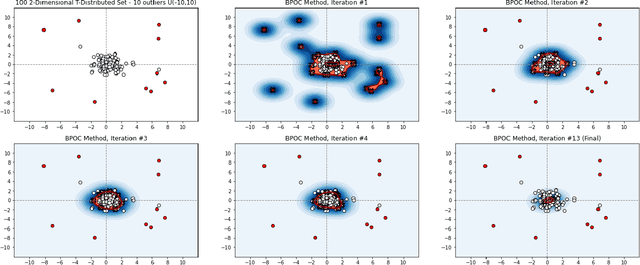
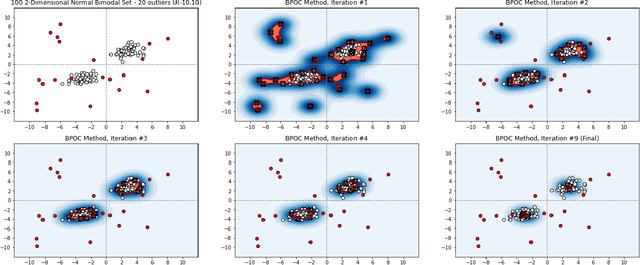

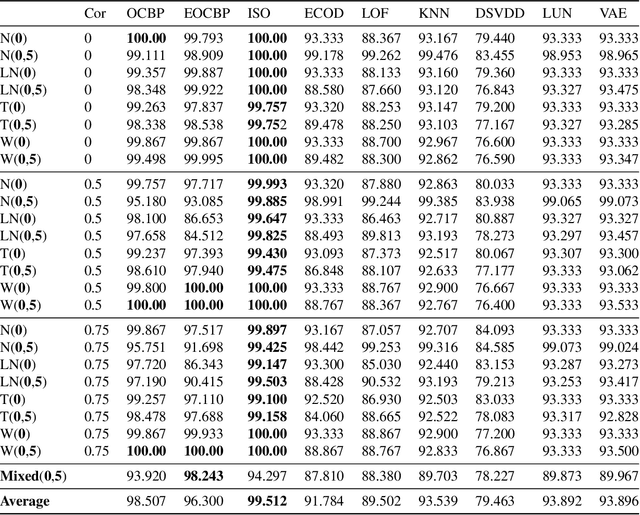
Unsupervised outlier detection constitutes a crucial phase within data analysis and remains a dynamic realm of research. A good outlier detection algorithm should be computationally efficient, robust to tuning parameter selection, and perform consistently well across diverse underlying data distributions. We introduce One-Class Boundary Peeling, an unsupervised outlier detection algorithm. One-class Boundary Peeling uses the average signed distance from iteratively-peeled, flexible boundaries generated by one-class support vector machines. One-class Boundary Peeling has robust hyperparameter settings and, for increased flexibility, can be cast as an ensemble method. In synthetic data simulations One-Class Boundary Peeling outperforms all state of the art methods when no outliers are present while maintaining comparable or superior performance in the presence of outliers, as compared to benchmark methods. One-Class Boundary Peeling performs competitively in terms of correct classification, AUC, and processing time using common benchmark data sets.