 Add to Chrome
 Add to Firefox
 Add to Edge
Invariants in Eddy Current Testing via Dimensional Analysis
Nov 08, 2025
The Buckingham's $π$, theorem has been recently introduced in the context of Non destructive Testing \& Evaluation (NdT\&E) , giving a theoretical basis for developing simple but effective methods for multi-parameter estimation via dimensional analysis. Dimensional groups, or $π-$groups, allow for the reduction of the number of parameters affecting the dimensionless measured quantities. In many real-world applications, the main interest is in estimating only a subset of the variables affecting the measurements. An example is estimating the thickness and electrical conductivity of a plate from Eddy Current Testing data, regardless of the lift-off of the probe, which may be either uncertain and/or variable. Alternatively, one may seek to estimate thickness and lift-off while neglecting the influence of the electrical conductivity, or to estimate the electrical conductivity and the lift-off, neglecting the thickness. This is where the concept of invariants becomes crucial. An invariant transformation is a mathematical mapping that makes the measured signal independent of one or more of these uncertain parameters. Invariant transformations provide a way to isolate useful signals from uncertain ones, improving the accuracy and reliability of the NdT results. The main contribution of this paper is a systematic method to derive \emph{invariant} transformations for frequency domain Eddy Current Testing data, via dimensional analysis. The proposed method is compatible with real-time and in-line operations. After its theoretical foundation is introduced, the method is validated by means of experimental data, with reference to configurations consisting of plates with different thicknesses, electrical conductivity, and lift-off. The experimental validation proves the effectiveness of the method in achieving excellent accuracy on a wide range of parameters of interest.

The inverse obstacle problem for nonlinear inclusions
Aug 15, 2024The Monotonocity Principle states a monotonic relationship between a possibly non-linear material property and a proper corresponding boundary operator. The Monotonicity Principle (MP) has attracted great interest in the field of inverse problems, because of its fundamental role in developing real time imaging methods. Recently, with quite general assumptions, a MP in the presence of non linear materials has been established for elliptic PDE, such as those governing Electrical Resistance Tomography. Together with recently introduced imaging methods and algorithms based on MP, arises a fundamental question related to the Converse (of the MP). Indeed, the Converse of the MP is fundamental to define the theoretical limits of applicability of imaging methods and algorithms. Specifically, the Converse of the MP guarantees that the outer boundary of a nonlinear anomaly can be reconstructed by means of MP based imaging methods. In this paper, the Converse of the Monotonicity Principle for nonlinear anomaly embedded in a linear material is proved. The results is provided in a quite general setting for Electrical Resistance Tomography. Moreover, the nonlinear electrical conductivity of the anomaly, as function of the electric field, can be either bounded or not bounded from infinity and/or zero.
The Kernel Method for Electrical Resistance Tomography
Dec 08, 2023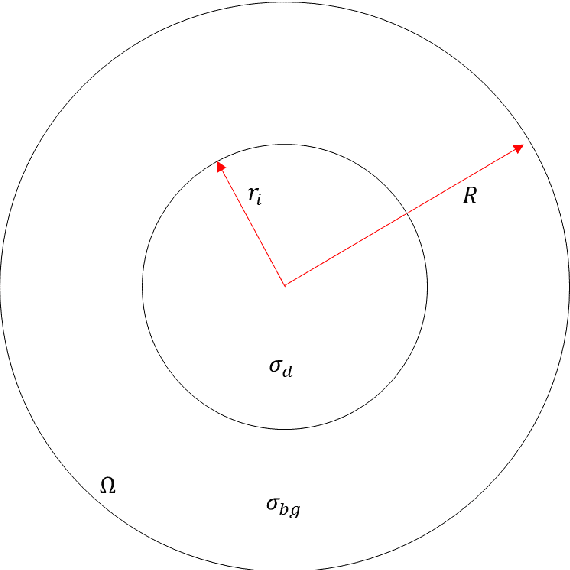
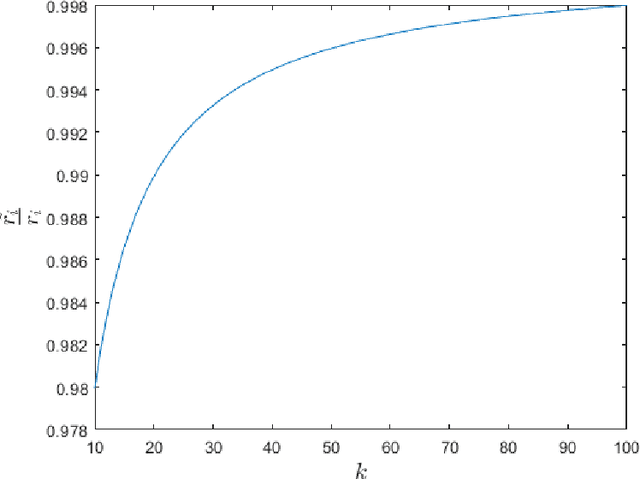
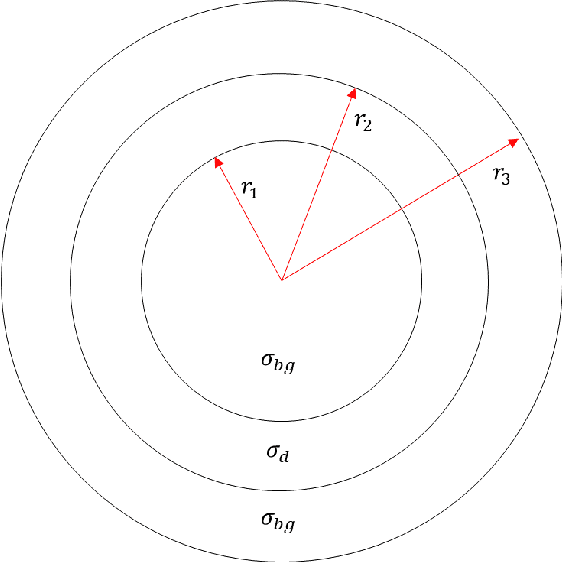
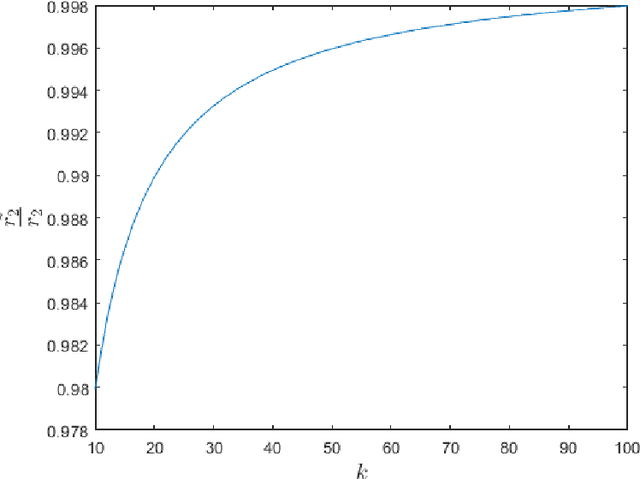
In this paper we consider the inverse problem of electrical conductivity retrieval starting from boundary measurements, in the framework of Electrical Resistance Tomography (ERT). In particular, the focus is on non-iterative reconstruction algorithms, compatible with real-time applications. In this work a new non-iterative reconstruction method for Electrical Resistance Tomography, termed Kernel Method, is presented. The imaging algorithm deals with the problem of retrieving the shape of one or more anomalies embedded in a known background. The foundation of the proposed method is given by the idea that if there exists a current flux at the boundary (Neumann data) able to produce the same voltage measurements on two different configurations, with and without the anomaly, respectively, then the corresponding electric current density for the problem involving only the background material vanishes in the region occupied by the anomaly. Coherently with this observation, the Kernel Method consists in (i) evaluating a proper current flux at the boundary $g$, (ii) solving one direct problem on a configuration without anomaly and driven by $g$, (iii) reconstructing the anomaly from the spatial plot of the power density as the region in which the power density vanishes. This new tomographic method has a very simple numerical implementation at a very low computational cost. Beside theoretical results and justifications of our method, we present a large number of numerical examples to show the potential of this new algorithm.
Imaging of nonlinear materials via the Monotonicity Principle
Oct 17, 2023The topic of inverse problems, related to Maxwell's equations, in the presence of nonlinear materials is quite new in literature. The lack of contributions in this area can be ascribed to the significant challenges that such problems pose. Retrieving the spatial behaviour of some unknown physical property, starting from boundary measurements, is a nonlinear and highly ill-posed problem even in the presence of linear materials. And the complexity exponentially grows when the focus is on nonlinear material properties. Recently, the Monotonicity Principle has been extended to nonlinear materials under very general assumptions. Starting from the theoretical background given by this extension, we develop a first real-time inversion method for the inverse obstacle problem in the presence of nonlinear materials. The Monotonicity Principle is the foundation of a class of non-iterative algorithms for tomography of linear materials. It has been successfully applied to various problems, governed by different PDEs. In the linear case, MP based inversion methods ensure excellent performances and compatibility with real-time applications. We focus on problems governed by elliptical PDEs and, as an example of application, we treat the Magnetostatic Permeability Tomography problem, in which the aim is to retrieve the spatial behaviour of magnetic permeability through boundary measurements in DC operations. In this paper, we provide some preliminary results giving the foundation of our method and extended numerical examples.