 Add to Chrome
 Add to Firefox
 Add to Edge
PLESS: Pseudo-Label Enhancement with Spreading Scribbles for Weakly Supervised Segmentation
Feb 12, 2026
Weakly supervised learning with scribble annotations uses sparse user-drawn strokes to indicate segmentation labels on a small subset of pixels. This annotation reduces the cost of dense pixel-wise labeling, but suffers inherently from noisy and incomplete supervision. Recent scribble-based approaches in medical image segmentation address this limitation using pseudo-label-based training; however, the quality of the pseudo-labels remains a key performance limit. We propose PLESS, a generic pseudo-label enhancement strategy which improves reliability and spatial consistency. It builds on a hierarchical partitioning of the image into a hierarchy of spatially coherent regions. PLESS propagates scribble information to refine pseudo-labels within semantically coherent regions. The framework is model-agnostic and easily integrates into existing pseudo-label methods. Experiments on two public cardiac MRI datasets (ACDC and MSCMRseg) across four scribble-supervised algorithms show consistent improvements in segmentation accuracy. Code will be made available on GitHub upon acceptance.

Parallel Watershed Partitioning: GPU-Based Hierarchical Image Segmentation
Oct 11, 2024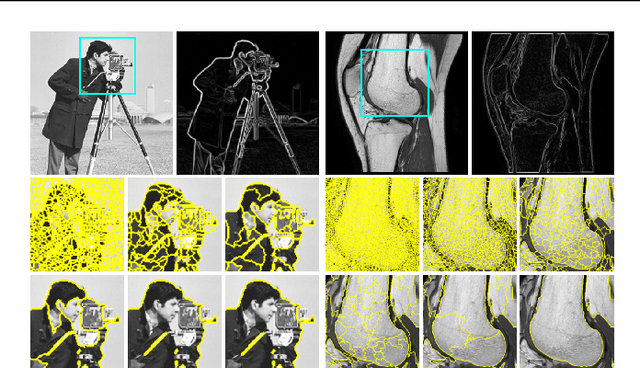
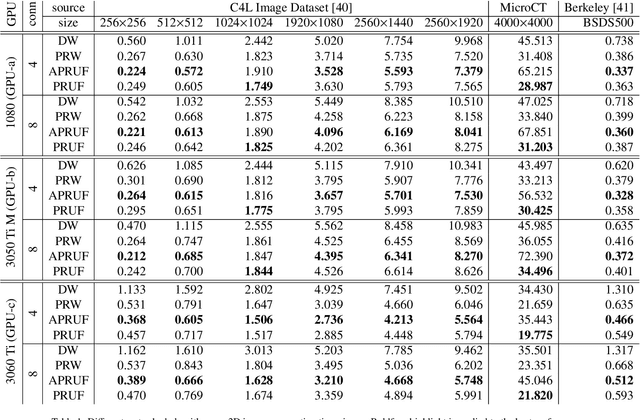
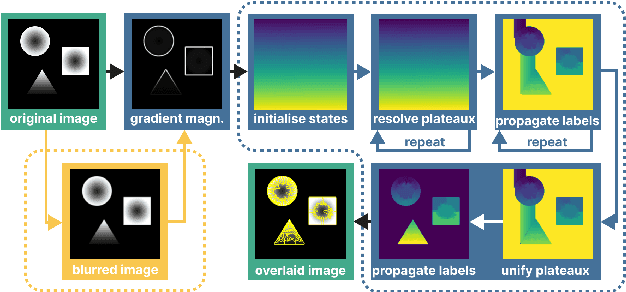
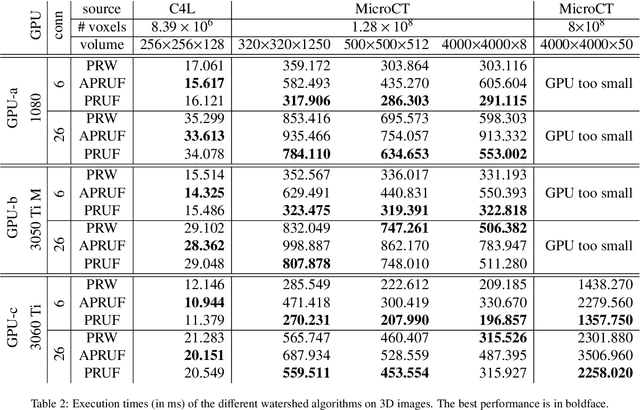
Many image processing applications rely on partitioning an image into disjoint regions whose pixels are 'similar.' The watershed and waterfall transforms are established mathematical morphology pixel clustering techniques. They are both relevant to modern applications where groups of pixels are to be decided upon in one go, or where adjacency information is relevant. We introduce three new parallel partitioning algorithms for GPUs. By repeatedly applying watershed algorithms, we produce waterfall results which form a hierarchy of partition regions over an input image. Our watershed algorithms attain competitive execution times in both 2D and 3D, processing an 800 megavoxel image in less than 1.4 sec. We also show how to use this fully deterministic image partitioning as a pre-processing step to machine learning based semantic segmentation. This replaces the role of superpixel algorithms, and results in comparable accuracy and faster training times.