 Add to Chrome
 Add to Firefox
 Add to Edge
Evaluation of Impression Difference of a Domestic Mobile Manipulator with Autonomous and/or Remote Control in Fetch-and-Carry Tasks
Dec 30, 2025
A single service robot can present two distinct agencies: its onboard autonomy and an operator-mediated agency, yet users experience them through one physical body. We formalize this dual-agency structure as a User-Robot-Operator triad in an autonomous remote-control setting that combines autonomous execution with remote human support. Prior to the recent surge of language-based and multimodal interfaces, we developed and evaluated an early-stage prototype in 2020 that combined natural-language text chat with freehand sketch annotations over the robot's live camera view to support remote intervention. We evaluated three modes - autonomous, remote, and hybrid - in controlled fetch-and-carry tasks using a domestic mobile manipulator (HSR) on a World Robot Summit 2020 rule-compliant test field. The results show systematic mode-dependent differences in user-rated affinity and additional insights on perceived security, indicating that switching or blending agency within one robot measurably shapes human impressions. These findings provide empirical guidance for designing human-in-the-loop mobile manipulation in domestic physical tasks.
* Published in Advanced Robotics (2020). This paper defines an autonomous remote-control setting that makes the User-Robot-Operator triadic interaction explicit in physical tasks, and reports empirical differences in affinity and perceived security across autonomous, remote, and hybrid modes. Please cite: Advanced Robotics 34(20):1291-1308, 2020. DOI:10.1080/01691864.2020.1780152

Sketch Interface for Teleoperation of Mobile Manipulator to Enable Intuitive and Intended Operation: A Proof of Concept
May 21, 2025Recent advancements in robotics have underscored the need for effective collaboration between humans and robots. Traditional interfaces often struggle to balance robot autonomy with human oversight, limiting their practical application in complex tasks like mobile manipulation. This study aims to develop an intuitive interface that enables a mobile manipulator to autonomously interpret user-provided sketches, enhancing user experience while minimizing burden. We implemented a web-based application utilizing machine learning algorithms to process sketches, making the interface accessible on mobile devices for use anytime, anywhere, by anyone. In the first validation, we examined natural sketches drawn by users for 27 selected manipulation and navigation tasks, gaining insights into trends related to sketch instructions. The second validation involved comparative experiments with five grasping tasks, showing that the sketch interface reduces workload and enhances intuitiveness compared to conventional axis control interfaces. These findings suggest that the proposed sketch interface improves the efficiency of mobile manipulators and opens new avenues for integrating intuitive human-robot collaboration in various applications.
Sketch-MoMa: Teleoperation for Mobile Manipulator via Interpretation of Hand-Drawn Sketches
Dec 26, 2024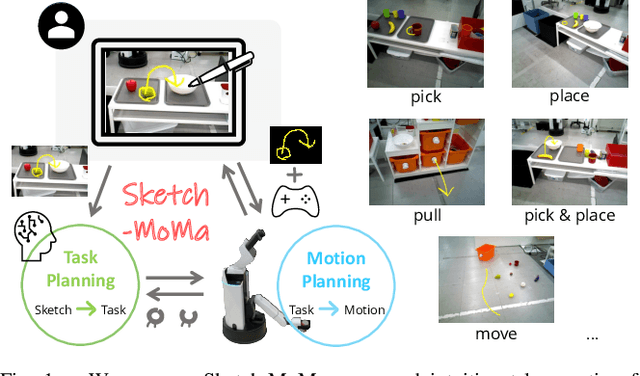
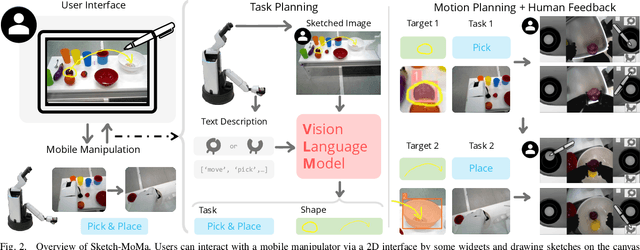
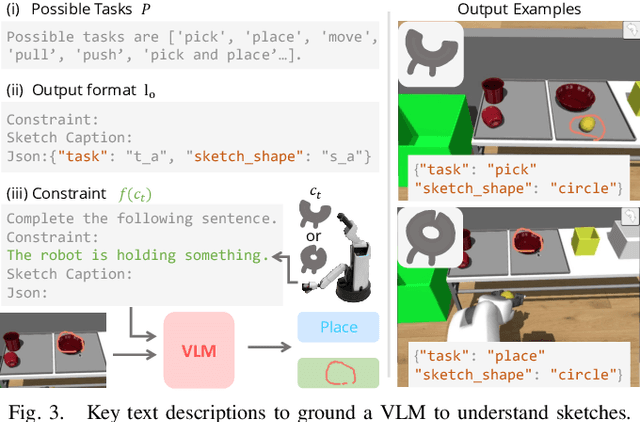
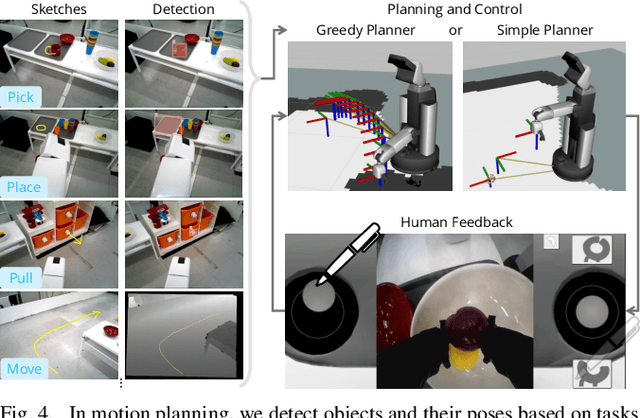
To use assistive robots in everyday life, a remote control system with common devices, such as 2D devices, is helpful to control the robots anytime and anywhere as intended. Hand-drawn sketches are one of the intuitive ways to control robots with 2D devices. However, since similar sketches have different intentions from scene to scene, existing work needs additional modalities to set the sketches' semantics. This requires complex operations for users and leads to decreasing usability. In this paper, we propose Sketch-MoMa, a teleoperation system using the user-given hand-drawn sketches as instructions to control a robot. We use Vision-Language Models (VLMs) to understand the user-given sketches superimposed on an observation image and infer drawn shapes and low-level tasks of the robot. We utilize the sketches and the generated shapes for recognition and motion planning of the generated low-level tasks for precise and intuitive operations. We validate our approach using state-of-the-art VLMs with 7 tasks and 5 sketch shapes. We also demonstrate that our approach effectively specifies the detailed motions, such as how to grasp and how much to rotate. Moreover, we show the competitive usability of our approach compared with the existing 2D interface through a user experiment with 14 participants.