 Add to Chrome
 Add to Firefox
 Add to Edge
Geospatial Soil Quality Analysis: A Roadmap for Integrated Systems
Dec 13, 2025
Soil quality (SQ) plays a crucial role in sustainable agriculture, environmental conservation, and land-use planning. Traditional SQ assessment techniques rely on costly, labor-intensive sampling and laboratory analysis, limiting their spatial and temporal coverage. Advances in Geographic Information Systems (GIS), remote sensing, and machine learning (ML) enabled efficient SQ evaluation. This paper presents a comprehensive roadmap distinguishing it from previous reviews by proposing a unified and modular pipeline that integrates multi-source soil data, GIS and remote sensing tools, and machine learning techniques to support transparent and scalable soil quality assessment. It also includes practical applications. Contrary to existing studies that predominantly target isolated soil parameters or specific modeling methodologies, this approach consolidates recent advancements in Geographic Information Systems (GIS), remote sensing technologies, and machine learning algorithms within the entire soil quality assessment pipeline. It also addresses existing challenges and limitations while exploring future developments and emerging trends in the field that can deliver the next generation of soil quality systems making them more transparent, adaptive, and aligned with sustainable land management.

A Noise-Resilient Semi-Supervised Graph Autoencoder for Overlapping Semantic Community Detection
May 09, 2025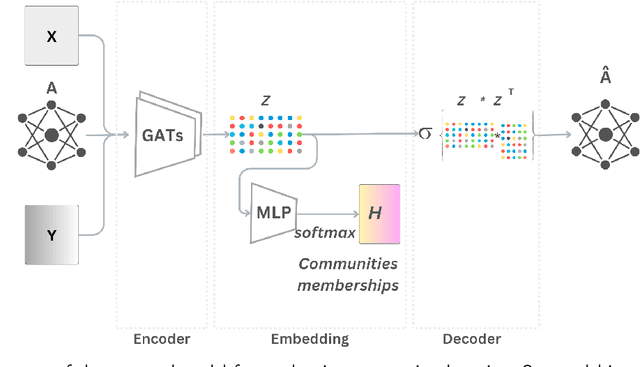

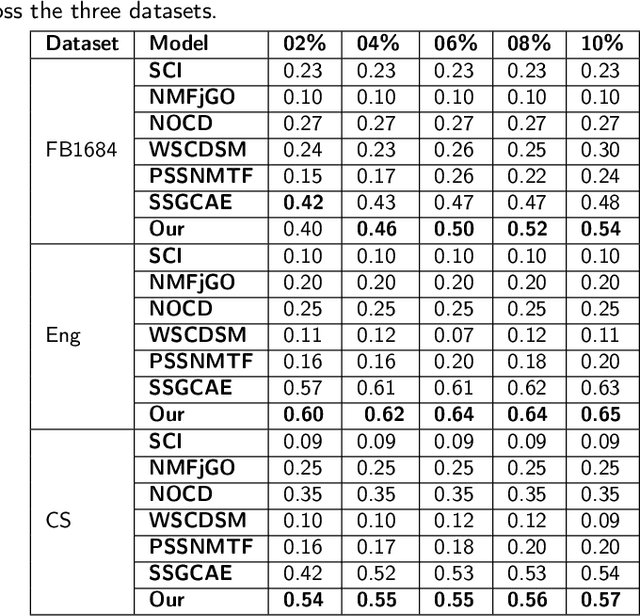
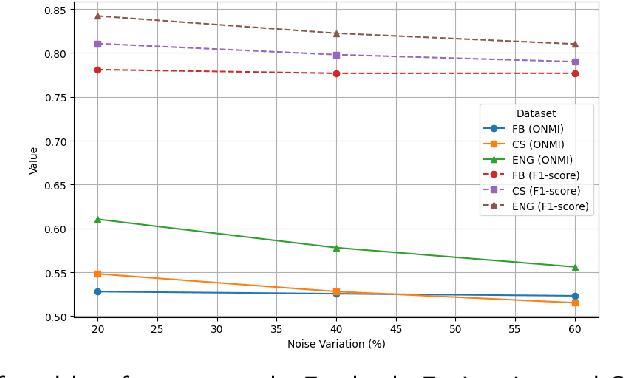
Community detection in networks with overlapping structures remains a significant challenge, particularly in noisy real-world environments where integrating topology, node attributes, and prior information is critical. To address this, we propose a semi-supervised graph autoencoder that combines graph multi-head attention and modularity maximization to robustly detect overlapping communities. The model learns semantic representations by fusing structural, attribute, and prior knowledge while explicitly addressing noise in node features. Key innovations include a noise-resistant architecture and a semantic semi-supervised design optimized for community quality through modularity constraints. Experiments demonstrate superior performance the model outperforms state-of-the-art methods in overlapping community detection (improvements in NMI and F1-score) and exhibits exceptional robustness to attribute noise, maintaining stable performance under 60\% feature corruption. These results highlight the importance of integrating attribute semantics and structural patterns for accurate community discovery in complex networks.
Unsupervised Graph Attention Autoencoder for Attributed Networks using K-means Loss
Nov 24, 2023Several natural phenomena and complex systems are often represented as networks. Discovering their community structure is a fundamental task for understanding these networks. Many algorithms have been proposed, but recently, Graph Neural Networks (GNN) have emerged as a compelling approach for enhancing this task.In this paper, we introduce a simple, efficient, and clustering-oriented model based on unsupervised \textbf{G}raph Attention \textbf{A}uto\textbf{E}ncoder for community detection in attributed networks (GAECO). The proposed model adeptly learns representations from both the network's topology and attribute information, simultaneously addressing dual objectives: reconstruction and community discovery. It places a particular emphasis on discovering compact communities by robustly minimizing clustering errors. The model employs k-means as an objective function and utilizes a multi-head Graph Attention Auto-Encoder for decoding the representations. Experiments conducted on three datasets of attributed networks show that our method surpasses state-of-the-art algorithms in terms of NMI and ARI. Additionally, our approach scales effectively with the size of the network, making it suitable for large-scale applications. The implications of our findings extend beyond biological network interpretation and social network analysis, where knowledge of the fundamental community structure is essential.