 Add to Chrome
 Add to Firefox
 Add to Edge
Autonomous battery research: Principles of heuristic operando experimentation
Dec 29, 2025
Unravelling the complex processes governing battery degradation is critical to the energy transition, yet the efficacy of operando characterisation is severely constrained by a lack of Reliability, Representativeness, and Reproducibility (the 3Rs). Current methods rely on bespoke hardware and passive, pre-programmed methodologies that are ill-equipped to capture stochastic failure events. Here, using the Rutherford Appleton Laboratory's multi-modal toolkit as a case study, we expose the systemic inability of conventional experiments to capture transient phenomena like dendrite initiation. To address this, we propose Heuristic Operando experiments: a framework where an AI pilot leverages physics-based digital twins to actively steer the beamline to predict and deterministically capture these rare events. Distinct from uncertainty-driven active learning, this proactive search anticipates failure precursors, redefining experimental efficiency via an entropy-based metric that prioritises scientific insight per photon, neutron, or muon. By focusing measurements only on mechanistically decisive moments, this framework simultaneously mitigates beam damage and drastically reduces data redundancy. When integrated with FAIR data principles, this approach serves as a blueprint for the trusted autonomous battery laboratories of the future.

Classification of Firn Data via Topological Features
Apr 22, 2025In this paper we evaluate the performance of topological features for generalizable and robust classification of firn image data, with the broader goal of understanding the advantages, pitfalls, and trade-offs in topological featurization. Firn refers to layers of granular snow within glaciers that haven't been compressed into ice. This compactification process imposes distinct topological and geometric structure on firn that varies with depth within the firn column, making topological data analysis (TDA) a natural choice for understanding the connection between depth and structure. We use two classes of topological features, sublevel set features and distance transform features, together with persistence curves, to predict sample depth from microCT images. A range of challenging training-test scenarios reveals that no one choice of method dominates in all categories, and uncoveres a web of trade-offs between accuracy, interpretability, and generalizability.
A Multi-parameter Persistence Framework for Mathematical Morphology
Mar 24, 2021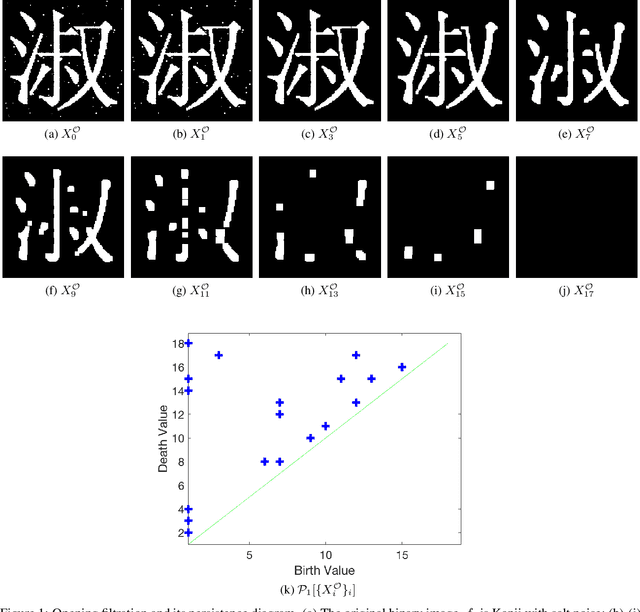
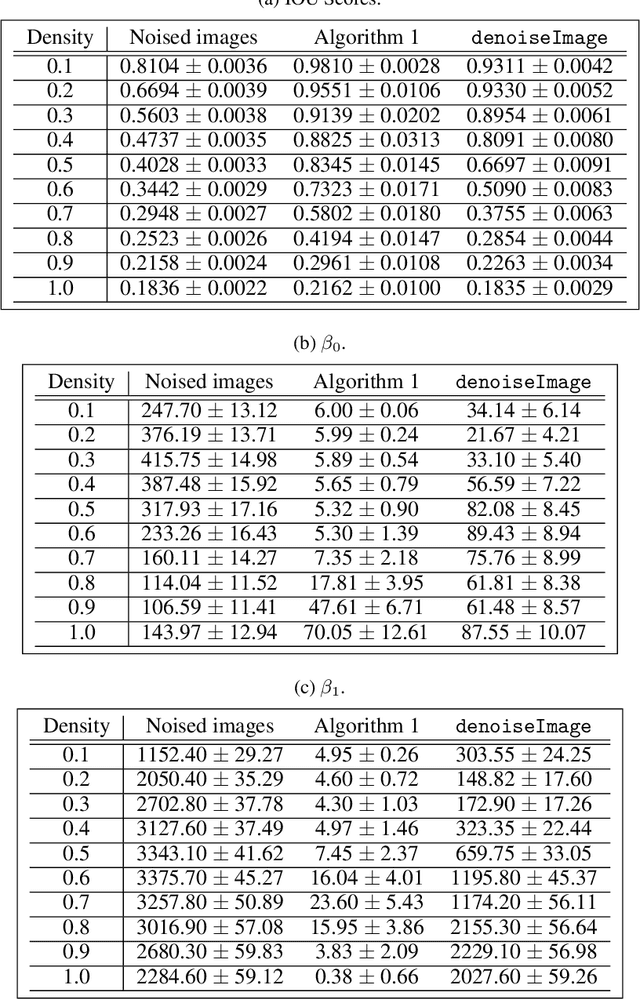
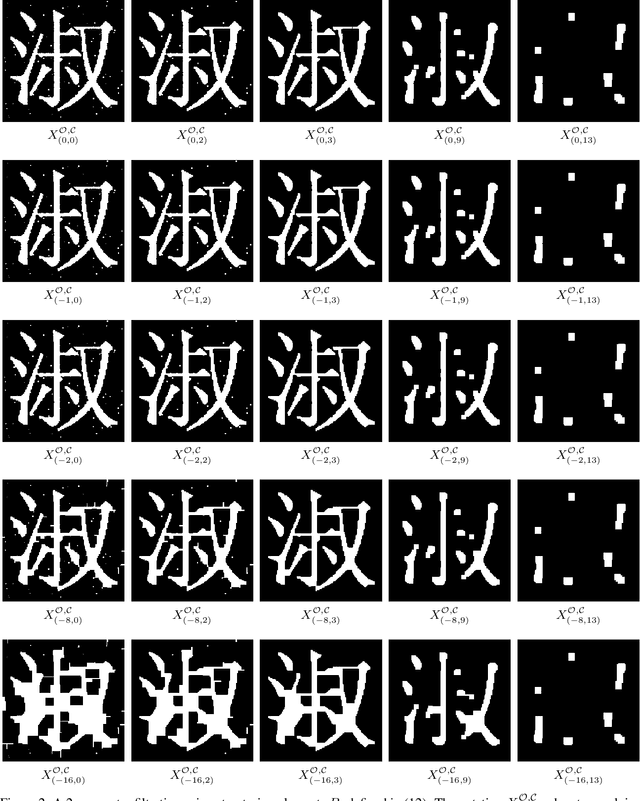
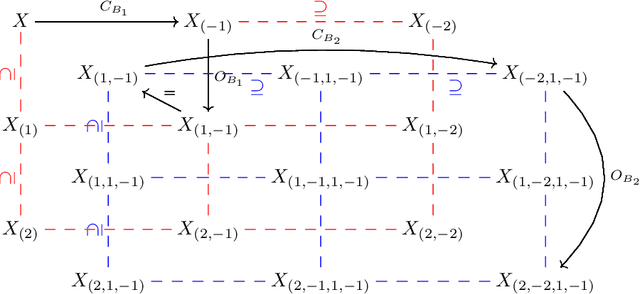
The field of mathematical morphology offers well-studied techniques for image processing. In this work, we view morphological operations through the lens of persistent homology, a tool at the heart of the field of topological data analysis. We demonstrate that morphological operations naturally form a multiparameter filtration and that persistent homology can then be used to extract information about both topology and geometry in the images as well as to automate methods for optimizing the study and rendering of structure in images. For illustration, we apply this framework to analyze noisy binary, grayscale, and color images.