 Add to Chrome
 Add to Firefox
 Add to Edge
Physiologically Grounded Driver Behavior Classification: SHAP-Driven Elite Feature Selection and Hybrid Gradient Boosting for Multimodal Physiological Signals
May 06, 2026
An interpretable and scalable framework for decoding driving behaviors from multimodal physiological signals is proposed in this study. We utilize multimodal physiological driving behavior large-scale dataset comprising synchronized electroencephalogram (EEG), electromyography (EMG), and galvanic skin response (GSR) signals. Our approach involves rigorous preprocessing followed by a domain-specific feature extraction pipeline targeting time-domain, frequency-domain, and derived physiological indices. To address high dimensionality, we employ SHAP-based elite feature selection, retaining the top 250 features to reduce computational overhead while preserving predictive power. Hyperparameter optimization for extreme gradient boosting (XGBoost) and light gradient boosting machine (LightGBM) models is conducted using Bayesian optimization via Optuna. Finally, a weighted soft-voting ensemble is constructed to leverage the complementary strengths of both gradient boosting frameworks. The results demonstrate that the proposed ensemble achieves a test accuracy of 80.91% and a macro-F1 score of 0.79, significantly outperforming single-modality baselines and traditional machine learning models. Ablation studies confirm an 8% performance gain over the best single modality (EEG), validating the necessity of multimodal fusion. SHAP analysis further validates the physiological plausibility of the model, revealing that the EEG contributes the majority of predictive weight, GSR and EMG features provide critical discriminatory signals for high-arousal and motor-intensive maneuvers.

QiVC-Net: Quantum-Inspired Variational Convolutional Network, with Application to Biosignal Classification
Nov 07, 2025This work introduces the quantum-inspired variational convolution (QiVC) framework, a novel learning paradigm that integrates principles of probabilistic inference, variational optimization, and quantum-inspired transformations within convolutional architectures. The central innovation of QiVC lies in its quantum-inspired rotated ensemble (QiRE) mechanism. QiRE performs differentiable low-dimensional subspace rotations of convolutional weights, analogously to quantum state evolution. This approach enables structured uncertainty modeling while preserving the intrinsic geometry of the parameter space, resulting in more expressive, stable, and uncertainty-aware representations. To demonstrate its practical potential, the concept is instantiated in a QiVC-based convolutional network (QiVC-Net) and evaluated in the context of biosignal classification, focusing on phonocardiogram (PCG) recordings, a challenging domain characterized by high noise, inter-subject variability, and often imbalanced data. The proposed QiVC-Net integrates an architecture in which the QiVC layer does not introduce additional parameters, instead performing an ensemble rotation of the convolutional weights through a structured mechanism ensuring robustness without added highly computational burden. Experiments on two benchmark datasets, PhysioNet CinC 2016 and PhysioNet CirCor DigiScope 2022, show that QiVC-Net achieves state-of-the-art performance, reaching accuracies of 97.84% and 97.89%, respectively. These findings highlight the versatility of the QiVC framework and its promise for advancing uncertainty-aware modeling in real-world biomedical signal analysis. The implementation of the QiVConv layer is openly available in GitHub.
Fidelitous Augmentation of Human Accelerometric Data for Deep Learning
Apr 22, 2024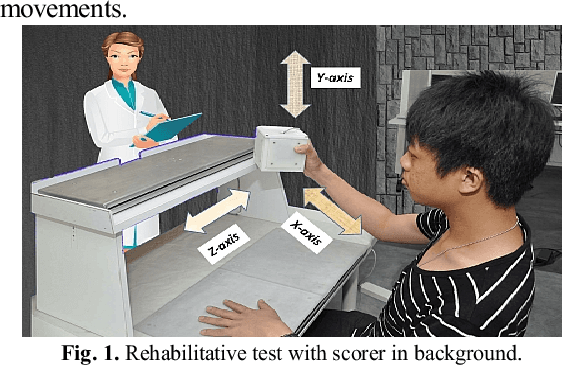
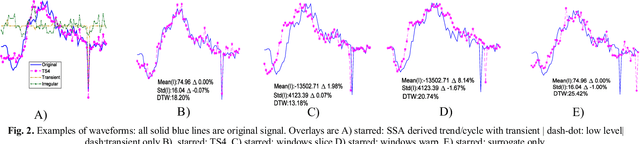
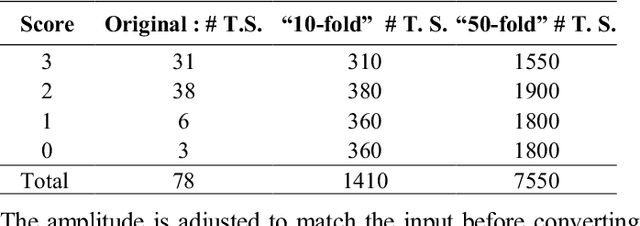
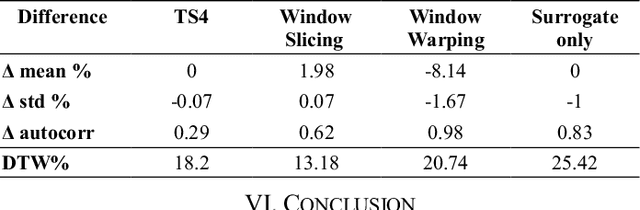
Time series (TS) data have consistently been in short supply, yet their demand remains high for training systems in prediction, modeling, classification, and various other applications. Synthesis can serve to expand the sample population, yet it is crucial to maintain the statistical characteristics between the synthesized and the original TS : this ensures consistent sampling of data for both training and testing purposes. However the time domain features of the data may not be maintained. This motivates for our work, the objective which is to preserve the following features in a synthesized TS: its fundamental statistical characteristics and important time domain features like its general shape and prominent transients. In a novel way, we first isolate important TS features into various components using a spectrogram and singular spectrum analysis. The residual signal is then randomized in a way that preserves its statistical properties. These components are then recombined for the synthetic time series. Using accelerometer data in a clinical setting, we use statistical and shape measures to compare our method to others. We show it has higher fidelity to the original signal features, has good diversity and performs better data classification in a deep learning application.
Vision-based techniques for gait recognition
Apr 30, 2020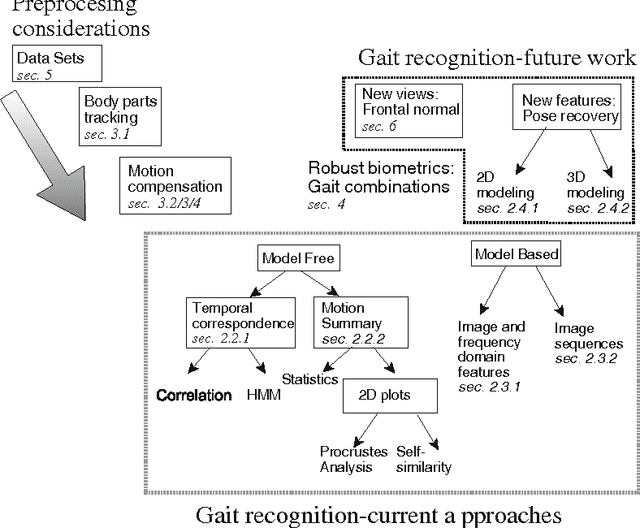


Global security concerns have raised a proliferation of video surveillance devices. Intelligent surveillance systems seek to discover possible threats automatically and raise alerts. Being able to identify the surveyed object can help determine its threat level. The current generation of devices provide digital video data to be analysed for time varying features to assist in the identification process. Commonly, people queue up to access a facility and approach a video camera in full frontal view. In this environment, a variety of biometrics are available - for example, gait which includes temporal features like stride period. Gait can be measured unobtrusively at a distance. The video data will also include face features, which are short-range biometrics. In this way, one can combine biometrics naturally using one set of data. In this paper we survey current techniques of gait recognition and modelling with the environment in which the research was conducted. We also discuss in detail the issues arising from deriving gait data, such as perspective and occlusion effects, together with the associated computer vision challenges of reliable tracking of human movement. Then, after highlighting these issues and challenges related to gait processing, we proceed to discuss the frameworks combining gait with other biometrics. We then provide motivations for a novel paradigm in biometrics-based human recognition, i.e. the use of the fronto-normal view of gait as a far-range biometrics combined with biometrics operating at a near distance.