 Add to Chrome
 Add to Firefox
 Add to Edge
Dual Mind World Model Inspired Network Digital Twin for Access Scheduling
Feb 04, 2026
Emerging networked systems such as industrial IoT and real-time cyber-physical infrastructures demand intelligent scheduling strategies capable of adapting to dynamic traffic, deadlines, and interference constraints. In this work, we present a novel Digital Twin-enabled scheduling framework inspired by Dual Mind World Model (DMWM) architecture, for learning-informed and imagination-driven network control. Unlike conventional rule-based or purely data-driven policies, the proposed DMWM combines short-horizon predictive planning with symbolic model-based rollout, enabling the scheduler to anticipate future network states and adjust transmission decisions accordingly. We implement the framework in a configurable simulation testbed and benchmark its performance against traditional heuristics and reinforcement learning baselines under varied traffic conditions. Our results show that DMWM achieves superior performance in bursty, interference-limited, and deadline-sensitive environments, while maintaining interpretability and sample efficiency. The proposed design bridges the gap between network-level reasoning and low-overhead learning, marking a step toward scalable and adaptive NDT-based network optimization.

Data-driven Modality Fusion: An AI-enabled Framework for Large-Scale Sensor Network Management
Feb 07, 2025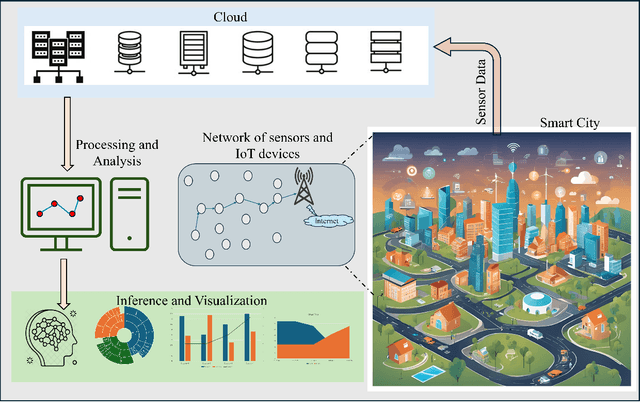
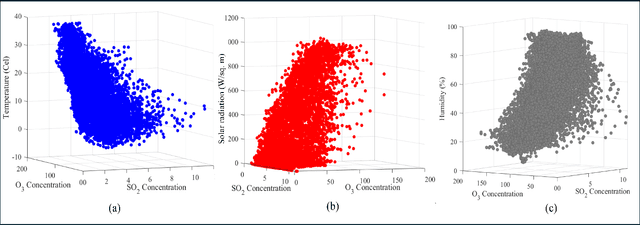
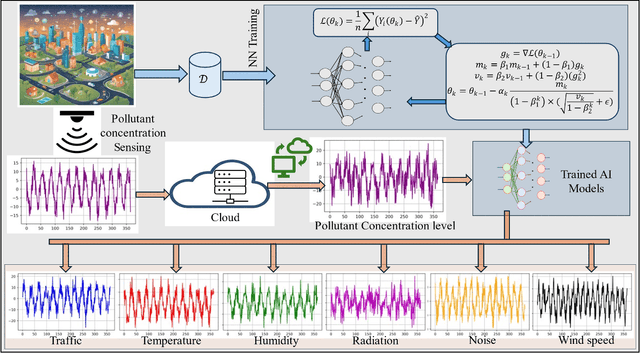
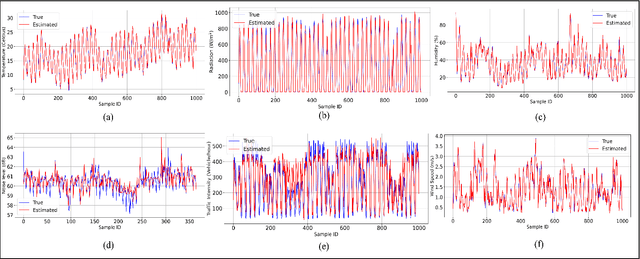
The development and operation of smart cities relyheavily on large-scale Internet-of-Things (IoT) networks and sensor infrastructures that continuously monitor various aspects of urban environments. These networks generate vast amounts of data, posing challenges related to bandwidth usage, energy consumption, and system scalability. This paper introduces a novel sensing paradigm called Data-driven Modality Fusion (DMF), designed to enhance the efficiency of smart city IoT network management. By leveraging correlations between timeseries data from different sensing modalities, the proposed DMF approach reduces the number of physical sensors required for monitoring, thereby minimizing energy expenditure, communication bandwidth, and overall deployment costs. The framework relocates computational complexity from the edge devices to the core, ensuring that resource-constrained IoT devices are not burdened with intensive processing tasks. DMF is validated using data from a real-world IoT deployment in Madrid, demonstrating the effectiveness of the proposed system in accurately estimating traffic, environmental, and pollution metrics from a reduced set of sensors. The proposed solution offers a scalable, efficient mechanism for managing urban IoT networks, while addressing issues of sensor failure and privacy concerns.