 Add to Chrome
 Add to Firefox
 Add to Edge
Dynamic Portfolio Optimization via Augmented DDPG with Quantum Price Levels-Based Trading Strategy
Jan 15, 2025


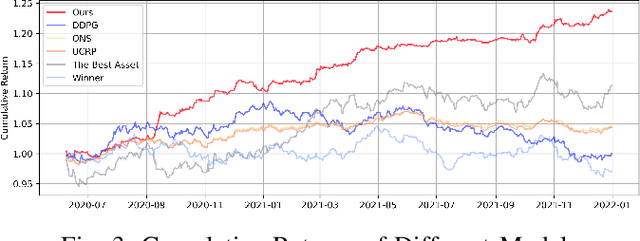
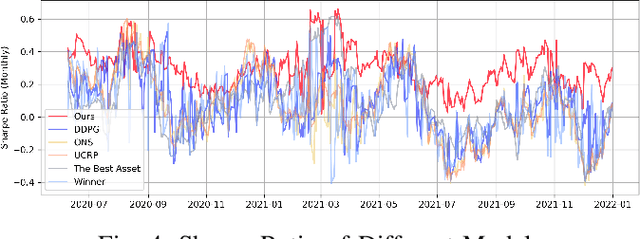
With the development of deep learning, Dynamic Portfolio Optimization (DPO) problem has received a lot of attention in recent years, not only in the field of finance but also in the field of deep learning. Some advanced research in recent years has proposed the application of Deep Reinforcement Learning (DRL) to the DPO problem, which demonstrated to be more advantageous than supervised learning in solving the DPO problem. However, there are still certain unsolved issues: 1) DRL algorithms usually have the problems of slow learning speed and high sample complexity, which is especially problematic when dealing with complex financial data. 2) researchers use DRL simply for the purpose of obtaining high returns, but pay little attention to the problem of risk control and trading strategy, which will affect the stability of model returns. In order to address these issues, in this study we revamped the intrinsic structure of the model based on the Deep Deterministic Policy Gradient (DDPG) and proposed the Augmented DDPG model. Besides, we also proposed an innovative risk control strategy based on Quantum Price Levels (QPLs) derived from Quantum Finance Theory (QFT). Our experimental results revealed that our model has better profitability as well as risk control ability with less sample complexity in the DPO problem compared to the baseline models.
* 8 pages

Deep Feature Embedding for Tabular Data
Aug 30, 2024Tabular data learning has extensive applications in deep learning but its existing embedding techniques are limited in numerical and categorical features such as the inability to capture complex relationships and engineering. This paper proposes a novel deep embedding framework with leverages lightweight deep neural networks to generate effective feature embeddings for tabular data in machine learning research. For numerical features, a two-step feature expansion and deep transformation technique is used to capture copious semantic information. For categorical features, a unique identification vector for each entity is referred by a compact lookup table with a parameterized deep embedding function to uniform the embedding size dimensions, and transformed into a embedding vector using deep neural network. Experiments are conducted on real-world datasets for performance evaluation.