 Add to Chrome
 Add to Firefox
 Add to Edge
Augmenting representations with scientific papers
Mar 04, 2026
Astronomers have acquired vast repositories of multimodal data, including images, spectra, and time series, complemented by decades of literature that analyzes astrophysical sources. Still, these data sources are rarely systematically integrated. This work introduces a contrastive learning framework designed to align X-ray spectra with domain knowledge extracted from scientific literature, facilitating the development of shared multimodal representations. Establishing this connection is inherently complex, as scientific texts encompass a broader and more diverse physical context than spectra. We propose a contrastive pipeline that achieves a 20% Recall@1% when retrieving texts from spectra, proving that a meaningful alignment between these modalities is not only possible but capable of accelerating the interpretation of rare or poorly understood sources. Furthermore, the resulting shared latent space effectively encodes physically significant information. By fusing spectral and textual data, we improve the estimation of 20 physical variables by 16-18% over unimodal spectral baselines. Our results indicate that a Mixture of Experts (MoE) strategy, which leverages both unimodal and shared representations, yields superior performance. Finally, outlier analysis within the multimodal latent space identifies high-priority targets for follow-up investigation, including a candidate pulsating ULX (PULX) and a gravitational lens system. Importantly, this framework can be extended to other scientific domains where aligning observational data with existing literature is possible.

Encoding and Understanding Astrophysical Information in Large Language Model-Generated Summaries
Nov 18, 2025Large Language Models have demonstrated the ability to generalize well at many levels across domains, modalities, and even shown in-context learning capabilities. This enables research questions regarding how they can be used to encode physical information that is usually only available from scientific measurements, and loosely encoded in textual descriptions. Using astrophysics as a test bed, we investigate if LLM embeddings can codify physical summary statistics that are obtained from scientific measurements through two main questions: 1) Does prompting play a role on how those quantities are codified by the LLM? and 2) What aspects of language are most important in encoding the physics represented by the measurement? We investigate this using sparse autoencoders that extract interpretable features from the text.
Representation Learning for Time-Domain High-Energy Astrophysics: Discovery of Extragalactic Fast X-ray Transient XRT 200515
Dec 02, 2024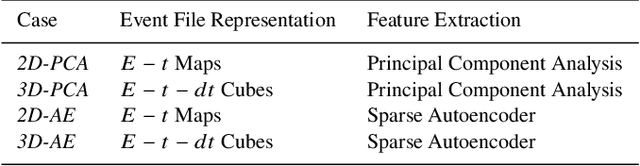
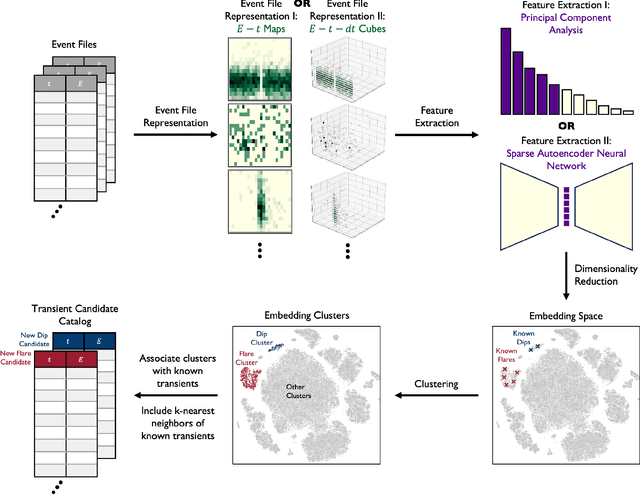
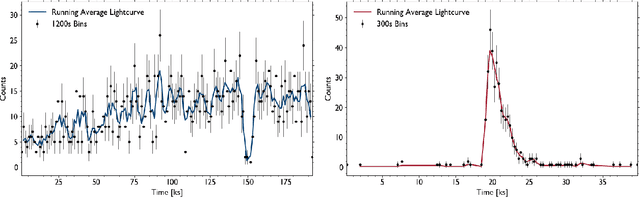
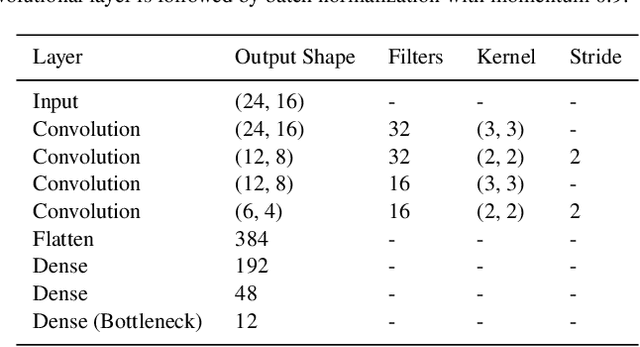
We present a novel representation learning method for downstream tasks such as anomaly detection and unsupervised transient classification in high-energy datasets. This approach enabled the discovery of a new fast X-ray transient (FXT) in the Chandra archive, XRT 200515, a needle-in-the-haystack event and the first Chandra FXT of its kind. Recent serendipitous breakthroughs in X-ray astronomy, including FXTs from binary neutron star mergers and an extragalactic planetary transit candidate, highlight the need for systematic transient searches in X-ray archives. We introduce new event file representations, E-t Maps and E-t-dt Cubes, designed to capture both temporal and spectral information, effectively addressing the challenges posed by variable-length event file time series in machine learning applications. Our pipeline extracts low-dimensional, informative features from these representations using principal component analysis or sparse autoencoders, followed by clustering in the embedding space with DBSCAN. New transients are identified within transient-dominant clusters or through nearest-neighbor searches around known transients, producing a catalog of 3,539 candidates (3,427 flares and 112 dips). XRT 200515 exhibits unique temporal and spectral variability, including an intense, hard <10 s initial burst followed by spectral softening in an ~800 s oscillating tail. We interpret XRT 200515 as either the first giant magnetar flare observed at low X-ray energies or the first extragalactic Type I X-ray burst from a faint LMXB in the LMC. Our method extends to datasets from other observatories such as XMM-Newton, Swift-XRT, eROSITA, Einstein Probe, and upcoming missions like AXIS.