 Add to Chrome
 Add to Firefox
 Add to Edge
Learning Heat-based Equations in Self-similar variables
Feb 03, 2026
We study solution learning for heat-based equations in self-similar variables (SSV). We develop an SSV training framework compatible with standard neural-operator training. We instantiate this framework on the two-dimensional incompressible Navier-Stokes equations and the one-dimensional viscous Burgers equation, and perform controlled comparisons between models trained in physical coordinates and in the corresponding self-similar coordinates using two simple fully connected architectures (standard multilayer perceptrons and a factorized fully connected network). Across both systems and both architectures, SSV-trained networks consistently deliver substantially more accurate and stable extrapolation beyond the training window and better capture qualitative long-time trends. These results suggest that self-similar coordinates provide a mathematically motivated inductive bias for learning the long-time dynamics of heat-based equations.

Wavelet-Inspired Multiscale Graph Convolutional Recurrent Network for Traffic Forecasting
Jan 11, 2024
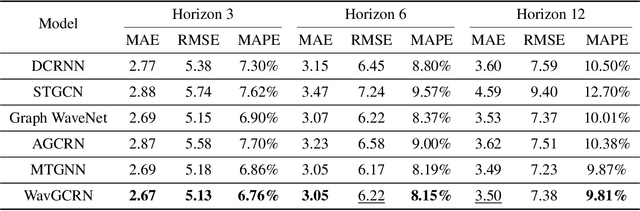
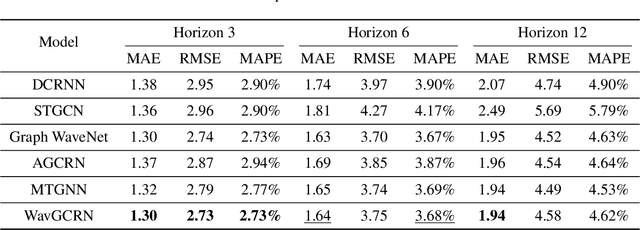
Traffic forecasting is the foundation for intelligent transportation systems. Spatiotemporal graph neural networks have demonstrated state-of-the-art performance in traffic forecasting. However, these methods do not explicitly model some of the natural characteristics in traffic data, such as the multiscale structure that encompasses spatial and temporal variations at different levels of granularity or scale. To that end, we propose a Wavelet-Inspired Graph Convolutional Recurrent Network (WavGCRN) which combines multiscale analysis (MSA)-based method with Deep Learning (DL)-based method. In WavGCRN, the traffic data is decomposed into time-frequency components with Discrete Wavelet Transformation (DWT), constructing a multi-stream input structure; then Graph Convolutional Recurrent networks (GCRNs) are employed as encoders for each stream, extracting spatiotemporal features in different scales; and finally the learnable Inversed DWT and GCRN are combined as the decoder, fusing the information from all streams for traffic metrics reconstruction and prediction. Furthermore, road-network-informed graphs and data-driven graph learning are combined to accurately capture spatial correlation. The proposed method can offer well-defined interpretability, powerful learning capability, and competitive forecasting performance on real-world traffic data sets.