 Add to Chrome
 Add to Firefox
 Add to Edge
TurkBench: A Benchmark for Evaluating Turkish Large Language Models
Jan 11, 2026
With the recent surge in the development of large language models, the need for comprehensive and language-specific evaluation benchmarks has become critical. While significant progress has been made in evaluating English language models, benchmarks for other languages, particularly those with unique linguistic characteristics such as Turkish, remain less developed. Our study introduces TurkBench, a comprehensive benchmark designed to assess the capabilities of generative large language models in the Turkish language. TurkBench involves 8,151 data samples across 21 distinct subtasks. These are organized under six main categories of evaluation: Knowledge, Language Understanding, Reasoning, Content Moderation, Turkish Grammar and Vocabulary, and Instruction Following. The diverse range of tasks and the culturally relevant data would provide researchers and developers with a valuable tool for evaluating their models and identifying areas for improvement. We further publish our benchmark for online submissions at https://huggingface.co/turkbench

Incorporating Human Translator Style into English-Turkish Literary Machine Translation
Jul 21, 2023
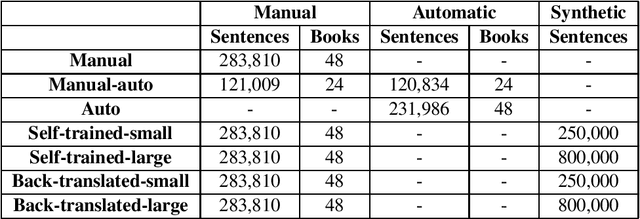
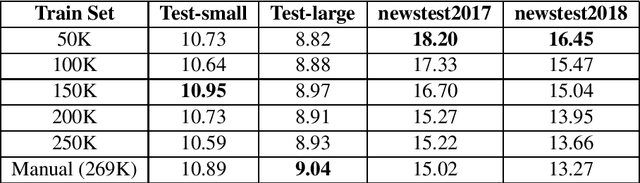

Although machine translation systems are mostly designed to serve in the general domain, there is a growing tendency to adapt these systems to other domains like literary translation. In this paper, we focus on English-Turkish literary translation and develop machine translation models that take into account the stylistic features of translators. We fine-tune a pre-trained machine translation model by the manually-aligned works of a particular translator. We make a detailed analysis of the effects of manual and automatic alignments, data augmentation methods, and corpus size on the translations. We propose an approach based on stylistic features to evaluate the style of a translator in the output translations. We show that the human translator style can be highly recreated in the target machine translations by adapting the models to the style of the translator.