 Add to Chrome
 Add to Firefox
 Add to Edge
FOVI: A biologically-inspired foveated interface for deep vision models
Feb 03, 2026
Human vision is foveated, with variable resolution peaking at the center of a large field of view; this reflects an efficient trade-off for active sensing, allowing eye-movements to bring different parts of the world into focus with other parts of the world in context. In contrast, most computer vision systems encode the visual world at a uniform resolution, raising challenges for processing full-field high-resolution images efficiently. We propose a foveated vision interface (FOVI) based on the human retina and primary visual cortex, that reformats a variable-resolution retina-like sensor array into a uniformly dense, V1-like sensor manifold. Receptive fields are defined as k-nearest-neighborhoods (kNNs) on the sensor manifold, enabling kNN-convolution via a novel kernel mapping technique. We demonstrate two use cases: (1) an end-to-end kNN-convolutional architecture, and (2) a foveated adaptation of the foundational DINOv3 ViT model, leveraging low-rank adaptation (LoRA). These models provide competitive performance at a fraction of the computational cost of non-foveated baselines, opening pathways for efficient and scalable active sensing for high-resolution egocentric vision. Code and pre-trained models are available at https://github.com/nblauch/fovi and https://huggingface.co/fovi-pytorch.

TopoLM: brain-like spatio-functional organization in a topographic language model
Oct 15, 2024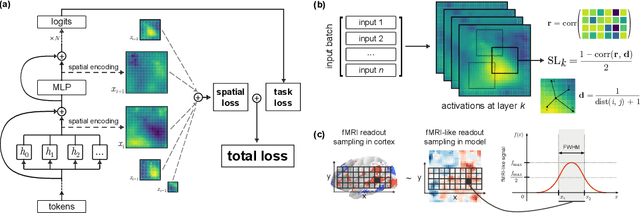
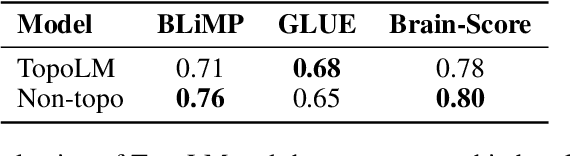
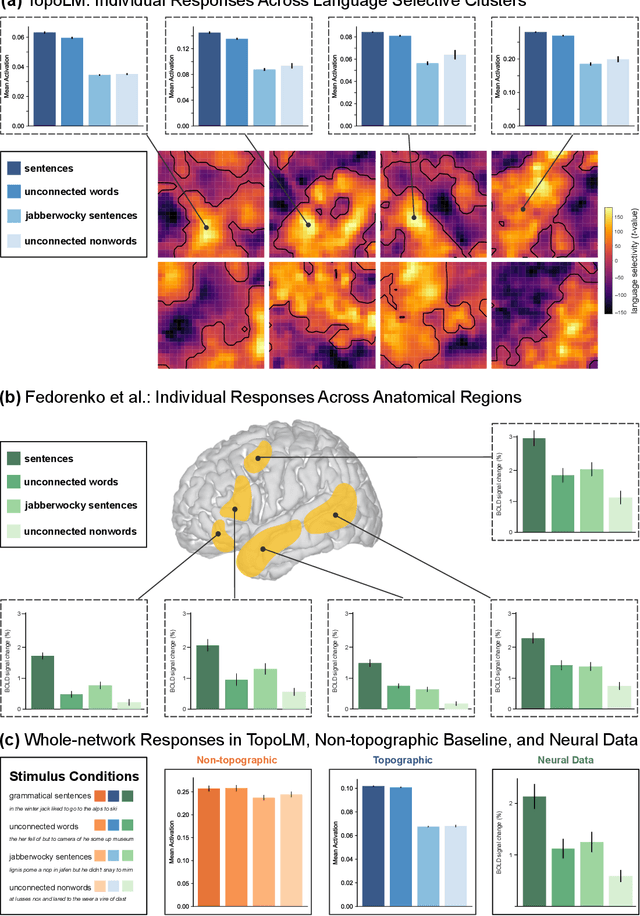
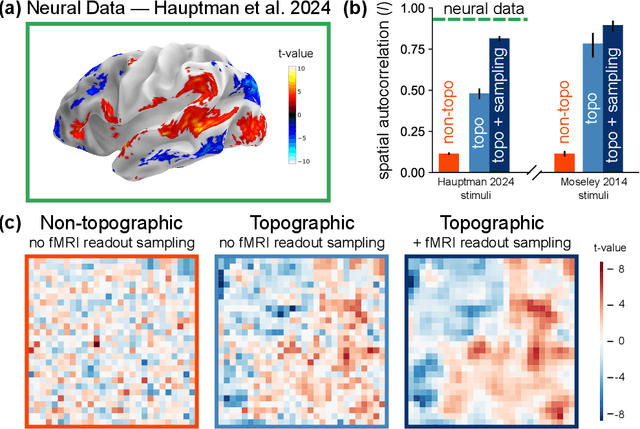
Neurons in the brain are spatially organized such that neighbors on tissue often exhibit similar response profiles. In the human language system, experimental studies have observed clusters for syntactic and semantic categories, but the mechanisms underlying this functional organization remain unclear. Here, building on work from the vision literature, we develop TopoLM, a transformer language model with an explicit two-dimensional spatial representation of model units. By combining a next-token prediction objective with a spatial smoothness loss, representations in this model assemble into clusters that correspond to semantically interpretable groupings of text and closely match the functional organization in the brain's language system. TopoLM successfully predicts the emergence of the spatio-functional organization of a cortical language system as well as the organization of functional clusters selective for fine-grained linguistic features empirically observed in human cortex. Our results suggest that the functional organization of the human language system is driven by a unified spatial objective, and provide a functionally and spatially aligned model of language processing in the brain.