 Add to Chrome
 Add to Firefox
 Add to Edge
Gradient Dynamics of Attention: How Cross-Entropy Sculpts Bayesian Manifolds
Dec 27, 2025
Transformers empirically perform precise probabilistic reasoning in carefully constructed ``Bayesian wind tunnels'' and in large-scale language models, yet the mechanisms by which gradient-based learning creates the required internal geometry remain opaque. We provide a complete first-order analysis of how cross-entropy training reshapes attention scores and value vectors in a transformer attention head. Our core result is an \emph{advantage-based routing law} for attention scores, \[ \frac{\partial L}{\partial s_{ij}} = α_{ij}\bigl(b_{ij}-\mathbb{E}_{α_i}[b]\bigr), \qquad b_{ij} := u_i^\top v_j, \] coupled with a \emph{responsibility-weighted update} for values, \[ Δv_j = -η\sum_i α_{ij} u_i, \] where $u_i$ is the upstream gradient at position $i$ and $α_{ij}$ are attention weights. These equations induce a positive feedback loop in which routing and content specialize together: queries route more strongly to values that are above-average for their error signal, and those values are pulled toward the queries that use them. We show that this coupled specialization behaves like a two-timescale EM procedure: attention weights implement an E-step (soft responsibilities), while values implement an M-step (responsibility-weighted prototype updates), with queries and keys adjusting the hypothesis frame. Through controlled simulations, including a sticky Markov-chain task where we compare a closed-form EM-style update to standard SGD, we demonstrate that the same gradient dynamics that minimize cross-entropy also sculpt the low-dimensional manifolds identified in our companion work as implementing Bayesian inference. This yields a unified picture in which optimization (gradient flow) gives rise to geometry (Bayesian manifolds), which in turn supports function (in-context probabilistic reasoning).

The Bayesian Geometry of Transformer Attention
Dec 27, 2025Transformers often appear to perform Bayesian reasoning in context, but verifying this rigorously has been impossible: natural data lack analytic posteriors, and large models conflate reasoning with memorization. We address this by constructing \emph{Bayesian wind tunnels} -- controlled environments where the true posterior is known in closed form and memorization is provably impossible. In these settings, small transformers reproduce Bayesian posteriors with $10^{-3}$-$10^{-4}$ bit accuracy, while capacity-matched MLPs fail by orders of magnitude, establishing a clear architectural separation. Across two tasks -- bijection elimination and Hidden Markov Model (HMM) state tracking -- we find that transformers implement Bayesian inference through a consistent geometric mechanism: residual streams serve as the belief substrate, feed-forward networks perform the posterior update, and attention provides content-addressable routing. Geometric diagnostics reveal orthogonal key bases, progressive query-key alignment, and a low-dimensional value manifold parameterized by posterior entropy. During training this manifold unfurls while attention patterns remain stable, a \emph{frame-precision dissociation} predicted by recent gradient analyses. Taken together, these results demonstrate that hierarchical attention realizes Bayesian inference by geometric design, explaining both the necessity of attention and the failure of flat architectures. Bayesian wind tunnels provide a foundation for mechanistically connecting small, verifiable systems to reasoning phenomena observed in large language models.
Geometric Scaling of Bayesian Inference in LLMs
Dec 27, 2025Recent work has shown that small transformers trained in controlled "wind-tunnel'' settings can implement exact Bayesian inference, and that their training dynamics produce a geometric substrate -- low-dimensional value manifolds and progressively orthogonal keys -- that encodes posterior structure. We investigate whether this geometric signature persists in production-grade language models. Across Pythia, Phi-2, Llama-3, and Mistral families, we find that last-layer value representations organize along a single dominant axis whose position strongly correlates with predictive entropy, and that domain-restricted prompts collapse this structure into the same low-dimensional manifolds observed in synthetic settings. To probe the role of this geometry, we perform targeted interventions on the entropy-aligned axis of Pythia-410M during in-context learning. Removing or perturbing this axis selectively disrupts the local uncertainty geometry, whereas matched random-axis interventions leave it intact. However, these single-layer manipulations do not produce proportionally specific degradation in Bayesian-like behavior, indicating that the geometry is a privileged readout of uncertainty rather than a singular computational bottleneck. Taken together, our results show that modern language models preserve the geometric substrate that enables Bayesian inference in wind tunnels, and organize their approximate Bayesian updates along this substrate.
Efficient Probabilistic Planning with Maximum-Coverage Distributionally Robust Backward Reachable Trees
Oct 06, 2025This paper presents a new multi-query motion planning algorithm for linear Gaussian systems with the goal of reaching a Euclidean ball with high probability. We develop a new formulation for ball-shaped ambiguity sets of Gaussian distributions and leverage it to develop a distributionally robust belief roadmap construction algorithm. This algorithm synthe- sizes robust controllers which are certified to be safe for maximal size ball-shaped ambiguity sets of Gaussian distributions. Our algorithm achieves better coverage than the maximal coverage algorithm for planning over Gaussian distributions [1], and we identify mild conditions under which our algorithm achieves strictly better coverage. For the special case of no process noise or state constraints, we formally prove that our algorithm achieves maximal coverage. In addition, we present a second multi-query motion planning algorithm for linear Gaussian systems with the goal of reaching a region parameterized by the Minkowski sum of an ellipsoid and a Euclidean ball with high probability. This algorithm plans over ellipsoidal sets of maximal size ball-shaped ambiguity sets of Gaussian distributions, and provably achieves equal or better coverage than the best-known algorithm for planning over ellipsoidal ambiguity sets of Gaussian distributions [2]. We demonstrate the efficacy of both methods in a wide range of conditions via extensive simulation experiments.
REVISE: Robust Probabilistic Motion Planning in a Gaussian Random Field
Nov 20, 2024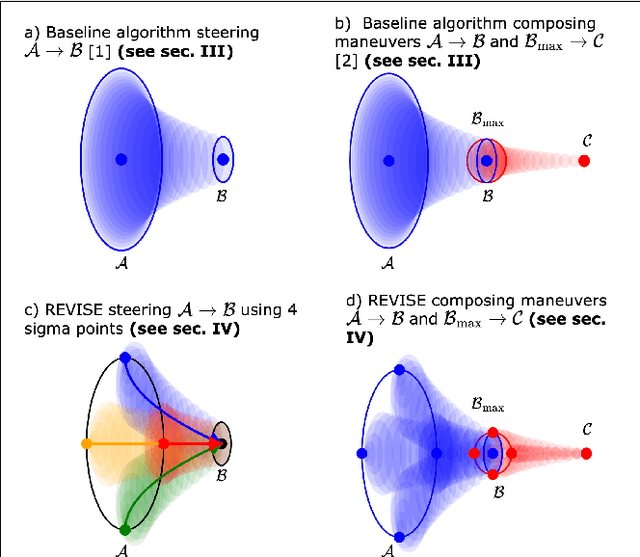
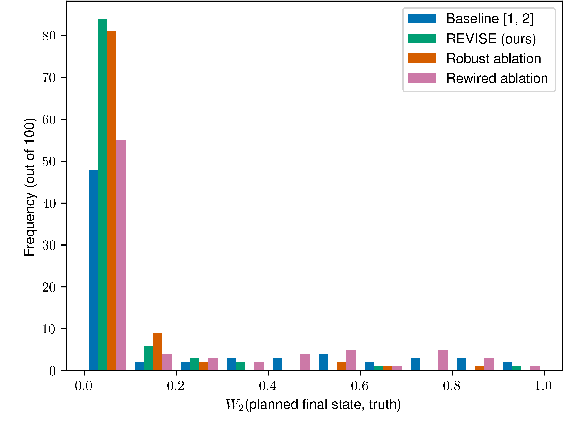
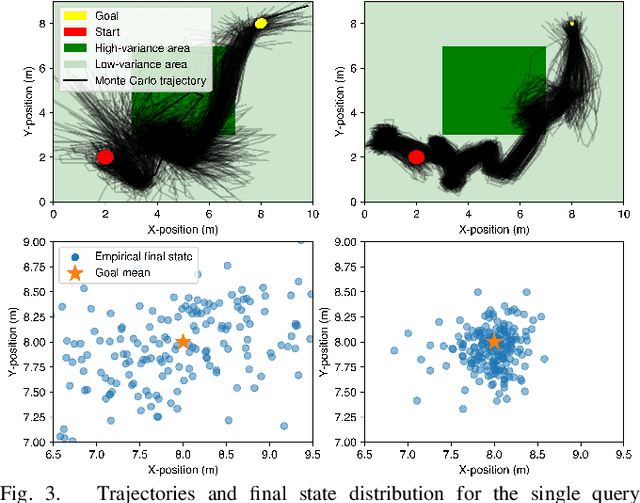
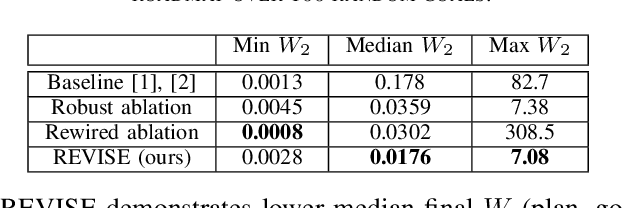
This paper presents Robust samplE-based coVarIance StEering (REVISE), a multi-query algorithm that generates robust belief roadmaps for dynamic systems navigating through spatially dependent disturbances modeled as a Gaussian random field. Our proposed method develops a novel robust sample-based covariance steering edge controller to safely steer a robot between state distributions, satisfying state constraints along the trajectory. Our proposed approach also incorporates an edge rewiring step into the belief roadmap construction process, which provably improves the coverage of the belief roadmap. When compared to state-of-the-art methods, REVISE improves median plan accuracy (as measured by Wasserstein distance between the actual and planned final state distribution) by 10x in multi-query planning and reduces median plan cost (as measured by the largest eigenvalue of the planned state covariance at the goal) by 2.5x in single-query planning for a 6DoF system. We will release our code at https://acl.mit.edu/REVISE/.
SDP Synthesis of Maximum Coverage Trees for Probabilistic Planning under Control Constraints
Mar 21, 2024The paper presents Maximal Covariance Backward Reachable Trees (MAXCOVAR BRT), which is a multi-query algorithm for planning of dynamic systems under stochastic motion uncertainty and constraints on the control input with explicit coverage guarantees. In contrast to existing roadmap-based probabilistic planning methods that sample belief nodes randomly and draw edges between them \cite{csbrm_tro2024}, under control constraints, the reachability of belief nodes needs to be explicitly established and is determined by checking the feasibility of a non-convex program. Moreover, there is no explicit consideration of coverage of the roadmap while adding nodes and edges during the construction procedure for the existing methods. Our contribution is a novel optimization formulation to add nodes and construct the corresponding edge controllers such that the generated roadmap results in provably maximal coverage under control constraints as compared to any other method of adding nodes and edges. We characterize formally the notion of coverage of a roadmap in this stochastic domain via introduction of the h-$\operatorname{BRS}$ (Backward Reachable Set of Distributions) of a tree of distributions under control constraints, and also support our method with extensive simulations on a 6 DoF model.