 Add to Chrome
 Add to Firefox
 Add to Edge
From Stories to Cities to Games: A Qualitative Evaluation of Behaviour Planning
Jan 08, 2026
The primary objective of a diverse planning approach is to generate a set of plans that are distinct from one another. Such an approach is applied in a variety of real-world domains, including risk management, automated stream data analysis, and malware detection. More recently, a novel diverse planning paradigm, referred to as behaviour planning, has been proposed. This approach extends earlier methods by explicitly incorporating a diversity model into the planning process and supporting multiple planning categories. In this paper, we demonstrate the usefulness of behaviour planning in real-world settings by presenting three case studies. The first case study focuses on storytelling, the second addresses urban planning, and the third examines game evaluation.

Bridging the Gap between Structural and Semantic Similarity in Diverse Planning
Oct 02, 2023

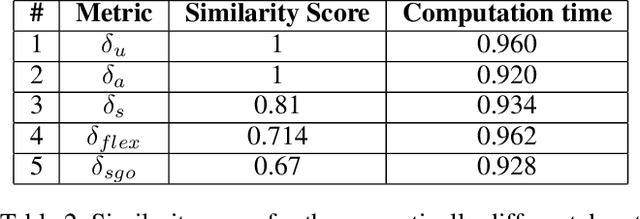

Diverse planning is the problem of finding multiple plans for a given problem specification, which is at the core of many real-world applications. For example, diverse planning is a critical piece for the efficiency of plan recognition systems when dealing with noisy and missing observations. Providing diverse solutions can also benefit situations where constraints are too expensive or impossible to model. Current diverse planners operate by generating multiple plans and then applying a selection procedure to extract diverse solutions using a similarity metric. Generally, current similarity metrics only consider the structural properties of the given plans. We argue that this approach is a limitation that sometimes prevents such metrics from capturing why two plans differ. In this work, we propose two new domain-independent metrics which are able to capture relevant information on the difference between two given plans from a domain-dependent viewpoint. We showcase their utility in various situations where the currently used metrics fail to capture the similarity between plans, failing to capture some structural symmetries.