 Add to Chrome
 Add to Firefox
 Add to Edge
Base Station Deployment under EMF constrain by Deep Reinforcement learning
Dec 23, 2025
As 5G networks rapidly expand and 6G technologies emerge, characterized by dense deployments, millimeter-wave communications, and dynamic beamforming, the need for scalable simulation tools becomes increasingly critical. These tools must support efficient evaluation of key performance metrics such as coverage and radio-frequency electromagnetic field (RF-EMF) exposure, inform network design decisions, and ensure compliance with safety regulations. Moreover, base station (BS) placement is a crucial task in the network design, where satisfying coverage requirements is essential. To address these, based on our previous work, we first propose a conditional generative adversarial network (cGAN) that predicts location specific received signal strength (RSS), and EMF exposure simultaneously from the network topology, as images. As a network designing application, we propose a Deep Q Network (DQN) framework, using the trained cGAN, for optimal base station (BS) deployment in the network. Compared to conventional ray tracing simulations, the proposed cGAN reduces inference and deployment time from several hours to seconds. Unlike a standalone cGAN, which provides static performance maps, the proposed GAN-DQN framework enables sequential decision making under coverage and exposure constraints, learning effective deployment strategies that directly solve the BS placement problem. Thus making it well suited for real time design and adaptation in dynamic scenarios in order to satisfy pre defined network specific heterogeneous performance goals.

Channel Estimation by Infinite Width Convolutional Networks
Apr 11, 2025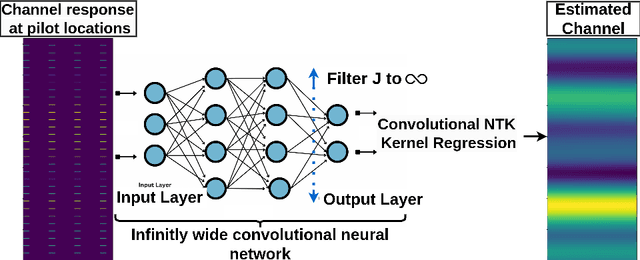
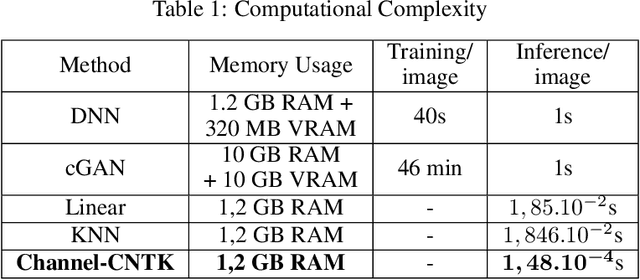
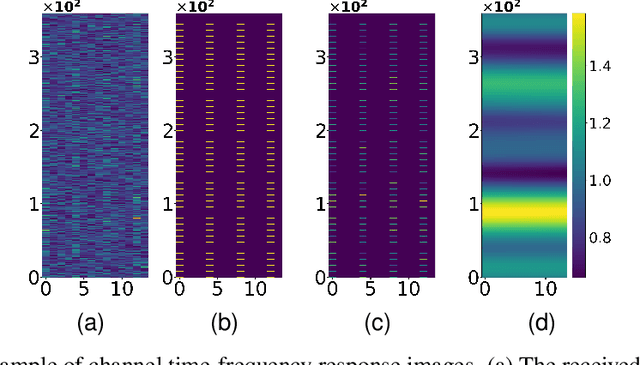
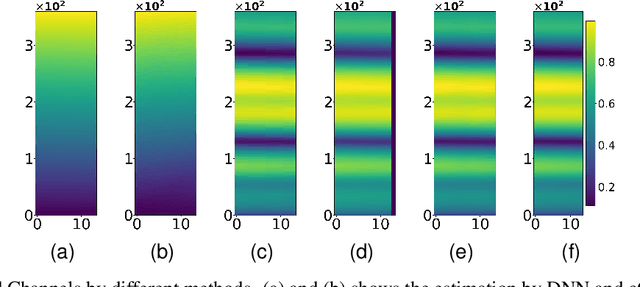
In wireless communications, estimation of channels in OFDM systems spans frequency and time, which relies on sparse collections of pilot data, posing an ill-posed inverse problem. Moreover, deep learning estimators require large amounts of training data, computational resources, and true channels to produce accurate channel estimates, which are not realistic. To address this, a convolutional neural tangent kernel (CNTK) is derived from an infinitely wide convolutional network whose training dynamics can be expressed by a closed-form equation. This CNTK is used to impute the target matrix and estimate the missing channel response using only the known values available at pilot locations. This is a promising solution for channel estimation that does not require a large training set. Numerical results on realistic channel datasets demonstrate that our strategy accurately estimates the channels without a large dataset and significantly outperforms deep learning methods in terms of speed, accuracy, and computational resources.
GLIP: Electromagnetic Field Exposure Map Completion by Deep Generative Networks
May 06, 2024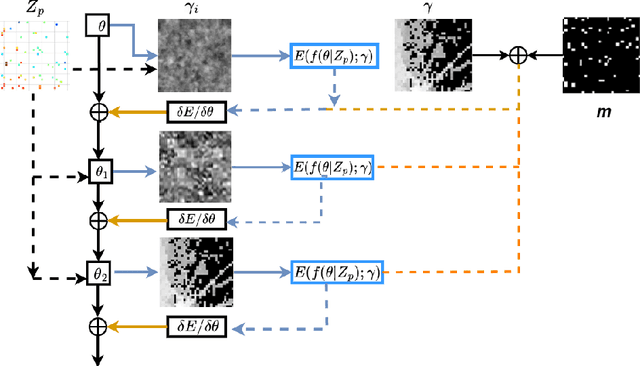
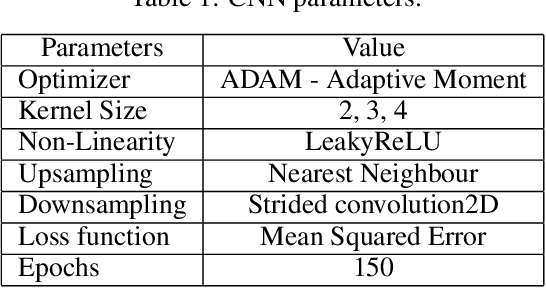
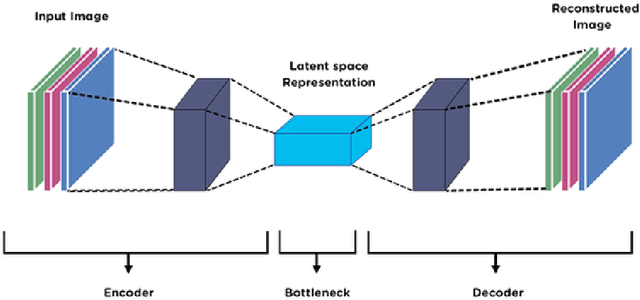
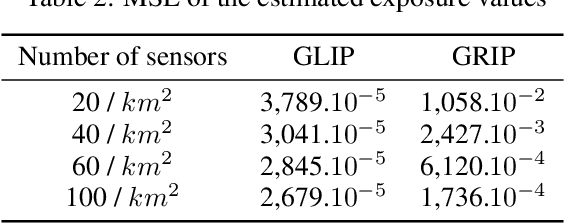
In Spectrum cartography (SC), the generation of exposure maps for radio frequency electromagnetic fields (RF-EMF) spans dimensions of frequency, space, and time, which relies on a sparse collection of sensor data, posing a challenging ill-posed inverse problem. Cartography methods based on models integrate designed priors, such as sparsity and low-rank structures, to refine the solution of this inverse problem. In our previous work, EMF exposure map reconstruction was achieved by Generative Adversarial Networks (GANs) where physical laws or structural constraints were employed as a prior, but they require a large amount of labeled data or simulated full maps for training to produce efficient results. In this paper, we present a method to reconstruct EMF exposure maps using only the generator network in GANs which does not require explicit training, thus overcoming the limitations of GANs, such as using reference full exposure maps. This approach uses a prior from sensor data as Local Image Prior (LIP) captured by deep convolutional generative networks independent of learning the network parameters from images in an urban environment. Experimental results show that, even when only sparse sensor data are available, our method can produce accurate estimates.