 Add to Chrome
 Add to Firefox
 Add to Edge
Beyond Predefined Schemas: TRACE-KG for Context-Enriched Knowledge Graphs from Complex Documents
Apr 03, 2026
Knowledge graph construction typically relies either on predefined ontologies or on schema-free extraction. Ontology-driven pipelines enforce consistent typing but require costly schema design and maintenance, whereas schema-free methods often produce fragmented graphs with weak global organization, especially in long technical documents with dense, context-dependent information. We propose TRACE-KG (Text-dRiven schemA for Context-Enriched Knowledge Graphs), a multimodal framework that jointly constructs a context-enriched knowledge graph and an induced schema without assuming a predefined ontology. TRACE-KG captures conditional relations through structured qualifiers and organizes entities and relations using a data-driven schema that serves as a reusable semantic scaffold while preserving full traceability to the source evidence. Experiments show that TRACE-KG produces structurally coherent, traceable knowledge graphs and offers a practical alternative to both ontology-driven and schema-free construction pipelines.

Measuring Dataset Diversity from a Geometric Perspective
Feb 10, 2026Diversity can be broadly defined as the presence of meaningful variation across elements, which can be viewed from multiple perspectives, including statistical variation and geometric structural richness in the dataset. Existing diversity metrics, such as feature-space dispersion and metric-space magnitude, primarily capture distributional variation or entropy, while largely neglecting the geometric structure of datasets. To address this gap, we introduce a framework based on topological data analysis (TDA) and persistence landscapes (PLs) to extract and quantify geometric features from data. This approach provides a theoretically grounded means of measuring diversity beyond entropy, capturing the rich geometric and structural properties of datasets. Through extensive experiments across diverse modalities, we demonstrate that our proposed PLs-based diversity metric (PLDiv) is powerful, reliable, and interpretable, directly linking data diversity to its underlying geometry and offering a foundational tool for dataset construction, augmentation, and evaluation.
Leveraging LLM for Automated Ontology Extraction and Knowledge Graph Generation
Dec 03, 2024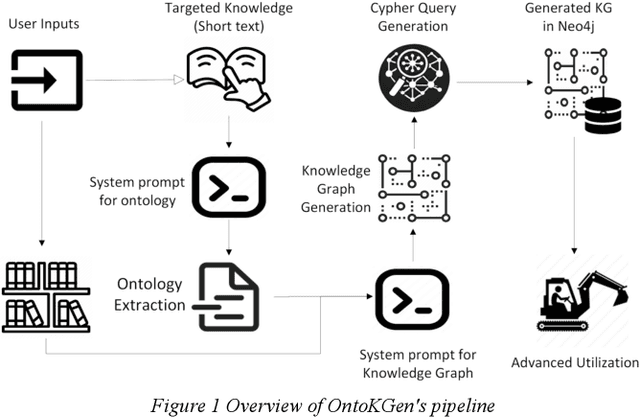
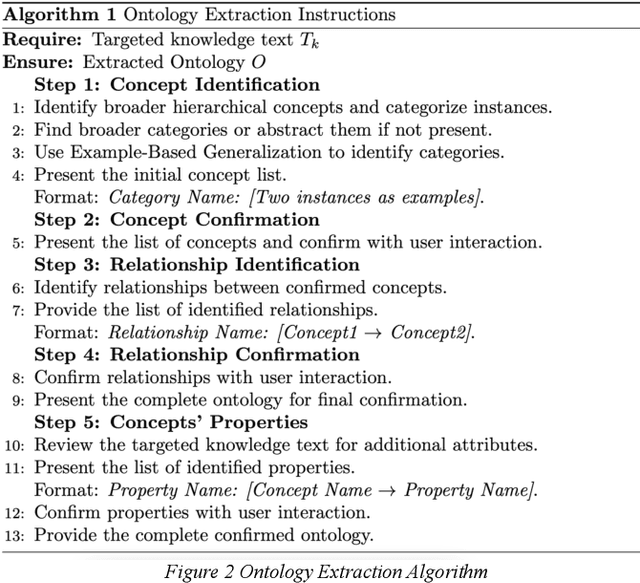
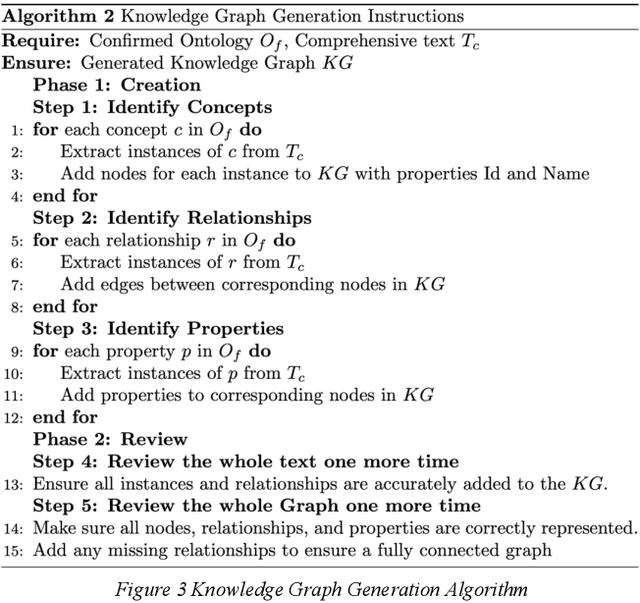
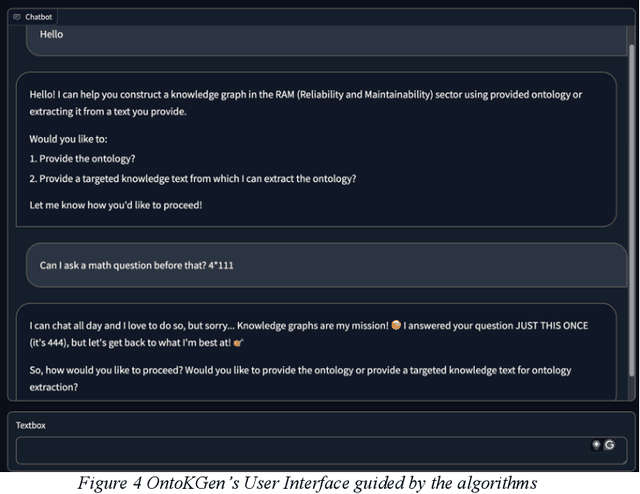
Extracting relevant and structured knowledge from large, complex technical documents within the Reliability and Maintainability (RAM) domain is labor-intensive and prone to errors. Our work addresses this challenge by presenting OntoKGen, a genuine pipeline for ontology extraction and Knowledge Graph (KG) generation. OntoKGen leverages Large Language Models (LLMs) through an interactive user interface guided by our adaptive iterative Chain of Thought (CoT) algorithm to ensure that the ontology extraction process and, thus, KG generation align with user-specific requirements. Although KG generation follows a clear, structured path based on the confirmed ontology, there is no universally correct ontology as it is inherently based on the user's preferences. OntoKGen recommends an ontology grounded in best practices, minimizing user effort and providing valuable insights that may have been overlooked, all while giving the user complete control over the final ontology. Having generated the KG based on the confirmed ontology, OntoKGen enables seamless integration into schemeless, non-relational databases like Neo4j. This integration allows for flexible storage and retrieval of knowledge from diverse, unstructured sources, facilitating advanced querying, analysis, and decision-making. Moreover, the generated KG serves as a robust foundation for future integration into Retrieval Augmented Generation (RAG) systems, offering enhanced capabilities for developing domain-specific intelligent applications.