 Add to Chrome
 Add to Firefox
 Add to Edge
Exploring Fine-Tuning for Tabular Foundation Models
Jan 14, 2026
Tabular Foundation Models (TFMs) have recently shown strong in-context learning capabilities on structured data, achieving zero-shot performance comparable to traditional machine learning methods. We find that zero-shot TFMs already achieve strong performance, while the benefits of fine-tuning are highly model and data-dependent. Meta-learning and PEFT provide moderate gains under specific conditions, whereas full supervised fine-tuning (SFT) often reduces accuracy or calibration quality. This work presents the first comprehensive study of fine-tuning in TFMs across benchmarks including TALENT, OpenML-CC18, and TabZilla. We compare Zero-Shot, Meta-Learning, Supervised (SFT), and parameter-efficient (PEFT) approaches, analyzing how dataset factors such as imbalance, size, and dimensionality affect outcomes. Our findings cover performance, calibration, and fairness, offering practical guidelines on when fine-tuning is most beneficial and its limitations.

Semantic-Guided RL for Interpretable Feature Engineering
Oct 03, 2024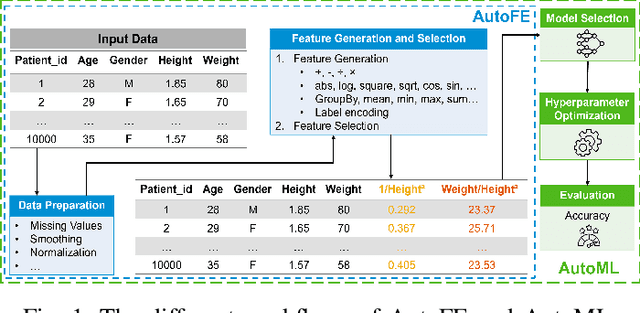
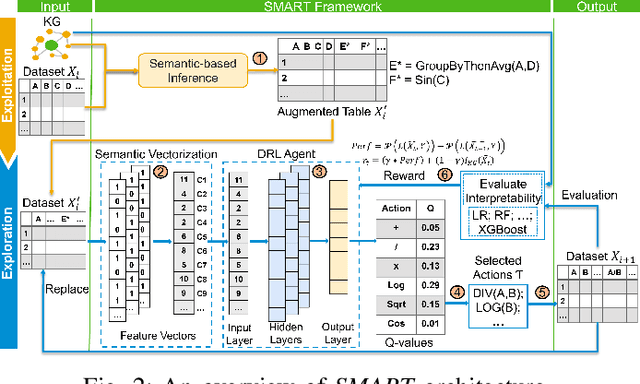
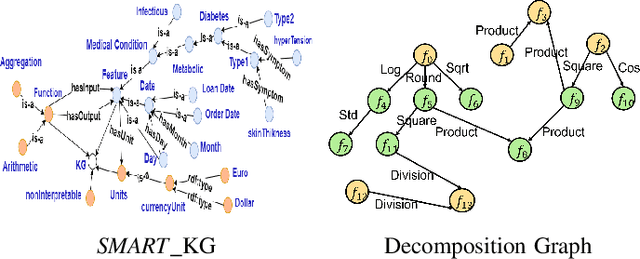
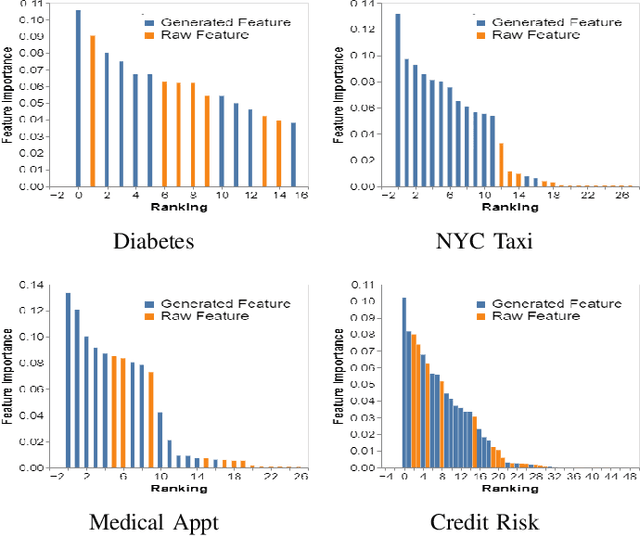
The quality of Machine Learning (ML) models strongly depends on the input data, as such generating high-quality features is often required to improve the predictive accuracy. This process is referred to as Feature Engineering (FE). However, since manual feature engineering is time-consuming and requires case-by-case domain knowledge, Automated Feature Engineering (AutoFE) is crucial. A major challenge that remains is to generate interpretable features. To tackle this problem, we introduce SMART, a hybrid approach that uses semantic technologies to guide the generation of interpretable features through a two-step process: Exploitation and Exploration. The former uses Description Logics (DL) to reason on the semantics embedded in Knowledge Graphs (KG) to infer domain-specific features, while the latter exploits the knowledge graph to conduct a guided exploration of the search space through Deep Reinforcement Learning (DRL). Our experiments on public datasets demonstrate that SMART significantly improves prediction accuracy while ensuring a high level of interpretability.
Leveraging Knowlegde Graphs for Interpretable Feature Generation
Jun 01, 2024
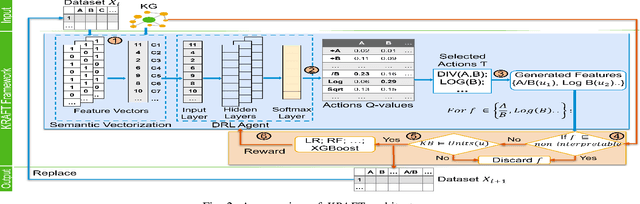
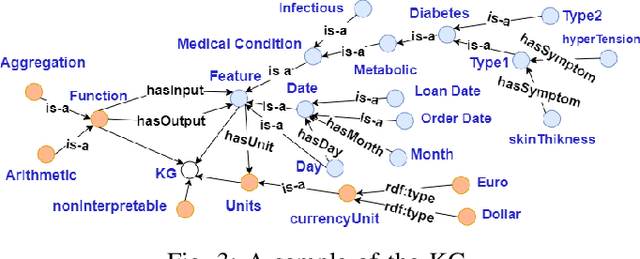
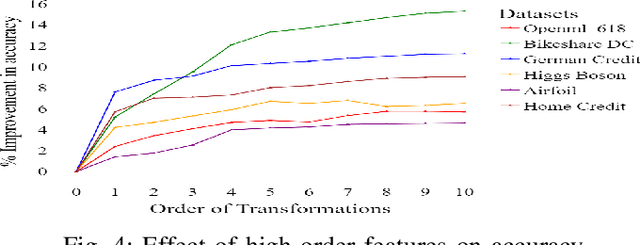
The quality of Machine Learning (ML) models strongly depends on the input data, as such Feature Engineering (FE) is often required in ML. In addition, with the proliferation of ML-powered systems, especially in critical contexts, the need for interpretability and explainability becomes increasingly important. Since manual FE is time-consuming and requires case specific knowledge, we propose KRAFT, an AutoFE framework that leverages a knowledge graph to guide the generation of interpretable features. Our hybrid AI approach combines a neural generator to transform raw features through a series of transformations and a knowledge-based reasoner to evaluate features interpretability using Description Logics (DL). The generator is trained through Deep Reinforcement Learning (DRL) to maximize the prediction accuracy and the interpretability of the generated features. Extensive experiments on real datasets demonstrate that KRAFT significantly improves accuracy while ensuring a high level of interpretability.