 Add to Chrome
 Add to Firefox
 Add to Edge
Reinforcement Learning from Meta-Evaluation: Aligning Language Models Without Ground-Truth Labels
Jan 29, 2026
Most reinforcement learning (RL) methods for training large language models (LLMs) require ground-truth labels or task-specific verifiers, limiting scalability when correctness is ambiguous or expensive to obtain. We introduce Reinforcement Learning from Meta-Evaluation (RLME), which optimizes a generator using reward derived from an evaluator's answers to natural-language meta-questions (e.g., "Is the answer correct?" or "Is the reasoning logically consistent?"). RLME treats the evaluator's probability of a positive judgment as a reward and updates the generator via group-relative policy optimization, enabling learning without labels. Across a suite of experiments, we show that RLME achieves accuracy and sample efficiency comparable to label-based training, enables controllable trade-offs among multiple objectives, steers models toward reliable reasoning patterns rather than post-hoc rationalization, and generalizes to open-domain settings where ground-truth labels are unavailable, broadening the domains in which LLMs may be trained with RL.

RL + Transformer = A General-Purpose Problem Solver
Jan 24, 2025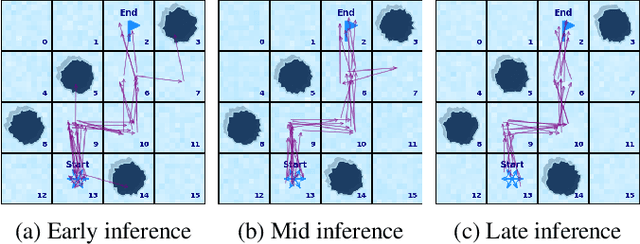

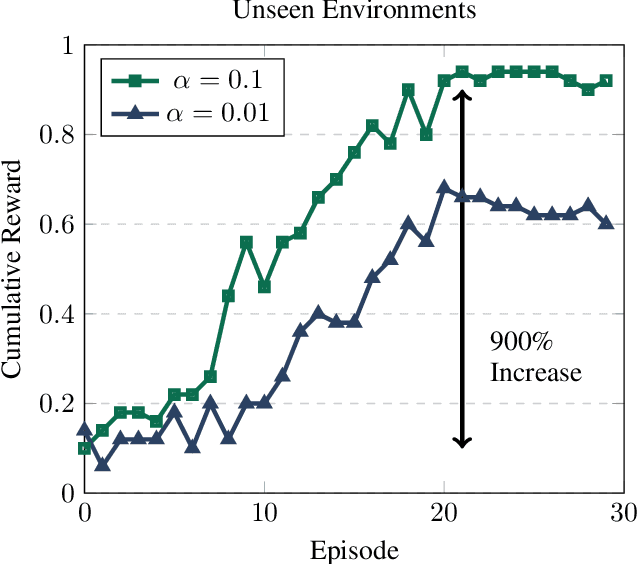
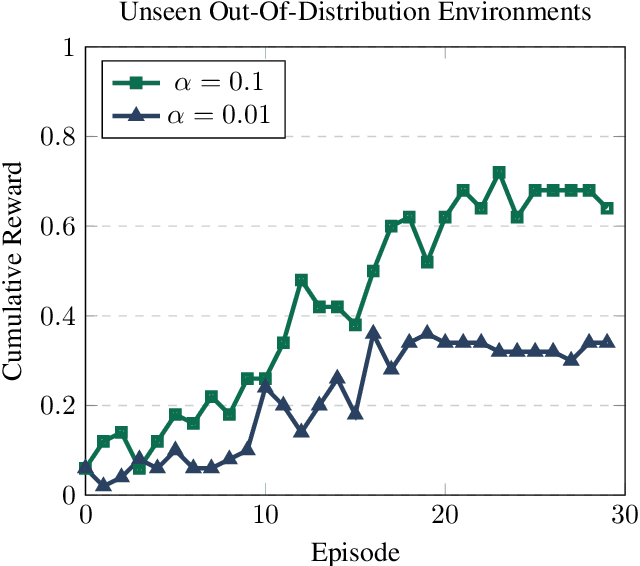
What if artificial intelligence could not only solve problems for which it was trained but also learn to teach itself to solve new problems (i.e., meta-learn)? In this study, we demonstrate that a pre-trained transformer fine-tuned with reinforcement learning over multiple episodes develops the ability to solve problems that it has never encountered before - an emergent ability called In-Context Reinforcement Learning (ICRL). This powerful meta-learner not only excels in solving unseen in-distribution environments with remarkable sample efficiency, but also shows strong performance in out-of-distribution environments. In addition, we show that it exhibits robustness to the quality of its training data, seamlessly stitches together behaviors from its context, and adapts to non-stationary environments. These behaviors demonstrate that an RL-trained transformer can iteratively improve upon its own solutions, making it an excellent general-purpose problem solver.