 Add to Chrome
 Add to Firefox
 Add to Edge
Layer-wise Positional Bias in Short-Context Language Modeling
Jan 07, 2026
Language models often show a preference for using information from specific positions in the input regardless of semantic relevance. While positional bias has been studied in various contexts, from attention sinks to task performance degradation in long-context settings, prior work has not established how these biases evolve across individual layers and input positions, or how they vary independent of task complexity. We introduce an attribution-based framework to analyze positional effects in short-context language modeling. Using layer conductance with a sliding-window approach, we quantify how each layer distributes importance across input positions, yielding layer-wise positional importance profiles. We find that these profiles are architecture-specific, stable across inputs, and invariant to lexical scrambling. Characterizing these profiles, we find prominent recency bias that increases with depth and subtle primacy bias that diminishes through model depth. Beyond positional structure, we also show that early layers preferentially weight content words over function words across all positions, while later layers lose this word-type differentiation.

Explanations of Deep Language Models Explain Language Representations in the Brain
Feb 21, 2025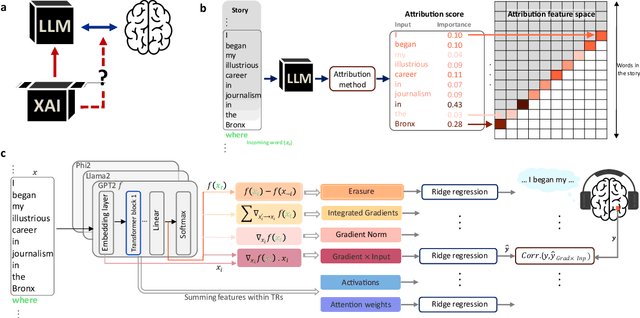
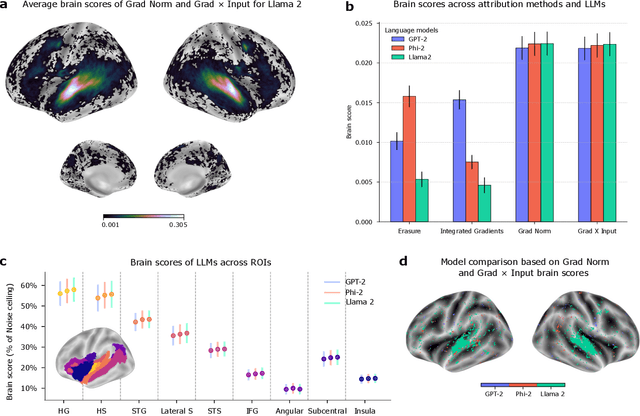
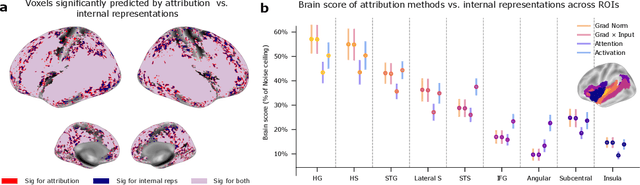
Recent advances in artificial intelligence have given rise to large language models (LLMs) that not only achieve human-like performance but also share computational principles with the brain's language processing mechanisms. While previous research has primarily focused on aligning LLMs' internal representations with neural activity, we introduce a novel approach that leverages explainable AI (XAI) methods to forge deeper connections between the two domains. Using attribution methods, we quantified how preceding words contribute to an LLM's next-word predictions and employed these explanations to predict fMRI recordings from participants listening to the same narratives. Our findings demonstrate that attribution methods robustly predict brain activity across the language network, surpassing traditional internal representations in early language areas. This alignment is hierarchical: early-layer explanations correspond to the initial stages of language processing in the brain, while later layers align with more advanced stages. Moreover, the layers more influential on LLM next-word prediction$\unicode{x2014}$those with higher attribution scores$\unicode{x2014}$exhibited stronger alignment with neural activity. This work establishes a bidirectional bridge between AI and neuroscience. First, we demonstrate that attribution methods offer a powerful lens for investigating the neural mechanisms of language comprehension, revealing how meaning emerges from preceding context. Second, we propose using brain alignment as a metric to evaluate the validity of attribution methods, providing a framework for assessing their biological plausibility.