 Add to Chrome
 Add to Firefox
 Add to Edge
Rethinking Gaussian-Windowed Wavelets for Damping Identification
Dec 16, 2025
In modal analysis, the prevalent use of Gaussian-based wavelets (such as Morlet and Gabor) for damping estimation is rarely questioned. In this study, we challenge this conventional approach by systematically exploring envelope-based damping estimators and proposing a data-driven framework that optimizes the shape and parameters of the envelope utilizing synthetic impulse responses with known ground-truth envelopes. The performance of the resulting estimators is benchmarked across a range of scenarios and compared against frequency-domain damping estimation methods, including Least Squares Rational Function (LSRF), poly-reference Least Squares Complex Frequency-Domain (pLSCF), peak picking (PP), and the Yoshida method. Our findings indicate that Triangle and Welch windows consistently outperform or are on par with Gaussian wavelet methods in contexts of moderate to high signal-to-noise ratios (SNR). In contrast, Blackman filtering demonstrates superior robustness under low SNR conditions and scenarios involving closely spaced modes. Among the frequency-domain methods assessed, LSRF shows the most reliability at very low SNR; however, the non-Gaussian optimized envelope estimators perform exceptionally well as the SNR improves.

Correcting Domain Shifts in Electric Motor Vibration Data for Unseen Operating Conditions
Apr 14, 2025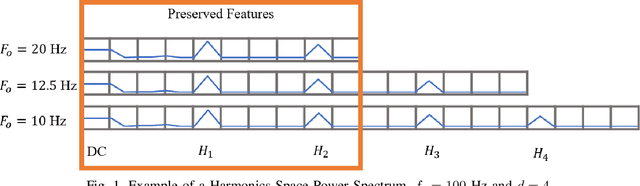
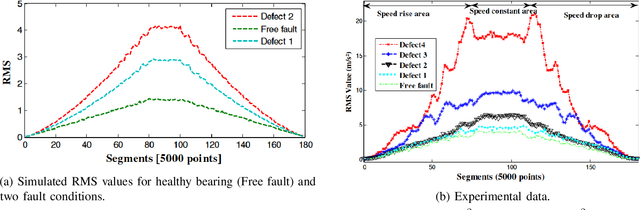
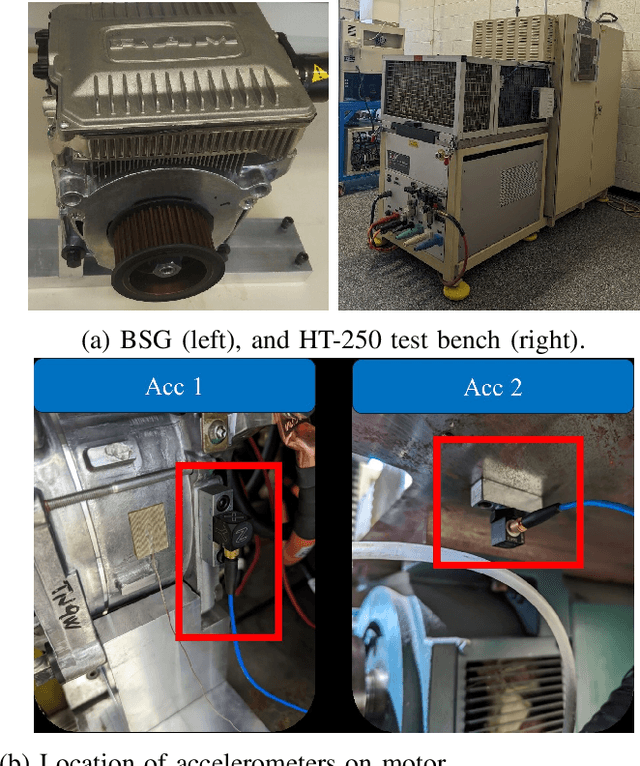
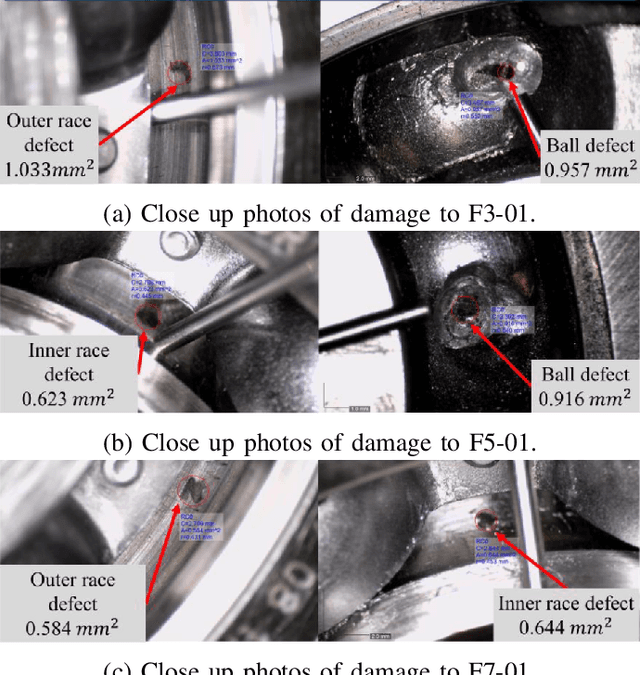
This paper addresses the problem of domain shifts in electric motor vibration data created by new operating conditions in testing scenarios, focusing on bearing fault detection and diagnosis (FDD). The proposed method combines the Harmonic Feature Space (HFS) with regression to correct for frequency and energy differentials in steady-state data, enabling accurate FDD on unseen operating conditions within the range of the training conditions. The HFS aligns harmonics across different operating frequencies, while regression compensates for energy variations, preserving the relative magnitude of vibrations critical for fault detection. The proposed approach is evaluated on a detection problem using experimental data from a Belt-Starter Generator (BSG) electric motor, with test conditions having a minimum 1000 RPM and 5 Nm difference from training conditions. Results demonstrate that the method outperforms traditional analysis techniques, achieving high classification accuracy at a 94% detection rate and effectively reducing domain shifts. The approach is computationally efficient, requires only healthy data for training, and is well-suited for real-world applications where the exact application operating conditions cannot be predetermined.