 Add to Chrome
 Add to Firefox
 Add to Edge
Performance Analysis of Digital Beamforming mmWave MIMO with Low-Resolution DACs/ADCs
Jan 22, 2026
Future wireless communications will rely on multiple-input multiple-output (MIMO) beamforming operating at millimeter wave (mmWave) frequency bands to deliver high data rates. To support flexible spatial processing and meet the demands of latency critical applications, it is essential to use fully digital mmWave MIMO beamforming, which relies on accurate channel estimation. However, ensuring power efficiency in fully digital mmWave MIMO systems requires the use of low-resolution digital-to-analog converters (DACs) and analog-to-digital converters (ADCs). The reduced resolution of these quantizers introduces distortion in both transmitted and received signals, ultimately degrading system performance. In this paper, we investigate the channel estimation performance of mmWave MIMO systems employing fully digital beamforming with low-resolution quantization, under practical system constraints. We evaluate the system performance in terms of spectral efficiency (SE) and energy efficiency (EE). Simulation results demonstrate that a moderate quantization resolutions of 4-bit per DAC/ADC offers a favorable trade-off between energy consumption and achievable data rate.
* Published at the IEEE Radio and Antenna Days of the Indian Ocean (RADIO), 2025

Channel Estimation for mmWave MIMO using sub-6 GHz Out-of-Band Information
Nov 16, 2023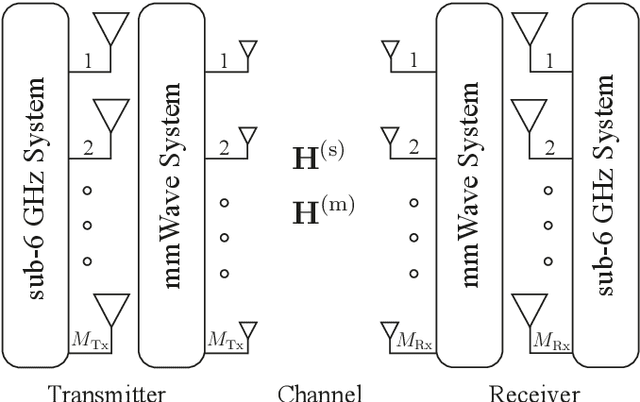
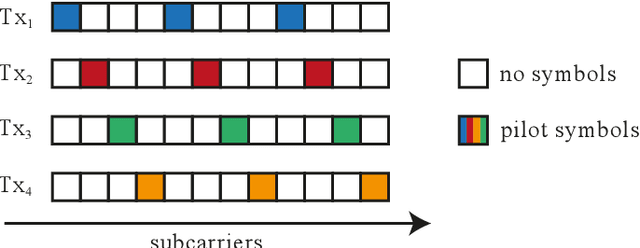
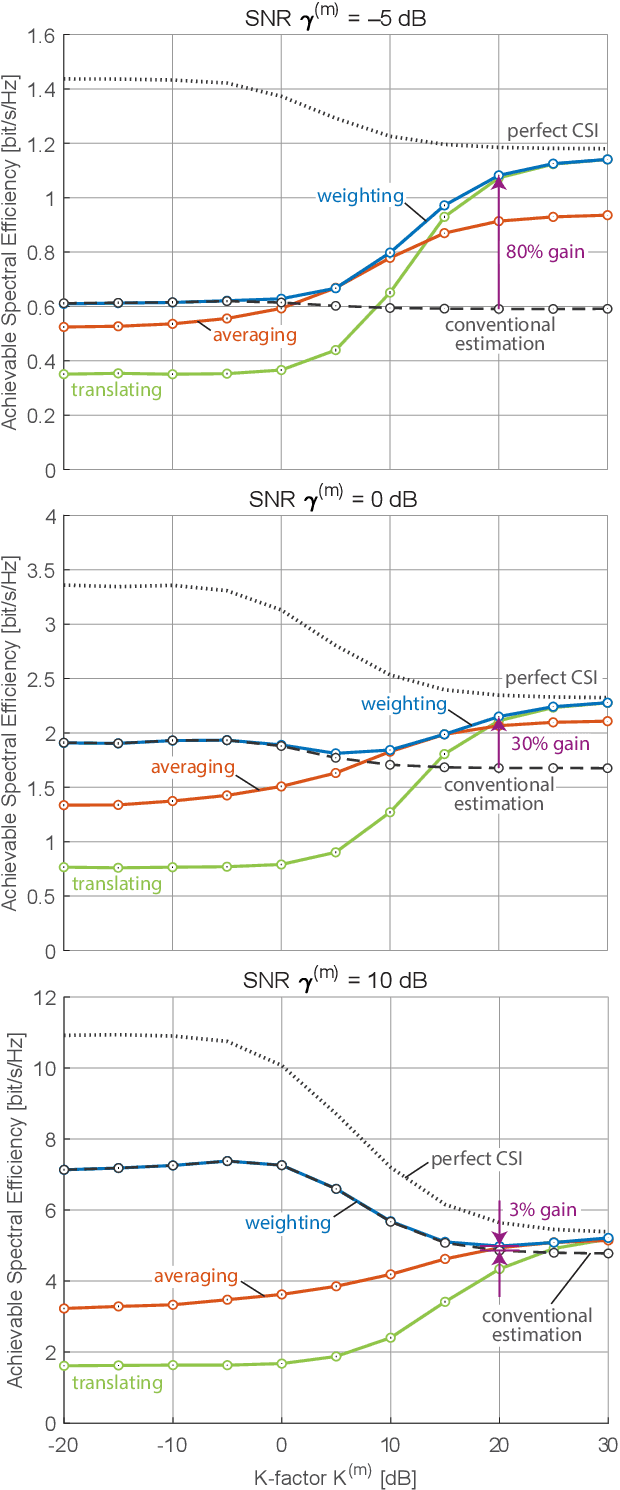
Future wireless multiple-input multiple-output (MIMO) communication systems will employ sub-6 GHz and millimeter wave (mmWave) frequency bands working cooperatively. Establishing a MIMO communication link usually relies on estimating channel state information (CSI) which is difficult to acquire at mmWave frequencies due to a low signal-to-noise ratio (SNR). In this paper, we propose three novel methods to estimate mmWave MIMO channels using out-of-band information obtained from the sub-6GHz band. We compare the proposed channel estimation methods with a conventional one utilizing only in-band information. Simulation results show that the proposed methods outperform the conventional mmWave channel estimation method in terms of achievable spectral efficiency, especially at low SNR and high K-factor.