 Add to Chrome
 Add to Firefox
 Add to Edge
Can Semantic Methods Enhance Team Sports Tactics? A Methodology for Football with Broader Applications
Jan 01, 2026
This paper explores how semantic-space reasoning, traditionally used in computational linguistics, can be extended to tactical decision-making in team sports. Building on the analogy between texts and teams -- where players act as words and collective play conveys meaning -- the proposed methodology models tactical configurations as compositional semantic structures. Each player is represented as a multidimensional vector integrating technical, physical, and psychological attributes; team profiles are aggregated through contextual weighting into a higher-level semantic representation. Within this shared vector space, tactical templates such as high press, counterattack, or possession build-up are encoded analogously to linguistic concepts. Their alignment with team profiles is evaluated using vector-distance metrics, enabling the computation of tactical ``fit'' and opponent-exploitation potential. A Python-based prototype demonstrates how these methods can generate interpretable, dynamically adaptive strategy recommendations, accompanied by fine-grained diagnostic insights at the attribute level. Beyond football, the approach offers a generalizable framework for collective decision-making and performance optimization in team-based domains -- ranging from basketball and hockey to cooperative robotics and human-AI coordination systems. The paper concludes by outlining future directions toward real-world data integration, predictive simulation, and hybrid human-machine tactical intelligence.

Recommending Actionable Strategies: A Semantic Approach to Integrating Analytical Frameworks with Decision Heuristics
Jan 24, 2025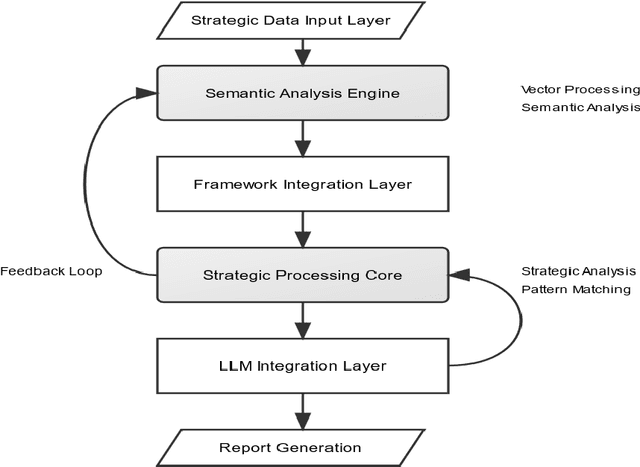
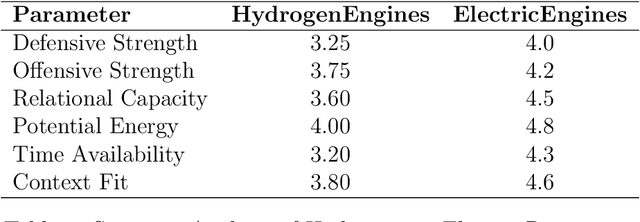
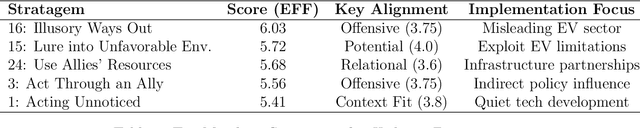
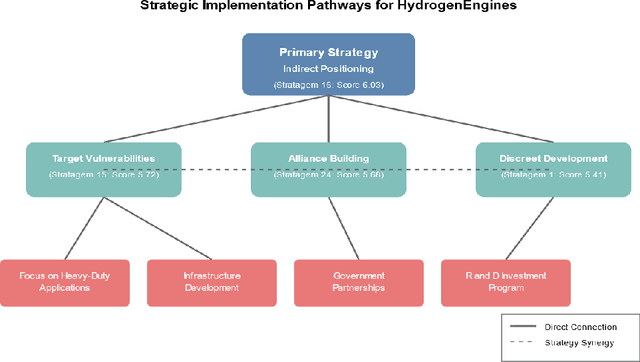
We present a novel approach for recommending actionable strategies by integrating strategic frameworks with decision heuristics through semantic analysis. While strategy frameworks provide systematic models for assessment and planning, and decision heuristics encode experiential knowledge,these traditions have historically remained separate. Our methodology bridges this gap using advanced natural language processing (NLP), demonstrated through integrating frameworks like the 6C model with the Thirty-Six Stratagems. The approach employs vector space representations and semantic similarity calculations to map framework parameters to heuristic patterns, supported by a computational architecture that combines deep semantic processing with constrained use of Large Language Models. By processing both primary content and secondary elements (diagrams, matrices) as complementary linguistic representations, we demonstrate effectiveness through corporate strategy case studies. The methodology generalizes to various analytical frameworks and heuristic sets, culminating in a plug-and-play architecture for generating recommender systems that enable cohesive integration of strategic frameworks and decision heuristics into actionable guidance.