 Add to Chrome
 Add to Firefox
 Add to Edge
Security and Detectability Analysis of Unicode Text Watermarking Methods Against Large Language Models
Dec 15, 2025
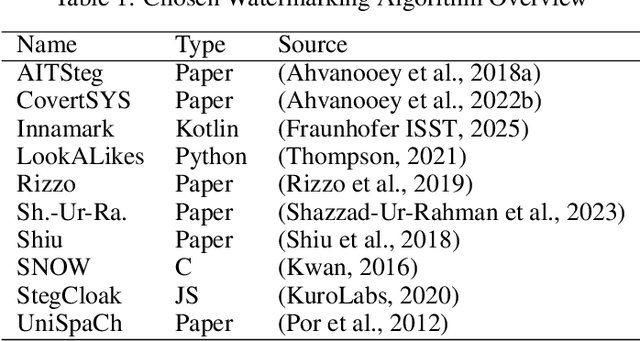

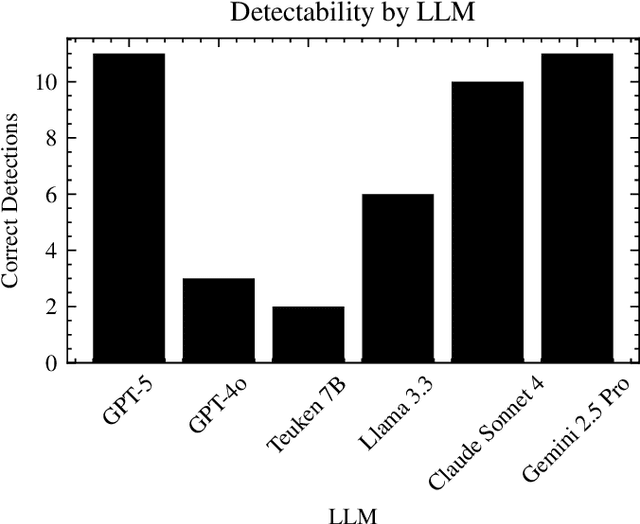
Securing digital text is becoming increasingly relevant due to the widespread use of large language models. Individuals' fear of losing control over data when it is being used to train such machine learning models or when distinguishing model-generated output from text written by humans. Digital watermarking provides additional protection by embedding an invisible watermark within the data that requires protection. However, little work has been taken to analyze and verify if existing digital text watermarking methods are secure and undetectable by large language models. In this paper, we investigate the security-related area of watermarking and machine learning models for text data. In a controlled testbed of three experiments, ten existing Unicode text watermarking methods were implemented and analyzed across six large language models: GPT-5, GPT-4o, Teuken 7B, Llama 3.3, Claude Sonnet 4, and Gemini 2.5 Pro. The findings of our experiments indicate that, especially the latest reasoning models, can detect a watermarked text. Nevertheless, all models fail to extract the watermark unless implementation details in the form of source code are provided. We discuss the implications for security researchers and practitioners and outline future research opportunities to address security concerns.

TREND: A Whitespace Replacement Information Hiding Method
Feb 18, 2025Large Language Models (LLMs) have gained significant popularity in recent years. Differentiating between a text written by a human and a text generated by an LLM has become almost impossible. Information hiding techniques such as digital watermarking or steganography can help by embedding information inside text without being noticed. However, existing techniques, such as linguistic-based or format-based methods, change the semantics or do not work on pure, unformatted text. In this paper, we introduce a novel method for information hiding termed TREND, which is able to conceal any byte-encoded sequence within a cover text. The proposed method is implemented as a multi-platform library using the Kotlin programming language, accompanied by a command-line tool and a web interface provided as examples of usage. By substituting conventional whitespace characters with visually similar Unicode whitespace characters, our proposed scheme preserves the semantics of the cover text without increasing the number of characters. Furthermore, we propose a specified structure for secret messages that enables configurable compression, encryption, hashing, and error correction. Our experimental benchmark comparison on a dataset of one million Wikipedia articles compares ten algorithms from literature and practice. It proves the robustness of our proposed method in various applications while remaining imperceptible to humans. We discuss the limitations of limited embedding capacity and further robustness, which guide implications for future work.