 Add to Chrome
 Add to Firefox
 Add to Edge
One Script Instead of Hundreds? On Pretraining Romanized Encoder Language Models
Jan 09, 2026
Exposing latent lexical overlap, script romanization has emerged as an effective strategy for improving cross-lingual transfer (XLT) in multilingual language models (mLMs). Most prior work, however, focused on setups that favor romanization the most: (1) transfer from high-resource Latin-script to low-resource non-Latin-script languages and/or (2) between genealogically closely related languages with different scripts. It thus remains unclear whether romanization is a good representation choice for pretraining general-purpose mLMs, or, more precisely, if information loss associated with romanization harms performance for high-resource languages. We address this gap by pretraining encoder LMs from scratch on both romanized and original texts for six typologically diverse high-resource languages, investigating two potential sources of degradation: (i) loss of script-specific information and (ii) negative cross-lingual interference from increased vocabulary overlap. Using two romanizers with different fidelity profiles, we observe negligible performance loss for languages with segmental scripts, whereas languages with morphosyllabic scripts (Chinese and Japanese) suffer degradation that higher-fidelity romanization mitigates but cannot fully recover. Importantly, comparing monolingual LMs with their mLM counterpart, we find no evidence that increased subword overlap induces negative interference. We further show that romanization improves encoding efficiency (i.e., fertility) for segmental scripts at a negligible performance cost.

SpeechTaxi: On Multilingual Semantic Speech Classification
Sep 10, 2024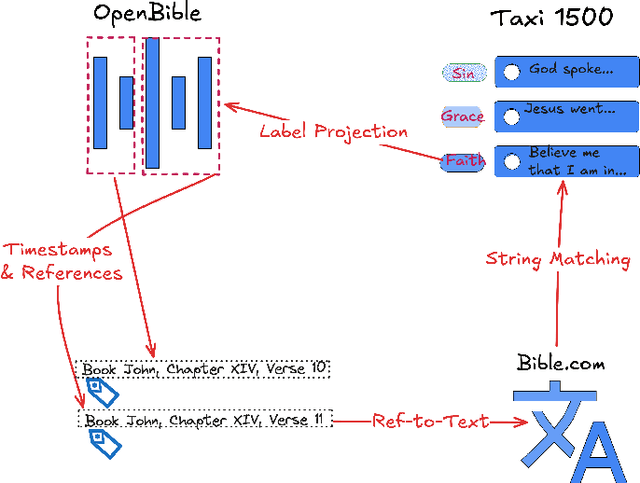
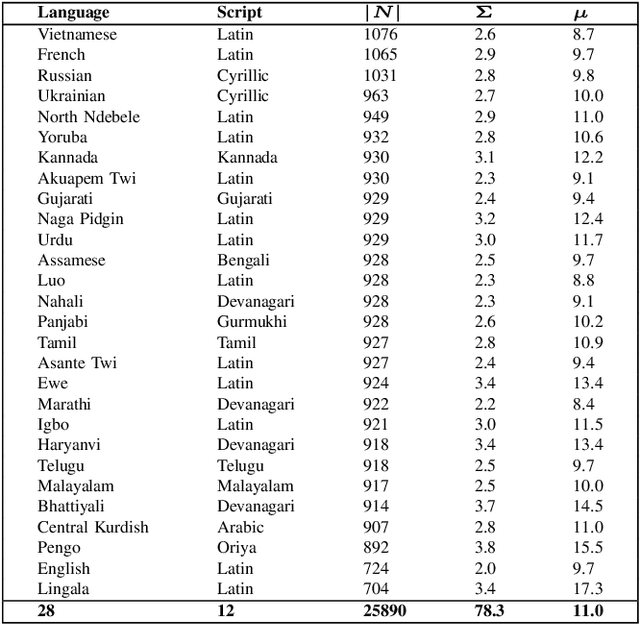
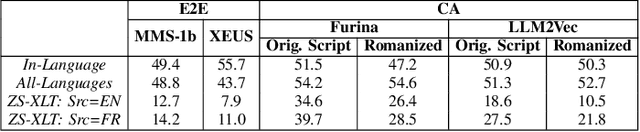
Recent advancements in multilingual speech encoding as well as transcription raise the question of the most effective approach to semantic speech classification. Concretely, can (1) end-to-end (E2E) classifiers obtained by fine-tuning state-of-the-art multilingual speech encoders (MSEs) match or surpass the performance of (2) cascading (CA), where speech is first transcribed into text and classification is delegated to a text-based classifier. To answer this, we first construct SpeechTaxi, an 80-hour multilingual dataset for semantic speech classification of Bible verses, covering 28 diverse languages. We then leverage SpeechTaxi to conduct a wide range of experiments comparing E2E and CA in monolingual semantic speech classification as well as in cross-lingual transfer. We find that E2E based on MSEs outperforms CA in monolingual setups, i.e., when trained on in-language data. However, MSEs seem to have poor cross-lingual transfer abilities, with E2E substantially lagging CA both in (1) zero-shot transfer to languages unseen in training and (2) multilingual training, i.e., joint training on multiple languages. Finally, we devise a novel CA approach based on transcription to Romanized text as a language-agnostic intermediate representation and show that it represents a robust solution for languages without native ASR support. Our SpeechTaxi dataset is publicly available at: https://huggingface.co/ datasets/LennartKeller/SpeechTaxi/.