 Add to Chrome
 Add to Firefox
 Add to Edge
Modeling Topological Impact on Node Attribute Distributions in Attributed Graphs
Feb 01, 2026
We investigate how the topology of attributed graphs influences the distribution of node attributes. This work offers a novel perspective by treating topology and attributes as structurally distinct but interacting components. We introduce an algebraic approach that combines a graph's topology with the probability distribution of node attributes, resulting in topology-influenced distributions. First, we develop a categorical framework to formalize how a node perceives the graph's topology. We then quantify this point of view and integrate it with the distribution of node attributes to capture topological effects. We interpret these topology-conditioned distributions as approximations of the posteriors $P(\cdot \mid v)$ and $P(\cdot \mid \mathcal{G})$. We further establish a principled sufficiency condition by showing that, on complete graphs, where topology carries no informative structure, our construction recovers the original attribute distribution. To evaluate our approach, we introduce an intentionally simple testbed model, $\textbf{ID}$, and use unsupervised graph anomaly detection as a probing task.

Grothendieck Graph Neural Networks Framework: An Algebraic Platform for Crafting Topology-Aware GNNs
Dec 12, 2024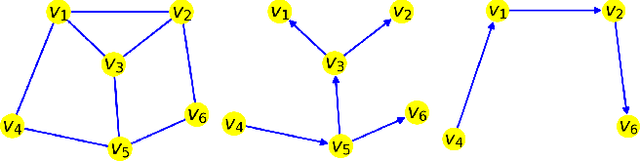
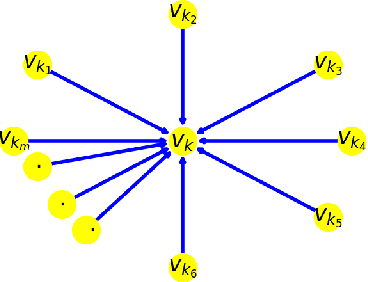
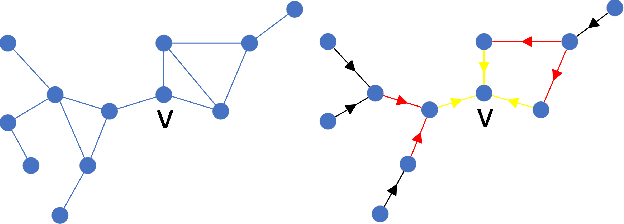
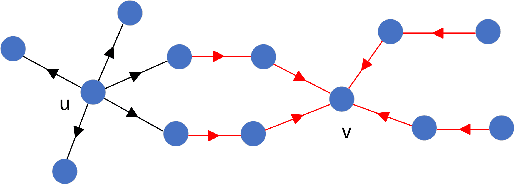
Due to the structural limitations of Graph Neural Networks (GNNs), in particular with respect to conventional neighborhoods, alternative aggregation strategies have recently been investigated. This paper investigates graph structure in message passing, aimed to incorporate topological characteristics. While the simplicity of neighborhoods remains alluring, we propose a novel perspective by introducing the concept of 'cover' as a generalization of neighborhoods. We design the Grothendieck Graph Neural Networks (GGNN) framework, offering an algebraic platform for creating and refining diverse covers for graphs. This framework translates covers into matrix forms, such as the adjacency matrix, expanding the scope of designing GNN models based on desired message-passing strategies. Leveraging algebraic tools, GGNN facilitates the creation of models that outperform traditional approaches. Based on the GGNN framework, we propose Sieve Neural Networks (SNN), a new GNN model that leverages the notion of sieves from category theory. SNN demonstrates outstanding performance in experiments, particularly on benchmarks designed to test the expressivity of GNNs, and exemplifies the versatility of GGNN in generating novel architectures.