 Add to Chrome
 Add to Firefox
 Add to Edge
AgenticTCAD: A LLM-based Multi-Agent Framework for Automated TCAD Code Generation and Device Optimization
Dec 26, 2025
With the continued scaling of advanced technology nodes, the design-technology co-optimization (DTCO) paradigm has become increasingly critical, rendering efficient device design and optimization essential. In the domain of TCAD simulation, however, the scarcity of open-source resources hinders language models from generating valid TCAD code. To overcome this limitation, we construct an open-source TCAD dataset curated by experts and fine-tune a domain-specific model for TCAD code generation. Building on this foundation, we propose AgenticTCAD, a natural language - driven multi-agent framework that enables end-to-end automated device design and optimization. Validation on a 2 nm nanosheet FET (NS-FET) design shows that AgenticTCAD achieves the International Roadmap for Devices and Systems (IRDS)-2024 device specifications within 4.2 hours, whereas human experts required 7.1 days with commercial tools.

Revolutionizing TCAD Simulations with Universal Device Encoding and Graph Attention Networks
Aug 01, 2023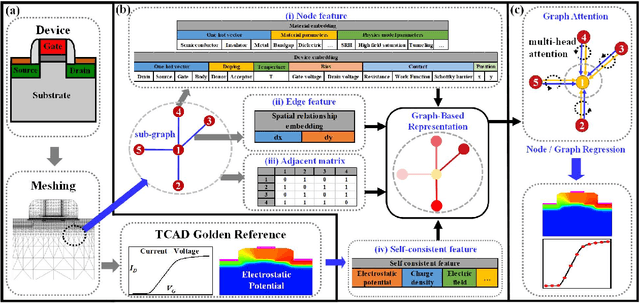
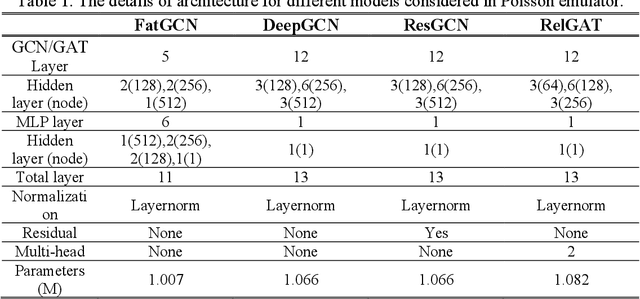
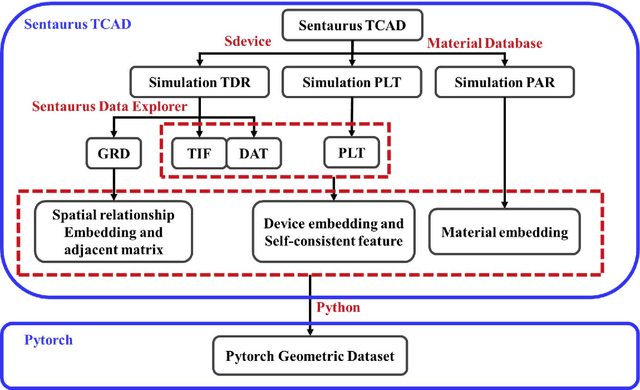
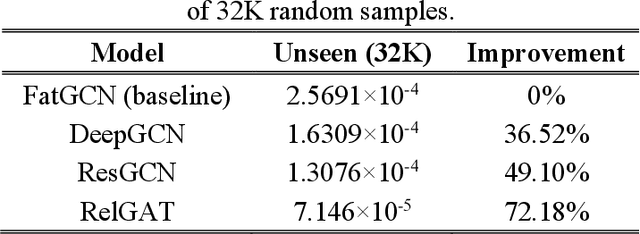
An innovative methodology that leverages artificial intelligence (AI) and graph representation for semiconductor device encoding in TCAD device simulation is proposed. A graph-based universal encoding scheme is presented that not only considers material-level and device-level embeddings, but also introduces a novel spatial relationship embedding inspired by interpolation operations typically used in finite element meshing. Universal physical laws from device simulations are leveraged for comprehensive data-driven modeling, which encompasses surrogate Poisson emulation and current-voltage (IV) prediction based on drift-diffusion model. Both are achieved using a novel graph attention network, referred to as RelGAT. Comprehensive technical details based on the device simulator Sentaurus TCAD are presented, empowering researchers to adopt the proposed AI-driven Electronic Design Automation (EDA) solution at the device level.