 Add to Chrome
 Add to Firefox
 Add to Edge
How to Train Your Resistive Network: Generalized Equilibrium Propagation and Analytical Learning
Feb 03, 2026
Machine learning is a powerful method of extracting meaning from data; unfortunately, current digital hardware is extremely energy-intensive. There is interest in an alternative analog computing implementation that could match the performance of traditional machine learning while being significantly more energy-efficient. However, it remains unclear how to train such analog computing systems while adhering to locality constraints imposed by the physical (as opposed to digital) nature of these systems. Local learning algorithms such as Equilibrium Propagation and Coupled Learning have been proposed to address this issue. In this paper, we develop an algorithm to exactly calculate gradients using a graph theoretic and analytical framework for Kirchhoff's laws. We also introduce Generalized Equilibrium Propagation, a framework encompassing a broad class of Hebbian learning algorithms, including Coupled Learning and Equilibrium Propagation, and show how our algorithm compares. We demonstrate our algorithm using numerical simulations and show that we can train resistor networks without the need for a replica or readout over all resistors, only at the output layer. We also show that under the analytical gradient approach, it is possible to update only a subset of the resistance values without a strong degradation in performance.

RACCOON: A Retrieval-Augmented Generation Approach for Location Coordinate Capture from News Articles
Jan 20, 2025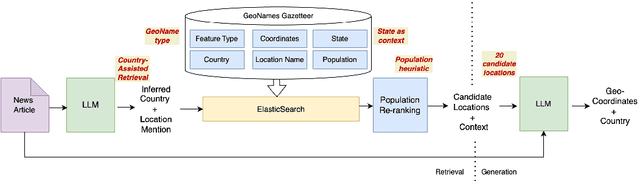
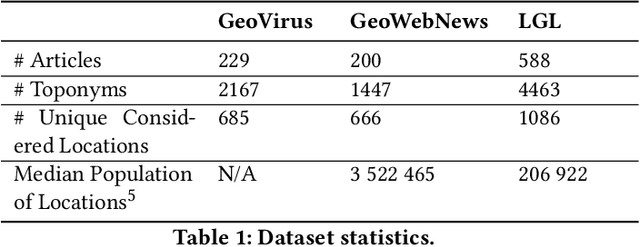
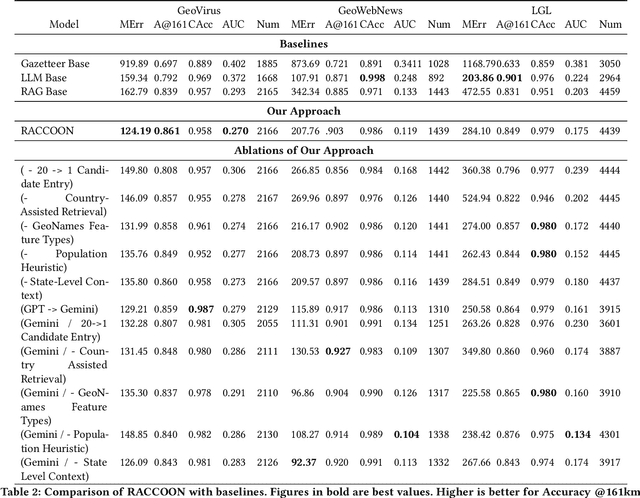
Geocoding involves automatic extraction of location coordinates of incidents reported in news articles, and can be used for epidemic intelligence or disaster management. This paper introduces Retrieval-Augmented Coordinate Capture Of Online News articles (RACCOON), an open-source geocoding approach that extracts geolocations from news articles. RACCOON uses a retrieval-augmented generation (RAG) approach where candidate locations and associated information are retrieved in the form of context from a location database, and a prompt containing the retrieved context, location mentions and news articles is fed to an LLM to generate the location coordinates. Our evaluation on three datasets, two underlying LLMs, three baselines and several ablation tests based on the components of RACCOON demonstrate the utility of RACCOON. To the best of our knowledge, RACCOON is the first RAG-based approach for geocoding using pre-trained LLMs.