 Add to Chrome
 Add to Firefox
 Add to Edge
RIR-Former: Coordinate-Guided Transformer for Continuous Reconstruction of Room Impulse Responses
Feb 03, 2026
Room impulse responses (RIRs) are essential for many acoustic signal processing tasks, yet measuring them densely across space is often impractical. In this work, we propose RIR-Former, a grid-free, one-step feed-forward model for RIR reconstruction. By introducing a sinusoidal encoding module into a transformer backbone, our method effectively incorporates microphone position information, enabling interpolation at arbitrary array locations. Furthermore, a segmented multi-branch decoder is designed to separately handle early reflections and late reverberation, improving reconstruction across the entire RIR. Experiments on diverse simulated acoustic environments demonstrate that RIR-Former consistently outperforms state-of-the-art baselines in terms of normalized mean square error (NMSE) and cosine distance (CD), under varying missing rates and array configurations. These results highlight the potential of our approach for practical deployment and motivate future work on scaling from randomly spaced linear arrays to complex array geometries, dynamic acoustic scenes, and real-world environments.

GMM based multi-stage Wiener filtering for low SNR speech enhancement
Jun 19, 2022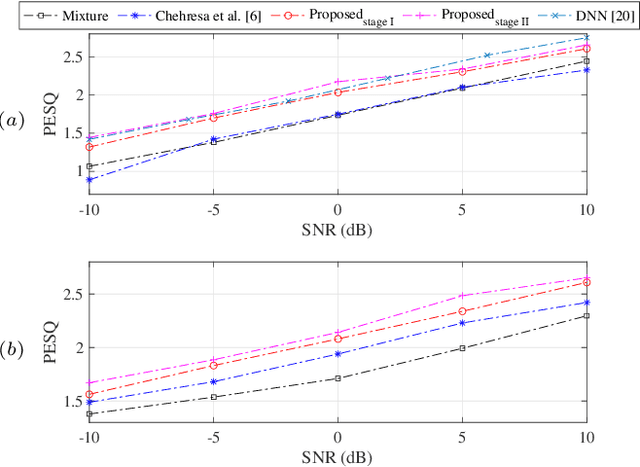
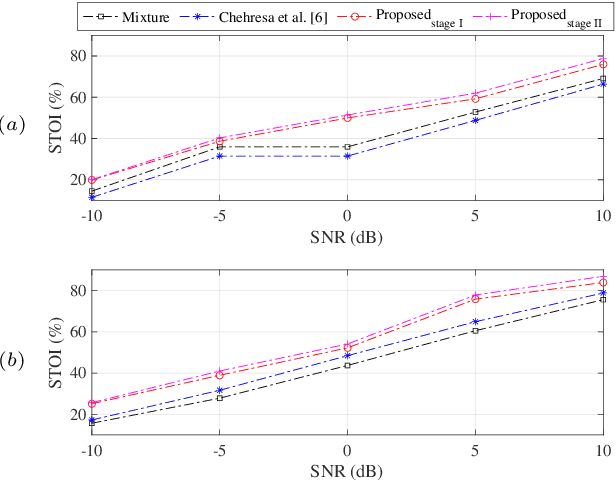
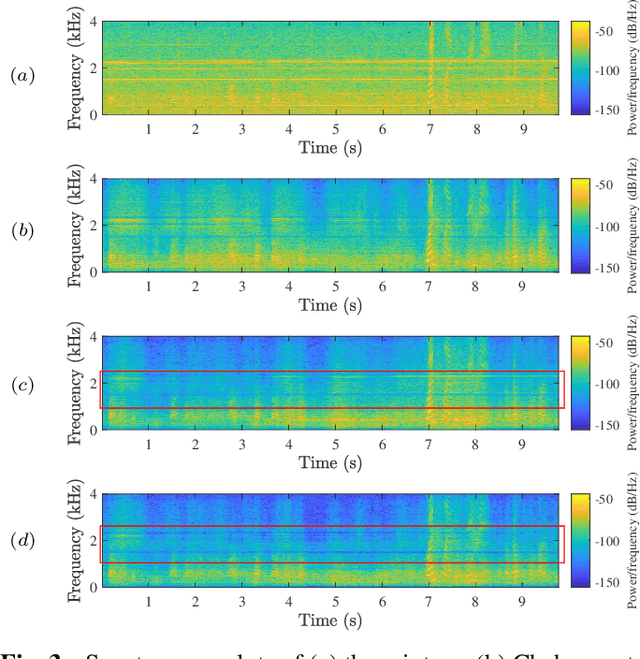
This paper proposes a single-channel speech enhancement method to reduce the noise and enhance speech at low signal-to-noise ratio (SNR) levels and non-stationary noise conditions. Specifically, we focus on modeling the noise using a Gaussian mixture model (GMM) based on a multi-stage process with a parametric Wiener filter. The proposed noise model estimates a more accurate noise power spectral density (PSD), and allows for better generalization under various noise conditions compared to traditional Wiener filtering methods. Simulations show that the proposed approach can achieve better performance in terms of speech quality (PESQ) and intelligibility (STOI) at low SNR levels.