 Add to Chrome
 Add to Firefox
 Add to Edge
MPF-Net: Exposing High-Fidelity AI-Generated Video Forgeries via Hierarchical Manifold Deviation and Micro-Temporal Fluctuations
Jan 29, 2026
With the rapid advancement of video generation models such as Veo and Wan, the visual quality of synthetic content has reached a level where macro-level semantic errors and temporal inconsistencies are no longer prominent. However, this does not imply that the distinction between real and cutting-edge high-fidelity fake is untraceable. We argue that AI-generated videos are essentially products of a manifold-fitting process rather than a physical recording. Consequently, the pixel composition logic of consecutive adjacent frames residual in AI videos exhibits a structured and homogenous characteristic. We term this phenomenon `Manifold Projection Fluctuations' (MPF). Driven by this insight, we propose a hierarchical dual-path framework that operates as a sequential filtering process. The first, the Static Manifold Deviation Branch, leverages the refined perceptual boundaries of Large-Scale Vision Foundation Models (VFMs) to capture residual spatial anomalies or physical violations that deviate from the natural real-world manifold (off-manifold). For the remaining high-fidelity videos that successfully reside on-manifold and evade spatial detection, we introduce the Micro-Temporal Fluctuation Branch as a secondary, fine-grained filter. By analyzing the structured MPF that persists even in visually perfect sequences, our framework ensures that forgeries are exposed regardless of whether they manifest as global real-world manifold deviations or subtle computational fingerprints.

CoInfra: A Large-Scale Cooperative Infrastructure Perception System and Dataset in Adverse Weather
Jul 03, 2025We present CoInfra, a large-scale cooperative infrastructure perception system and dataset designed to advance robust multi-agent perception under real-world and adverse weather conditions. The CoInfra system includes 14 fully synchronized sensor nodes, each equipped with dual RGB cameras and a LiDAR, deployed across a shared region and operating continuously to capture all traffic participants in real-time. A robust, delay-aware synchronization protocol and a scalable system architecture that supports real-time data fusion, OTA management, and remote monitoring are provided in this paper. On the other hand, the dataset was collected in different weather scenarios, including sunny, rainy, freezing rain, and heavy snow and includes 195k LiDAR frames and 390k camera images from 8 infrastructure nodes that are globally time-aligned and spatially calibrated. Furthermore, comprehensive 3D bounding box annotations for five object classes (i.e., car, bus, truck, person, and bicycle) are provided in both global and individual node frames, along with high-definition maps for contextual understanding. Baseline experiments demonstrate the trade-offs between early and late fusion strategies, the significant benefits of HD map integration are discussed. By openly releasing our dataset, codebase, and system documentation at https://github.com/NingMingHao/CoInfra, we aim to enable reproducible research and drive progress in infrastructure-supported autonomous driving, particularly in challenging, real-world settings.
DriveSOTIF: Advancing Perception SOTIF Through Multimodal Large Language Models
May 11, 2025Human drivers naturally possess the ability to perceive driving scenarios, predict potential hazards, and react instinctively due to their spatial and causal intelligence, which allows them to perceive, understand, predict, and interact with the 3D world both spatially and temporally. Autonomous vehicles, however, lack these capabilities, leading to challenges in effectively managing perception-related Safety of the Intended Functionality (SOTIF) risks, particularly in complex and unpredictable driving conditions. To address this gap, we propose an approach that fine-tunes multimodal language models (MLLMs) on a customized dataset specifically designed to capture perception-related SOTIF scenarios. Model benchmarking demonstrates that this tailored dataset enables the models to better understand and respond to these complex driving situations. Additionally, in real-world case studies, the proposed method correctly handles challenging scenarios that even human drivers may find difficult. Real-time performance tests further indicate the potential for the models to operate efficiently in live driving environments. This approach, along with the dataset generation pipeline, shows significant promise for improving the identification, cognition, prediction, and reaction to SOTIF-related risks in autonomous driving systems. The dataset and information are available: https://github.com/s95huang/DriveSOTIF.git
SAP-CoPE: Social-Aware Planning using Cooperative Pose Estimation with Infrastructure Sensor Nodes
Apr 08, 2025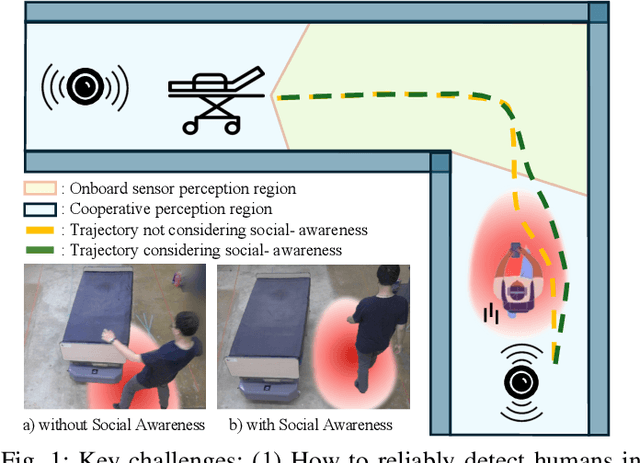
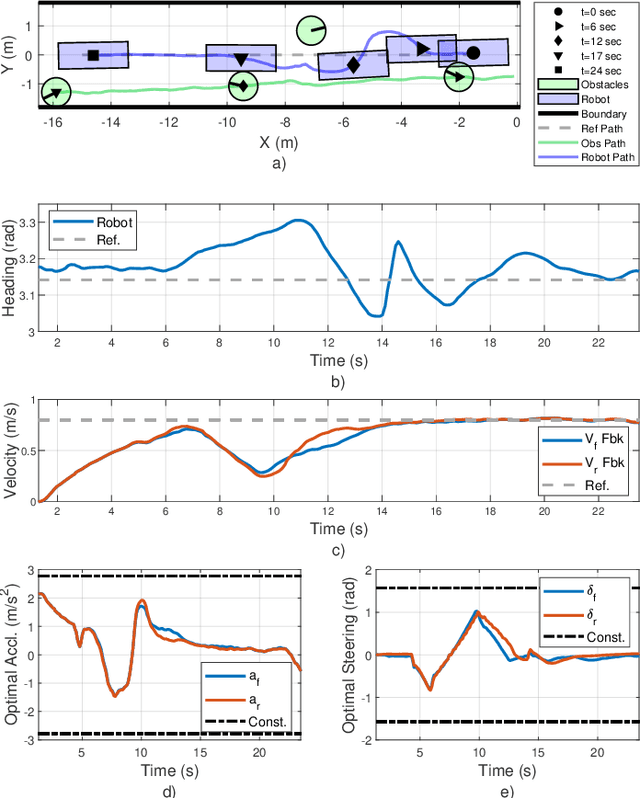
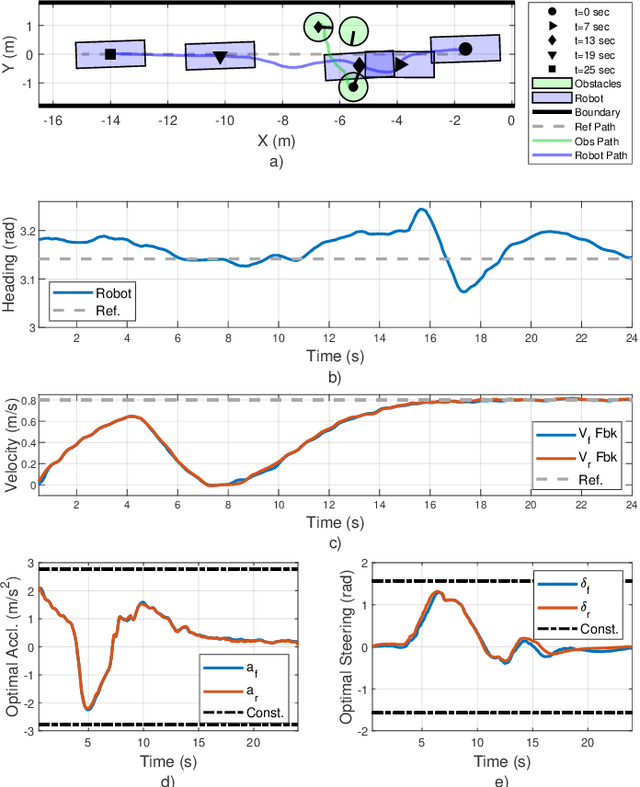
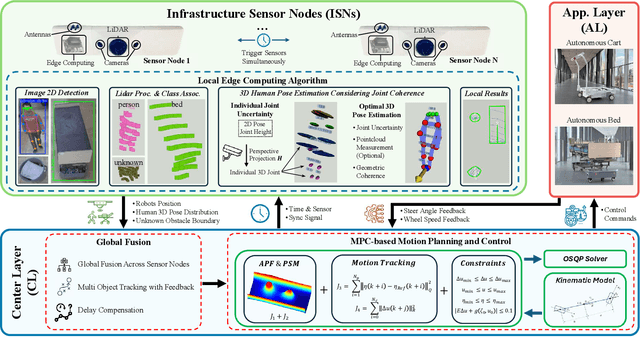
Autonomous driving systems must operate safely in human-populated indoor environments, where challenges such as limited perception and occlusion sensitivity arise when relying solely on onboard sensors. These factors generate difficulties in the accurate recognition of human intentions and the generation of comfortable, socially aware trajectories. To address these issues, we propose SAP-CoPE, a social-aware planning framework that integrates cooperative infrastructure with a novel 3D human pose estimation method and a model predictive control-based controller. This real-time framework formulates an optimization problem that accounts for uncertainty propagation in the camera projection matrix while ensuring human joint coherence. The proposed method is adaptable to single- or multi-camera configurations and can incorporate sparse LiDAR point-cloud data. To enhance safety and comfort in human environments, we integrate a human personal space field based on human pose into a model predictive controller, enabling the system to navigate while avoiding discomfort zones. Extensive evaluations in both simulated and real-world settings demonstrate the effectiveness of our approach in generating socially aware trajectories for autonomous systems.
Augmented Kinesthetic Teaching: Enhancing Task Execution Efficiency through Intuitive Human Instructions
Dec 01, 2023In this paper, we present a complete and efficient implementation of a knowledge-sharing augmented kinesthetic teaching approach for efficient task execution in robotics. Our augmented kinesthetic teaching method integrates intuitive human feedback, including verbal, gesture, gaze, and physical guidance, to facilitate the extraction of multiple layers of task information including control type, attention direction, input and output type, action state change trigger, etc., enhancing the adaptability and autonomy of robots during task execution. We propose an efficient Programming by Demonstration (PbD) framework for users with limited technical experience to teach the robot in an intuitive manner. The proposed framework provides an interface for such users to teach customized tasks using high-level commands, with the goal of achieving a smoother teaching experience and task execution. This is demonstrated with the sample task of pouring water.