 Add to Chrome
 Add to Firefox
 Add to Edge
Burst Aware Forecasting of User Traffic Demand in LEO Satellite Networks
Jan 20, 2026
In Low Earth Orbit (LEO) satellite networks, Beam Hopping (BH) technology enables the efficient utilization of limited radio resources by adapting to varying user demands and link conditions. Effective BH planning requires prior knowledge of upcoming traffic at the time of scheduling, making forecasting an important sub-task. Forecasting becomes particularly critical under heavy load conditions where an unexpected demand burst combined with link degradation may cause buffer overflows and packet loss. To address this challenge, we propose a burst aware forecasting solution. This challenge may arise in a wide range of wireless networks; therefore, the proposed solution is broadly applicable to settings characterized by bursty traffic patterns where accurate demand forecasting is essential. Our approach introduces three key enhancements to a transformer architecture: (i) a distance from the last burst embedding to capture burst proximity, (ii) two additional linear layers in the decoder to forecast both upcoming bursts and their relative impact, and (iii) use of an asymmetric cost function during model training to better capture burst dynamics. Empirical evaluations in an Earth-fixed cell under high-traffic demand scenario demonstrate that the proposed model reduces prediction error by up to 94% at a one-step horizon and maintains the ability to accurately capture bursts even near the end of longer prediction horizons following Mean Square Error (MSE) metric.

Limited-Fronthaul Cell-Free Hybrid Beamforming with Distributed Deep Neural Network
Jun 30, 2021

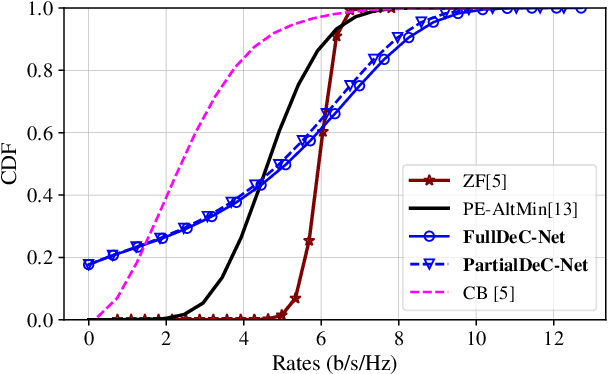

Cell-free massive MIMO (CF-mMIMO) systems represent a promising approach to increase the spectral efficiency of wireless communication systems. However, near-optimal solutions require a large amount of signaling exchange between access points (APs) and the network controller (NC). In addition, the use of hybrid beamforming in each AP reduces the number of power hungry RF chains, but imposes a large computational complexity to find near-optimal precoders. In this letter, we propose two unsupervised deep neural networks (DNN) architectures, fully and partially distributed, that can perform coordinated hybrid beamforming with zero or limited communication overhead between APs and NC, while achieving near-optimal sum-rate with a reduced computational complexity compared to conventional near-optimal solutions.
Unsupervised Deep Learning for Massive MIMO Hybrid Beamforming
Jul 02, 2020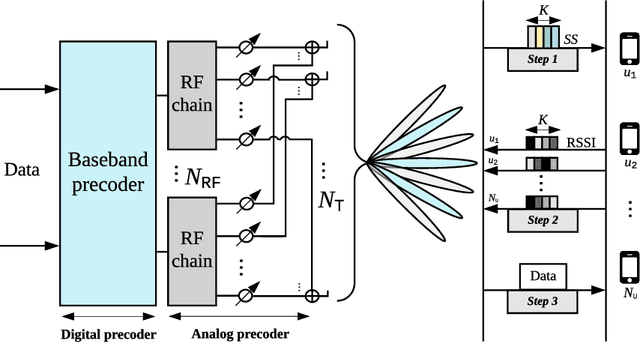
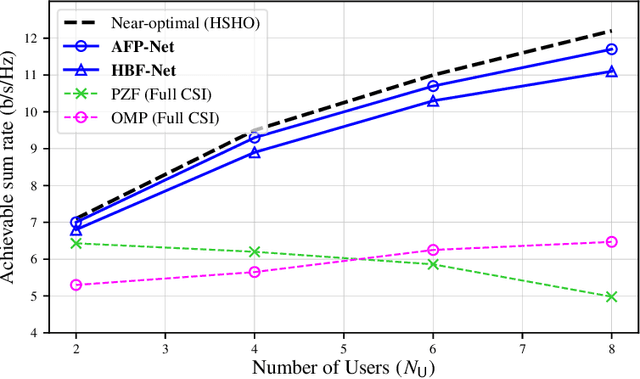
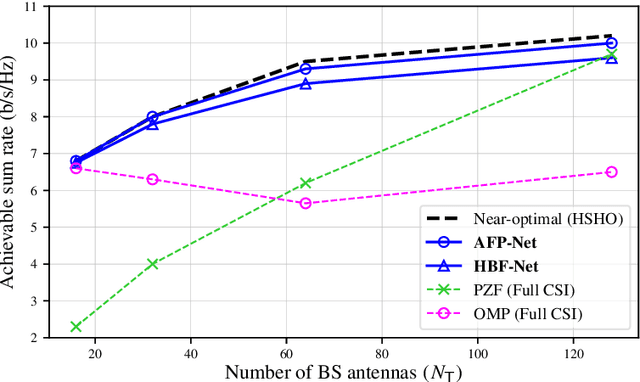
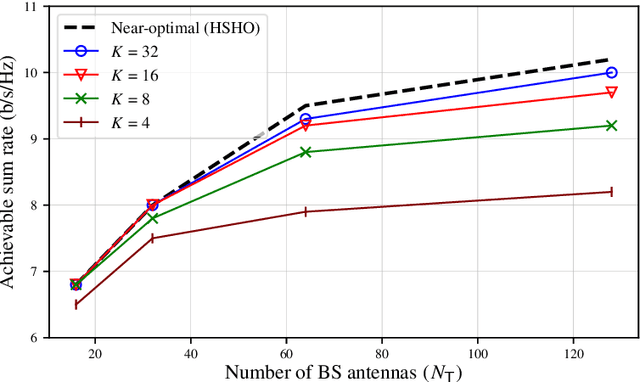
Hybrid beamforming is a promising technique to reduce the complexity and cost of massive multiple-input multiple-output (MIMO) systems while providing high data rate. However, the hybrid precoder design is a challenging task requiring channel state information (CSI) feedback and solving a complex optimization problem. This paper proposes a novel RSSI-based unsupervised deep learning method to design the hybrid beamforming in massive MIMO systems. Furthermore, we propose i) a method to design the synchronization signal (SS) in initial access (IA); and ii) a method to design the codebook for the analog precoder. We also evaluate the system performance through a realistic channel model in various scenarios. We show that the proposed method not only greatly increases the spectral efficiency especially in frequency-division duplex (FDD) communication by using partial CSI feedback, but also has near-optimal sum-rate and outperforms other state-of-the-art full-CSI solutions.