 Add to Chrome
 Add to Firefox
 Add to Edge
New Adaptive Mechanism for Large Neighborhood Search using Dual Actor-Critic
Jan 16, 2026
Adaptive Large Neighborhood Search (ALNS) is a widely used heuristic method for solving combinatorial optimization problems. ALNS explores the solution space by iteratively using destroy and repair operators with probabilities, which are adjusted by an adaptive mechanism to find optimal solutions. However, the classic ALNS adaptive mechanism does not consider the interaction between destroy and repair operators when selecting them. To overcome this limitation, this study proposes a novel adaptive mechanism. This mechanism enhances the adaptability of the algorithm through a Dual Actor-Critic (DAC) model, which fully considers the fact that the quality of new solutions is jointly determined by the destroy and repair operators. It effectively utilizes the interaction between these operators during the weight adjustment process, greatly improving the adaptability of the ALNS algorithm. In this mechanism, the destroy and repair processes are modeled as independent Markov Decision Processes to guide the selection of operators more accurately. Furthermore, we use Graph Neural Networks to extract key features from problem instances and perform effective aggregation and normalization to enhance the algorithm's transferability to different sizes and characteristics of problems. Through a series of experiments, we demonstrate that the proposed DAC-ALNS algorithm significantly improves solution efficiency and exhibits excellent transferability.

The bi-objective multimodal car-sharing problem
Oct 18, 2020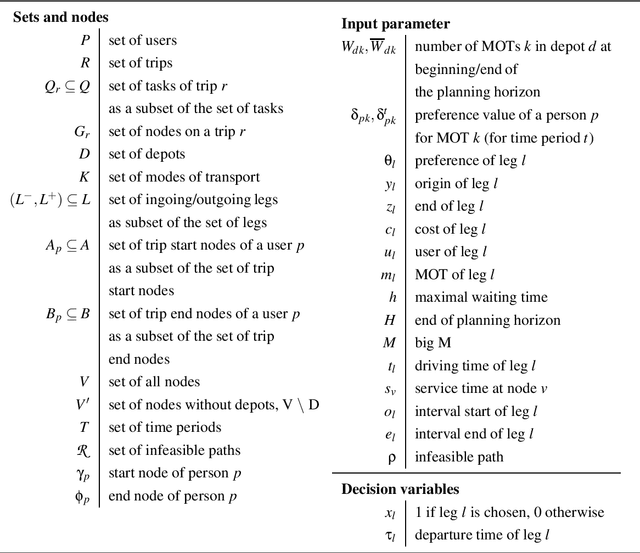
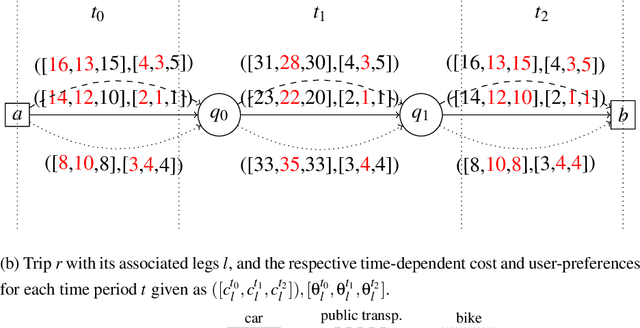
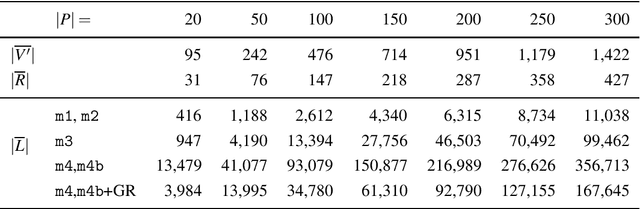
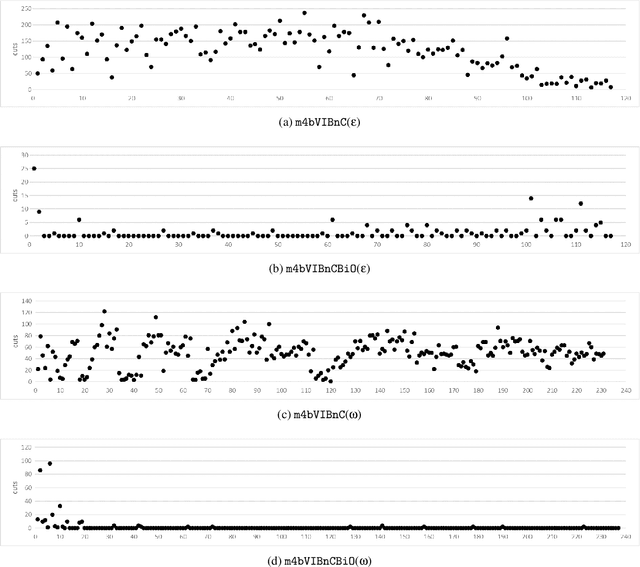
The aim of the bi-objective multimodal car-sharing problem (BiO-MMCP) is to determine the optimal mode of transport assignment for trips and to schedule the routes of available cars and users whilst minimizing cost and maximizing user satisfaction. We investigate the BiO-MMCP from a user-centred point of view. As user satisfaction is a crucial aspect in shared mobility systems, we consider user preferences in a second objective. Users may choose and rank their preferred modes of transport for different times of the day. In this way we account for, e.g., different traffic conditions throughout the planning horizon. We study different variants of the problem. In the base problem, the sequence of tasks a user has to fulfill is fixed in advance and travel times as well as preferences are constant over the planning horizon. In variant 2, time-dependent travel times and preferences are introduced. In variant 3, we examine the challenges when allowing additional routing decisions. Variant 4 integrates variants 2 and 3. For this last variant, we develop a branch-and-cut algorithm which is embedded in two bi-objective frameworks, namely the $\epsilon$-constraint method and a weighting binary search method. Computational experiments show that the branch-and cut algorithm outperforms the MIP formulation and we discuss changing solutions along the Pareto frontier.