 Add to Chrome
 Add to Firefox
 Add to Edge
Opportunities in AI/ML for the Rubin LSST Dark Energy Science Collaboration
Jan 20, 2026
The Vera C. Rubin Observatory's Legacy Survey of Space and Time (LSST) will produce unprecedented volumes of heterogeneous astronomical data (images, catalogs, and alerts) that challenge traditional analysis pipelines. The LSST Dark Energy Science Collaboration (DESC) aims to derive robust constraints on dark energy and dark matter from these data, requiring methods that are statistically powerful, scalable, and operationally reliable. Artificial intelligence and machine learning (AI/ML) are already embedded across DESC science workflows, from photometric redshifts and transient classification to weak lensing inference and cosmological simulations. Yet their utility for precision cosmology hinges on trustworthy uncertainty quantification, robustness to covariate shift and model misspecification, and reproducible integration within scientific pipelines. This white paper surveys the current landscape of AI/ML across DESC's primary cosmological probes and cross-cutting analyses, revealing that the same core methodologies and fundamental challenges recur across disparate science cases. Since progress on these cross-cutting challenges would benefit multiple probes simultaneously, we identify key methodological research priorities, including Bayesian inference at scale, physics-informed methods, validation frameworks, and active learning for discovery. With an eye on emerging techniques, we also explore the potential of the latest foundation model methodologies and LLM-driven agentic AI systems to reshape DESC workflows, provided their deployment is coupled with rigorous evaluation and governance. Finally, we discuss critical software, computing, data infrastructure, and human capital requirements for the successful deployment of these new methodologies, and consider associated risks and opportunities for broader coordination with external actors.

Primordial non-Gaussianity from the Completed SDSS-IV extended Baryon Oscillation Spectroscopic Survey I: Catalogue Preparation and Systematic Mitigation
Jun 25, 2021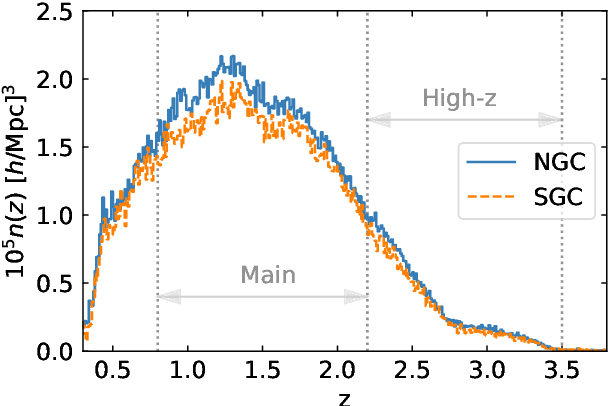
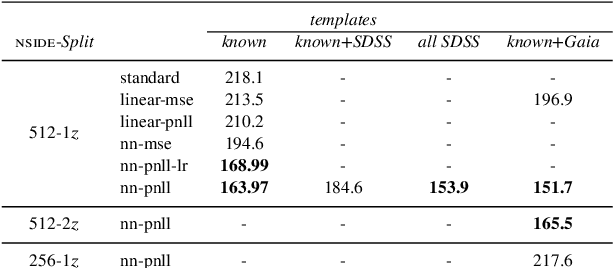
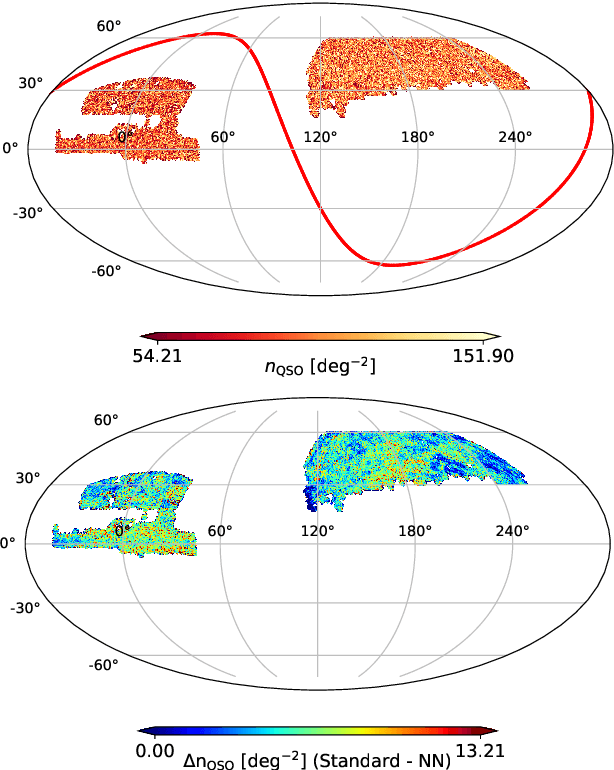
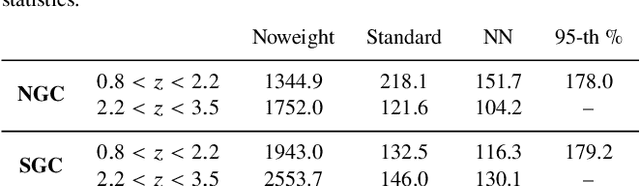
We investigate the large-scale clustering of the final spectroscopic sample of quasars from the recently completed extended Baryon Oscillation Spectroscopic Survey (eBOSS). The sample contains $343708$ objects in the redshift range $0.8<z<2.2$ and $72667$ objects with redshifts $2.2<z<3.5$, covering an effective area of $4699~{\rm deg}^{2}$. We develop a neural network-based approach to mitigate spurious fluctuations in the density field caused by spatial variations in the quality of the imaging data used to select targets for follow-up spectroscopy. Simulations are used with the same angular and radial distributions as the real data to estimate covariance matrices, perform error analyses, and assess residual systematic uncertainties. We measure the mean density contrast and cross-correlations of the eBOSS quasars against maps of potential sources of imaging systematics to address algorithm effectiveness, finding that the neural network-based approach outperforms standard linear regression. Stellar density is one of the most important sources of spurious fluctuations, and a new template constructed using data from the Gaia spacecraft provides the best match to the observed quasar clustering. The end-product from this work is a new value-added quasar catalogue with the improved weights to correct for nonlinear imaging systematic effects, which will be made public. Our quasar catalogue is used to measure the local-type primordial non-Gaussianity in our companion paper, Mueller et al. in preparation.