 Add to Chrome
 Add to Firefox
 Add to Edge
Replicating Human Motivated Reasoning Studies with LLMs
Jan 22, 2026
Motivated reasoning -- the idea that individuals processing information may be motivated to reach a certain conclusion, whether it be accurate or predetermined -- has been well-explored as a human phenomenon. However, it is unclear whether base LLMs mimic these motivational changes. Replicating 4 prior political motivated reasoning studies, we find that base LLM behavior does not align with expected human behavior. Furthermore, base LLM behavior across models shares some similarities, such as smaller standard deviations and inaccurate argument strength assessments. We emphasize the importance of these findings for researchers using LLMs to automate tasks such as survey data collection and argument assessment.

AI Can Enhance Creativity in Social Networks
Oct 20, 2024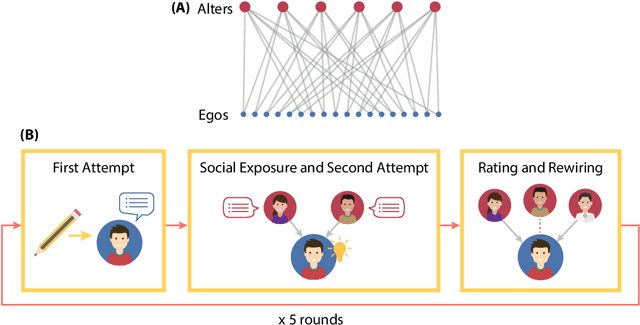


Can peer recommendation engines elevate people's creative performances in self-organizing social networks? Answering this question requires resolving challenges in data collection (e.g., tracing inspiration links and psycho-social attributes of nodes) and intervention design (e.g., balancing idea stimulation and redundancy in evolving information environments). We trained a model that predicts people's ideation performances using semantic and network-structural features in an online platform. Using this model, we built SocialMuse, which maximizes people's predicted performances to generate peer recommendations for them. We found treatment networks leveraging SocialMuse outperforming AI-agnostic control networks in several creativity measures. The treatment networks were more decentralized than the control, as SocialMuse increasingly emphasized network-structural features at large network sizes. This decentralization spreads people's inspiration sources, helping inspired ideas stand out better. Our study provides actionable insights into building intelligent systems for elevating creativity.