 Add to Chrome
 Add to Firefox
 Add to Edge
GNNs for Time Series Anomaly Detection: An Open-Source Framework and a Critical Evaluation
Mar 10, 2026
There is growing interest in applying graph-based methods to Time Series Anomaly Detection (TSAD), particularly Graph Neural Networks (GNNs), as they naturally model dependencies among multivariate signals. GNNs are typically used as backbones in score-based TSAD pipelines, where anomalies are identified through reconstruction or prediction errors followed by thresholding. However, and despite promising results, the field still lacks standardized frameworks for evaluation and suffers from persistent issues with metric design and interpretation. We thus present an open-source framework for TSAD using GNNs, designed to support reproducible experimentation across datasets, graph structures, and evaluation strategies. Built with flexibility and extensibility in mind, the framework facilitates systematic comparisons between TSAD models and enables in-depth analysis of performance and interpretability. Using this tool, we evaluate several GNN-based architectures alongside baseline models across two real-world datasets with contrasting structural characteristics. Our results show that GNNs not only improve detection performance but also offer significant gains in interpretability, an especially valuable feature for practical diagnosis. We also find that attention-based GNNs offer robustness when graph structure is uncertain or inferred. In addition, we reflect on common evaluation practices in TSAD, showing how certain metrics and thresholding strategies can obscure meaningful comparisons. Overall, this work contributes both practical tools and critical insights to advance the development and evaluation of graph-based TSAD systems.

Towards Foundation Auto-Encoders for Time-Series Anomaly Detection
Jul 02, 2025We investigate a novel approach to time-series modeling, inspired by the successes of large pretrained foundation models. We introduce FAE (Foundation Auto-Encoders), a foundation generative-AI model for anomaly detection in time-series data, based on Variational Auto-Encoders (VAEs). By foundation, we mean a model pretrained on massive amounts of time-series data which can learn complex temporal patterns useful for accurate modeling, forecasting, and detection of anomalies on previously unseen datasets. FAE leverages VAEs and Dilated Convolutional Neural Networks (DCNNs) to build a generic model for univariate time-series modeling, which could eventually perform properly in out-of-the-box, zero-shot anomaly detection applications. We introduce the main concepts of FAE, and present preliminary results in different multi-dimensional time-series datasets from various domains, including a real dataset from an operational mobile ISP, and the well known KDD 2021 Anomaly Detection dataset.
On the Usage of Generative Models for Network Anomaly Detection in Multivariate Time-Series
Oct 16, 2020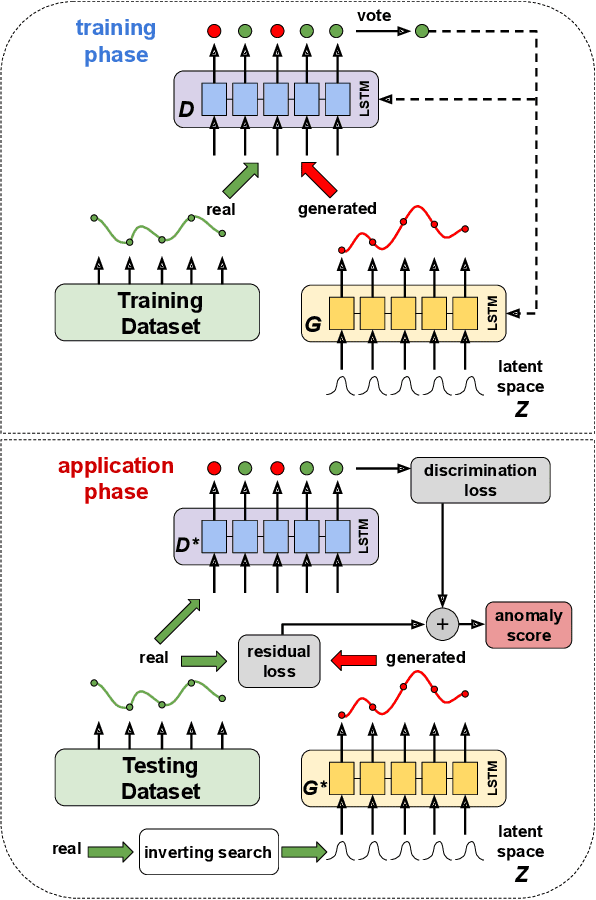

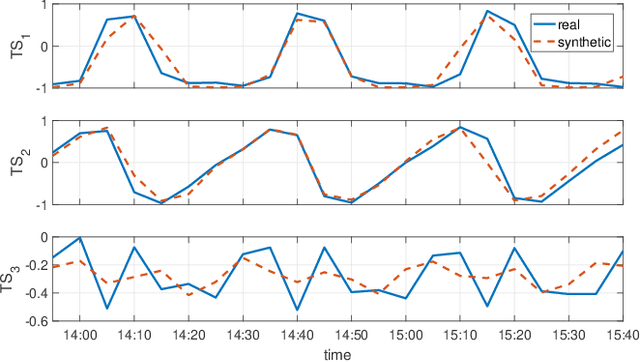

Despite the many attempts and approaches for anomaly detection explored over the years, the automatic detection of rare events in data communication networks remains a complex problem. In this paper we introduce Net-GAN, a novel approach to network anomaly detection in time-series, using recurrent neural networks (RNNs) and generative adversarial networks (GAN). Different from the state of the art, which traditionally focuses on univariate measurements, Net-GAN detects anomalies in multivariate time-series, exploiting temporal dependencies through RNNs. Net-GAN discovers the underlying distribution of the baseline, multivariate data, without making any assumptions on its nature, offering a powerful approach to detect anomalies in complex, difficult to model network monitoring data. We further exploit the concepts behind generative models to conceive Net-VAE, a complementary approach to Net-GAN for network anomaly detection, based on variational auto-encoders (VAE). We evaluate Net-GAN and Net-VAE in different monitoring scenarios, including anomaly detection in IoT sensor data, and intrusion detection in network measurements. Generative models represent a promising approach for network anomaly detection, especially when considering the complexity and ever-growing number of time-series to monitor in operational networks.