 Add to Chrome
 Add to Firefox
 Add to Edge
Expert Selections In MoE Models Reveal (Almost) As Much As Text
Feb 04, 2026
We present a text-reconstruction attack on mixture-of-experts (MoE) language models that recovers tokens from expert selections alone. In MoE models, each token is routed to a subset of expert subnetworks; we show these routing decisions leak substantially more information than previously understood. Prior work using logistic regression achieves limited reconstruction; we show that a 3-layer MLP improves this to 63.1% top-1 accuracy, and that a transformer-based sequence decoder recovers 91.2% of tokens top-1 (94.8% top-10) on 32-token sequences from OpenWebText after training on 100M tokens. These results connect MoE routing to the broader literature on embedding inversion. We outline practical leakage scenarios (e.g., distributed inference and side channels) and show that adding noise reduces but does not eliminate reconstruction. Our findings suggest that expert selections in MoE deployments should be treated as sensitive as the underlying text.

FLAASH: Flexible Accelerator Architecture for Sparse High-Order Tensor Contraction
Apr 25, 2024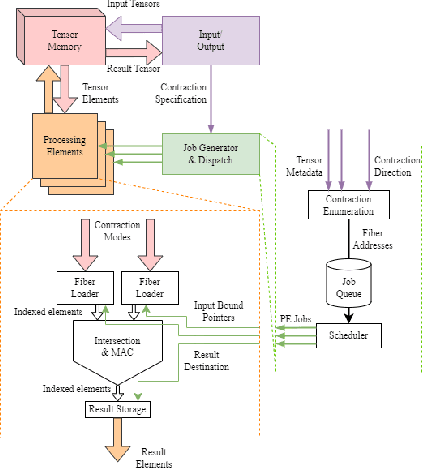
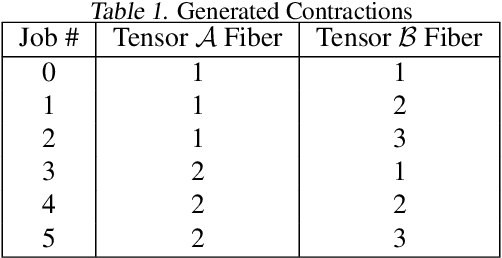
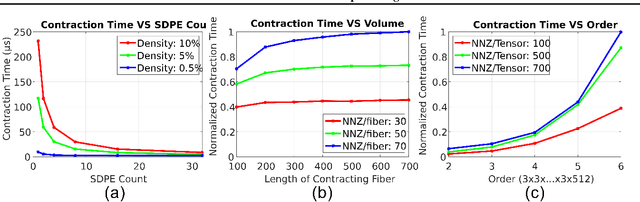
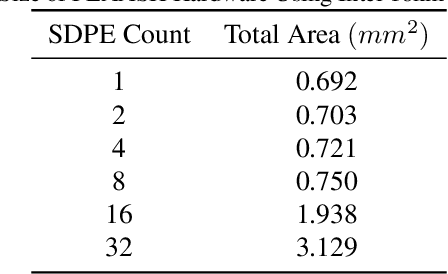
Tensors play a vital role in machine learning (ML) and often exhibit properties best explored while maintaining high-order. Efficiently performing ML computations requires taking advantage of sparsity, but generalized hardware support is challenging. This paper introduces FLAASH, a flexible and modular accelerator design for sparse tensor contraction that achieves over 25x speedup for a deep learning workload. Our architecture performs sparse high-order tensor contraction by distributing sparse dot products, or portions thereof, to numerous Sparse Dot Product Engines (SDPEs). Memory structure and job distribution can be customized, and we demonstrate a simple approach as a proof of concept. We address the challenges associated with control flow to navigate data structures, high-order representation, and high-sparsity handling. The effectiveness of our approach is demonstrated through various evaluations, showcasing significant speedup as sparsity and order increase.