 Add to Chrome
 Add to Firefox
 Add to Edge
FAConvLSTM: Factorized-Attention ConvLSTM for Efficient Feature Extraction in Multivariate Climate Data
Jan 16, 2026
Learning physically meaningful spatiotemporal representations from high-resolution multivariate Earth observation data is challenging due to strong local dynamics, long-range teleconnections, multi-scale interactions, and nonstationarity. While ConvLSTM2D is a commonly used baseline, its dense convolutional gating incurs high computational cost and its strictly local receptive fields limit the modeling of long-range spatial structure and disentangled climate dynamics. To address these limitations, we propose FAConvLSTM, a Factorized-Attention ConvLSTM layer designed as a drop-in replacement for ConvLSTM2D that simultaneously improves efficiency, spatial expressiveness, and physical interpretability. FAConvLSTM factorizes recurrent gate computations using lightweight [1 times 1] bottlenecks and shared depthwise spatial mixing, substantially reducing channel complexity while preserving recurrent dynamics. Multi-scale dilated depthwise branches and squeeze-and-excitation recalibration enable efficient modeling of interacting physical processes across spatial scales, while peephole connections enhance temporal precision. To capture teleconnection-scale dependencies without incurring global attention cost, FAConvLSTM incorporates a lightweight axial spatial attention mechanism applied sparsely in time. A dedicated subspace head further produces compact per timestep embeddings refined through temporal self-attention with fixed seasonal positional encoding. Experiments on multivariate spatiotemporal climate data shows superiority demonstrating that FAConvLSTM yields more stable, interpretable, and robust latent representations than standard ConvLSTM, while significantly reducing computational overhead.

B-TGAT: A Bi-directional Temporal Graph Attention Transformer for Clustering Multivariate Spatiotemporal Data
Sep 16, 2025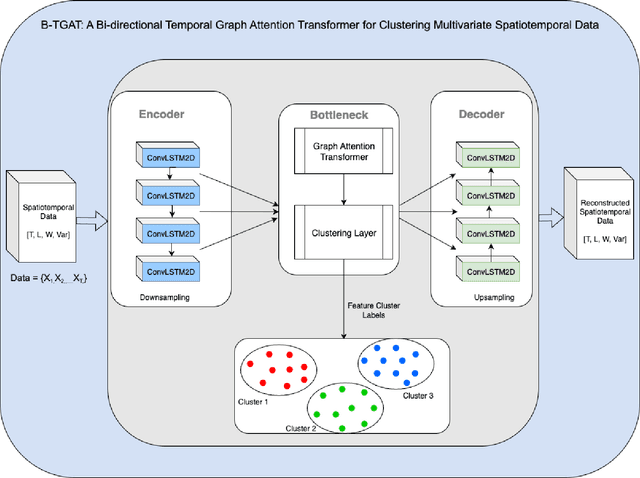
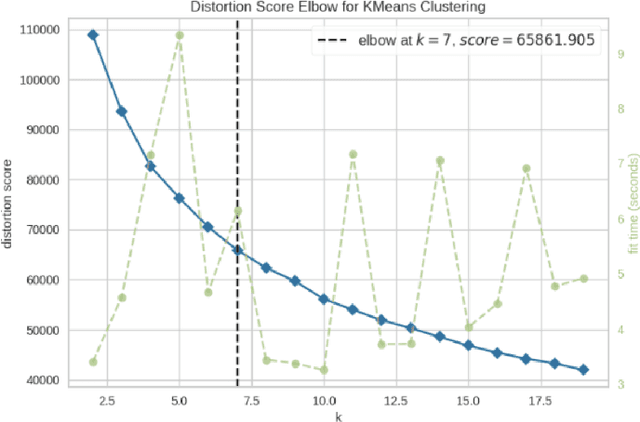
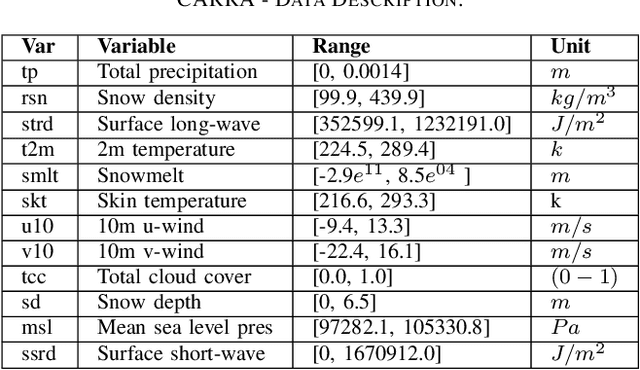
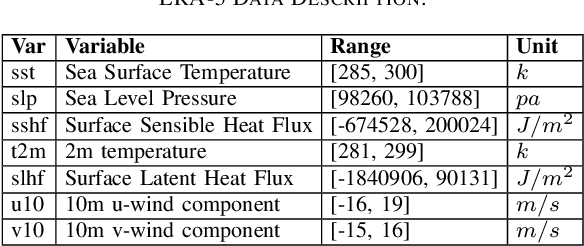
Clustering high-dimensional multivariate spatiotemporal climate data is challenging due to complex temporal dependencies, evolving spatial interactions, and non-stationary dynamics. Conventional clustering methods, including recurrent and convolutional models, often struggle to capture both local and global temporal relationships while preserving spatial context. We present a time-distributed hybrid U-Net autoencoder that integrates a Bi-directional Temporal Graph Attention Transformer (B-TGAT) to guide efficient temporal clustering of multidimensional spatiotemporal climate datasets. The encoder and decoder are equipped with ConvLSTM2D modules that extract joint spatial--temporal features by modeling localized dynamics and spatial correlations over time, and skip connections that preserve multiscale spatial details during feature compression and reconstruction. At the bottleneck, B-TGAT integrates graph-based spatial modeling with attention-driven temporal encoding, enabling adaptive weighting of temporal neighbors and capturing both short and long-range dependencies across regions. This architecture produces discriminative latent embeddings optimized for clustering. Experiments on three distinct spatiotemporal climate datasets demonstrate superior cluster separability, temporal stability, and alignment with known climate transitions compared to state-of-the-art baselines. The integration of ConvLSTM2D, U-Net skip connections, and B-TGAT enhances temporal clustering performance while providing interpretable insights into complex spatiotemporal variability, advancing both methodological development and climate science applications.
Deep Spatiotemporal Clustering: A Temporal Clustering Approach for Multi-dimensional Climate Data
Apr 27, 2023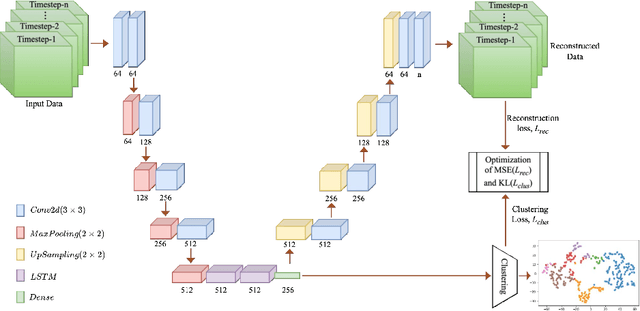
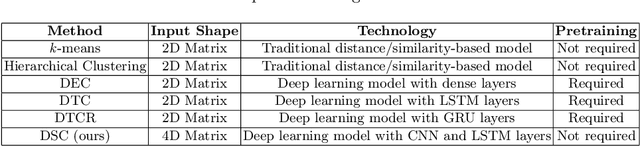
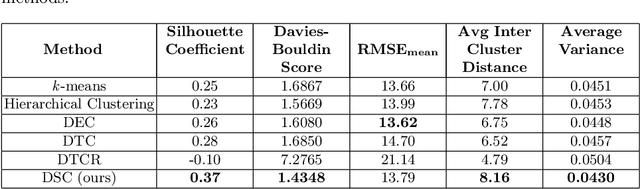
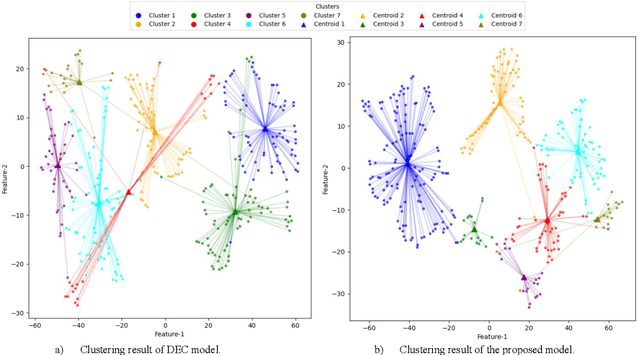
Clustering high-dimensional spatiotemporal data using an unsupervised approach is a challenging problem for many data-driven applications. Existing state-of-the-art methods for unsupervised clustering use different similarity and distance functions but focus on either spatial or temporal features of the data. Concentrating on joint deep representation learning of spatial and temporal features, we propose Deep Spatiotemporal Clustering (DSC), a novel algorithm for the temporal clustering of high-dimensional spatiotemporal data using an unsupervised deep learning method. Inspired by the U-net architecture, DSC utilizes an autoencoder integrating CNN-RNN layers to learn latent representations of the spatiotemporal data. DSC also includes a unique layer for cluster assignment on latent representations that uses the Student's t-distribution. By optimizing the clustering loss and data reconstruction loss simultaneously, the algorithm gradually improves clustering assignments and the nonlinear mapping between low-dimensional latent feature space and high-dimensional original data space. A multivariate spatiotemporal climate dataset is used to evaluate the efficacy of the proposed method. Our extensive experiments show our approach outperforms both conventional and deep learning-based unsupervised clustering algorithms. Additionally, we compared the proposed model with its various variants (CNN encoder, CNN autoencoder, CNN-RNN encoder, CNN-RNN autoencoder, etc.) to get insight into using both the CNN and RNN layers in the autoencoder, and our proposed technique outperforms these variants in terms of clustering results.