 Add to Chrome
 Add to Firefox
 Add to Edge
Cross-Modal Knowledge Distillation for PET-Free Amyloid-Beta Detection from MRI
Apr 14, 2026
Detecting amyloid-$β$ (A$β$) positivity is crucial for early diagnosis of Alzheimer's disease but typically requires PET imaging, which is costly, invasive, and not widely accessible, limiting its use for population-level screening. We address this gap by proposing a PET-guided knowledge distillation framework that enables A$β$ prediction from MRI alone, without requiring non-imaging clinical covariates or PET at inference. Our approach employs a BiomedCLIP-based teacher model that learns PET-MRI alignment via cross-modal attention and triplet contrastive learning with PET-informed (Centiloid-aware) online negative sampling. An MRI-only student then mimics the teacher via feature-level and logit-level distillation. Evaluated across four MRI contrasts (T1w, T2w, FLAIR, T2*) and two independent datasets, our approach demonstrates effective knowledge transfer (best AUC: 0.74 on OASIS-3, 0.68 on ADNI) while maintaining interpretability and eliminating the need for clinical variables. Saliency analysis confirms that predictions focus on anatomically relevant cortical regions, supporting the clinical viability of PET-free A$β$ screening. Code is available at https://github.com/FrancescoChiumento/pet-guided-mri-amyloid-detection.

Leveraging Multimodal Models for Enhanced Neuroimaging Diagnostics in Alzheimer's Disease
Nov 12, 2024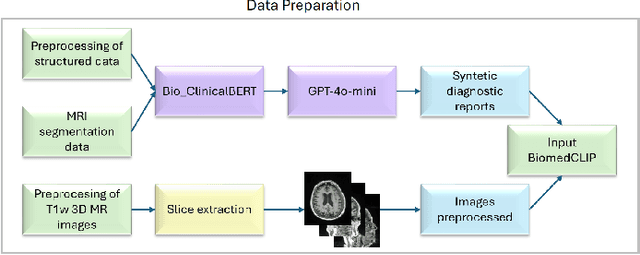
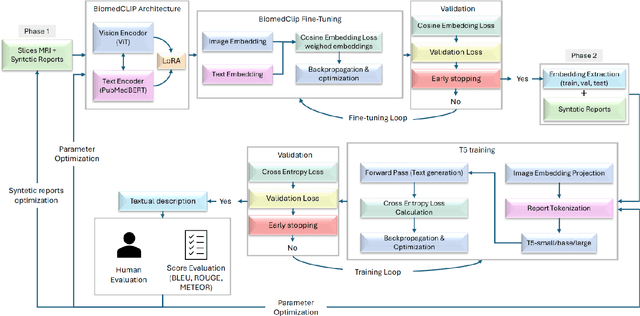
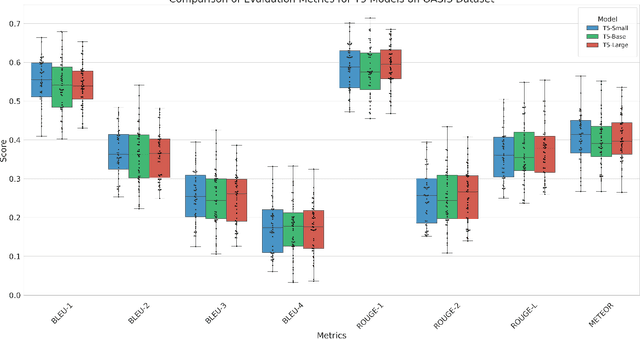

The rapid advancements in Large Language Models (LLMs) and Vision-Language Models (VLMs) have shown great potential in medical diagnostics, particularly in radiology, where datasets such as X-rays are paired with human-generated diagnostic reports. However, a significant research gap exists in the neuroimaging field, especially for conditions such as Alzheimer's disease, due to the lack of comprehensive diagnostic reports that can be utilized for model fine-tuning. This paper addresses this gap by generating synthetic diagnostic reports using GPT-4o-mini on structured data from the OASIS-4 dataset, which comprises 663 patients. Using the synthetic reports as ground truth for training and validation, we then generated neurological reports directly from the images in the dataset leveraging the pre-trained BiomedCLIP and T5 models. Our proposed method achieved a BLEU-4 score of 0.1827, ROUGE-L score of 0.3719, and METEOR score of 0.4163, revealing its potential in generating clinically relevant and accurate diagnostic reports.