 Add to Chrome
 Add to Firefox
 Add to Edge
Tournament Informed Adversarial Quality Diversity
Jan 27, 2026
Quality diversity (QD) is a branch of evolutionary computation that seeks high-quality and behaviorally diverse solutions to a problem. While adversarial problems are common, classical QD cannot be easily applied to them, as both the fitness and the behavior depend on the opposing solutions. Recently, Generational Adversarial MAP-Elites (GAME) has been proposed to coevolve both sides of an adversarial problem by alternating the execution of a multi-task QD algorithm against previous elites, called tasks. The original algorithm selects new tasks based on a behavioral criterion, which may lead to undesired dynamics due to inter-side dependencies. In addition, comparing sets of solutions cannot be done directly using classical QD measures due to side dependencies. In this paper, we (1) use an inter-variants tournament to compare the sets of solutions, ensuring a fair comparison, with 6 measures of quality and diversity, and (2) propose two tournament-informed task selection methods to promote higher quality and diversity at each generation. We evaluate the variants across three adversarial problems: Pong, a Cat-and-mouse game, and a Pursuers-and-evaders game. We show that the tournament-informed task selection method leads to higher adversarial quality and diversity. We hope that this work will help further advance adversarial quality diversity. Code, videos, and supplementary material are available at https://github.com/Timothee-ANNE/GAME_tournament_informed.

Adversarial Coevolutionary Illumination with Generational Adversarial MAP-Elites
May 10, 2025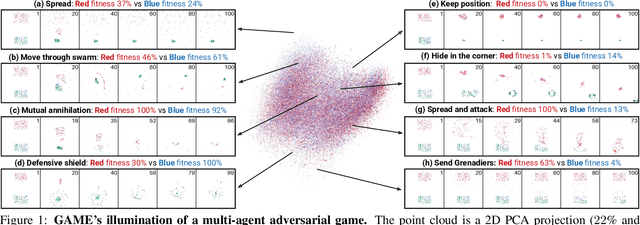

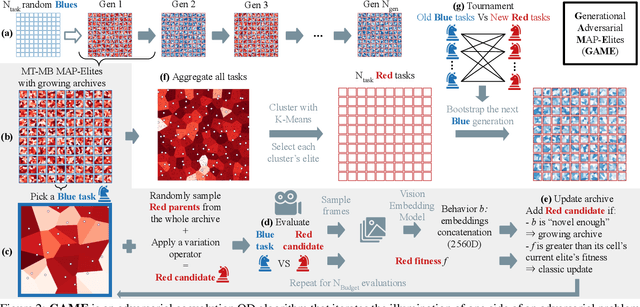
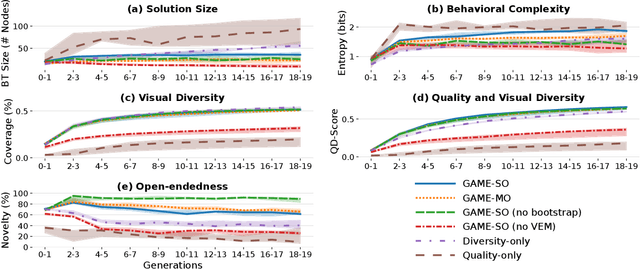
Unlike traditional optimization algorithms focusing on finding a single optimal solution, Quality-Diversity (QD) algorithms illuminate a search space by finding high-performing solutions that cover a specified behavior space. However, tackling adversarial problems is more challenging due to the behavioral interdependence between opposing sides. Most applications of QD algorithms to these problems evolve only one side, thus reducing illumination coverage. In this paper, we propose a new QD algorithm, Generational Adversarial MAP-Elites (GAME), which coevolves solutions by alternating sides through a sequence of generations. Combining GAME with vision embedding models enables the algorithm to directly work from videos of behaviors instead of handcrafted descriptors. Some key findings are that (1) emerging evolutionary dynamics sometimes resemble an arms race, (2) starting each generation from scratch increases open-endedness, and (3) keeping neutral mutations preserves stepping stones that seem necessary to reach the highest performance. In conclusion, the results demonstrate that GAME can successfully illuminate an adversarial multi-agent game, opening up interesting future directions in understanding the emergence of open-ended coevolution.
Harnessing Language for Coordination: A Framework and Benchmark for LLM-Driven Multi-Agent Control
Dec 16, 2024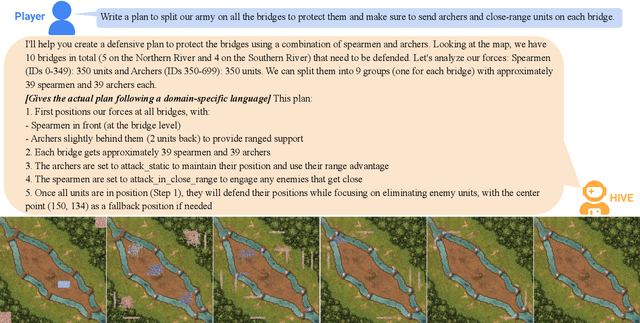
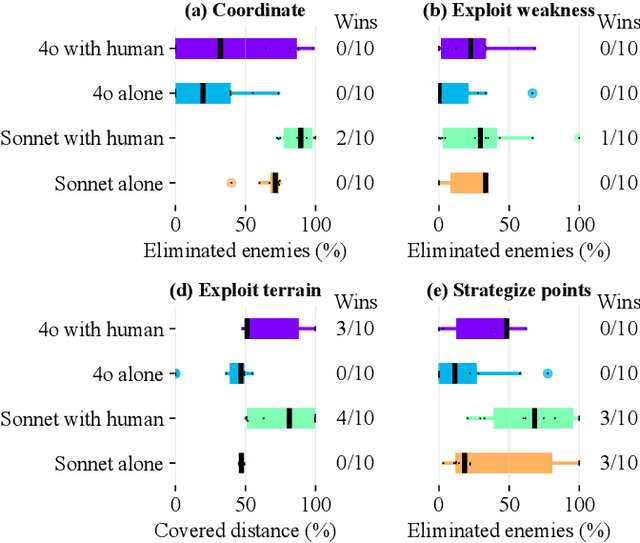
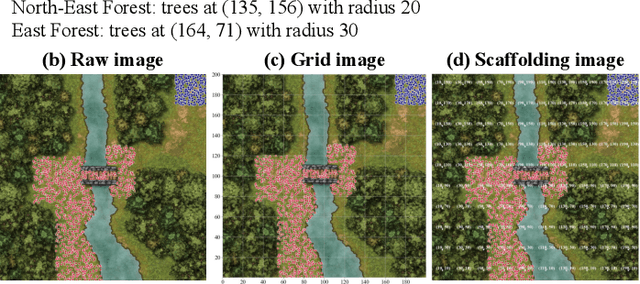
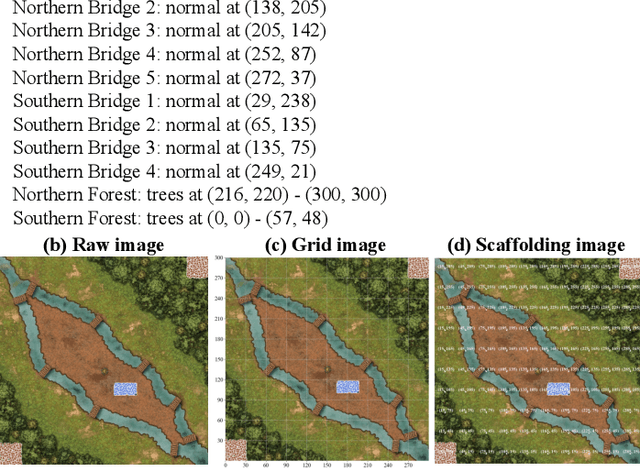
Large Language Models (LLMs) have demonstrated remarkable performance across various tasks. A promising but largely under-explored area is their potential to facilitate human coordination with many agents. Such capabilities would be useful in domains including disaster response, urban planning, and real-time strategy scenarios. In this work, we introduce (1) a real-time strategy game benchmark designed to evaluate these abilities and (2) a novel framework we term HIVE. HIVE empowers a single human to coordinate swarms of up to 2,000 agents using natural language dialog with an LLM. We present promising results on this multi-agent benchmark, with our hybrid approach solving tasks such as coordinating agent movements, exploiting unit weaknesses, leveraging human annotations, and understanding terrain and strategic points. However, our findings also highlight critical limitations of current models, including difficulties in processing spatial visual information and challenges in formulating long-term strategic plans. This work sheds light on the potential and limitations of LLMs in human-swarm coordination, paving the way for future research in this area. The HIVE project page, which includes videos of the system in action, can be found here: hive.syrkis.com.