 Add to Chrome
 Add to Firefox
 Add to Edge
Privacy-Utility Tradeoffs in Quantum Information Processing
Feb 11, 2026
When sensitive information is encoded in data, it is important to ensure the privacy of information when attempting to learn useful information from the data. There is a natural tradeoff whereby increasing privacy requirements may decrease the utility of a learning protocol. In the quantum setting of differential privacy, such tradeoffs between privacy and utility have so far remained largely unexplored. In this work, we study optimal privacy-utility tradeoffs for both generic and application-specific utility metrics when privacy is quantified by $(\varepsilon,δ)$-quantum local differential privacy. In the generic setting, we focus on optimizing fidelity and trace distance between the original state and the privatized state. We show that the depolarizing mechanism achieves the optimal utility for given privacy requirements. We then study the specific application of learning the expectation of an observable with respect to an input state when only given access to privatized states. We derive a lower bound on the number of samples of privatized data required to achieve a fixed accuracy guarantee with high probability. To prove this result, we employ existing lower bounds on private quantum hypothesis testing, thus showcasing the first operational use of them. We also devise private mechanisms that achieve optimal sample complexity with respect to the privacy parameters and accuracy parameters, demonstrating that utility can be significantly improved for specific tasks in contrast to the generic setting. In addition, we show that the number of samples required to privately learn observable expectation values scales as $Θ((\varepsilon β)^{-2})$, where $\varepsilon \in (0,1)$ is the privacy parameter and $β$ is the accuracy tolerance. We conclude by initiating the study of private classical shadows, which promise useful applications for private learning tasks.

Quantum Codes from Neural Networks
Jun 22, 2018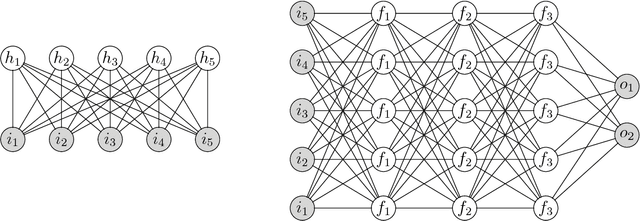
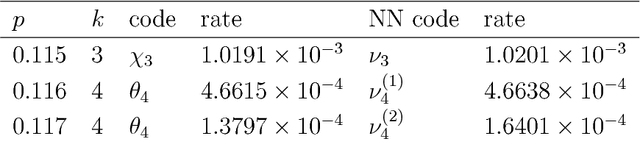


We report on the usefulness of using neural networks as a variational state ansatz for many-body quantum systems in the context of quantum information-processing tasks. In the neural network state ansatz, the complex amplitude function of a quantum state is computed by a neural network. The resulting multipartite entanglement structure captured by this ansatz has proven rich enough to describe the ground states and unitary dynamics of various physical systems of interest. In the present paper, we supply further evidence for the usefulness of neural network states to describe multipartite entanglement. We demonstrate that neural network states are capable of efficiently representing quantum codes for quantum information transmission and quantum error correction. In particular, we show that a) neural network states yield quantum codes with a high coherent information for two important quantum channels, the depolarizing channel and the dephrasure channel; b) neural network states can be used to represent absolutely maximally entangled states, a special type of quantum error correction codes. In both cases, the neural network state ansatz provides an efficient and versatile means as variational parametrization of these states.