 Add to Chrome
 Add to Firefox
 Add to Edge
SEAFormer: A Spatial Proximity and Edge-Aware Transformer for Real-World Vehicle Routing Problems
Jan 27, 2026
Real-world Vehicle Routing Problems (RWVRPs) require solving complex, sequence-dependent challenges at scale with constraints such as delivery time window, replenishment or recharging stops, asymmetric travel cost, etc. While recent neural methods achieve strong results on large-scale classical VRP benchmarks, they struggle to address RWVRPs because their strategies overlook sequence dependencies and underutilize edge-level information, which are precisely the characteristics that define the complexity of RWVRPs. We present SEAFormer, a novel transformer that incorporates both node-level and edge-level information in decision-making through two key innovations. First, our Clustered Proximity Attention (CPA) exploits locality-aware clustering to reduce the complexity of attention from $O(n^2)$ to $O(n)$ while preserving global perspective, allowing SEAFormer to efficiently train on large instances. Second, our lightweight edge-aware module captures pairwise features through residual fusion, enabling effective incorporation of edge-based information and faster convergence. Extensive experiments across four RWVRP variants with various scales demonstrate that SEAFormer achieves superior results over state-of-the-art methods. Notably, SEAFormer is the first neural method to solve 1,000+ node RWVRPs effectively, while also achieving superior performance on classic VRPs, making it a versatile solution for both research benchmarks and real-world applications.

DeepMDV: Learning Global Matching for Multi-depot Vehicle Routing Problems
Nov 26, 2024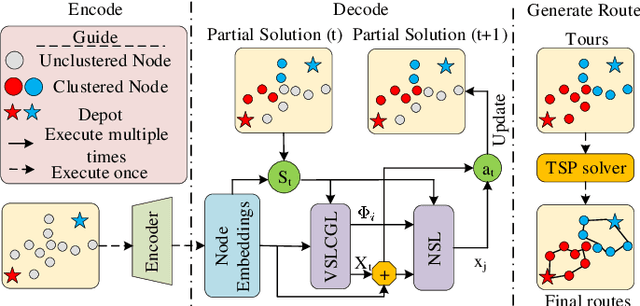
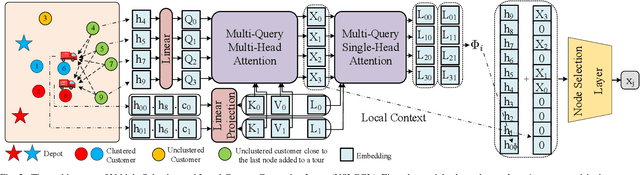
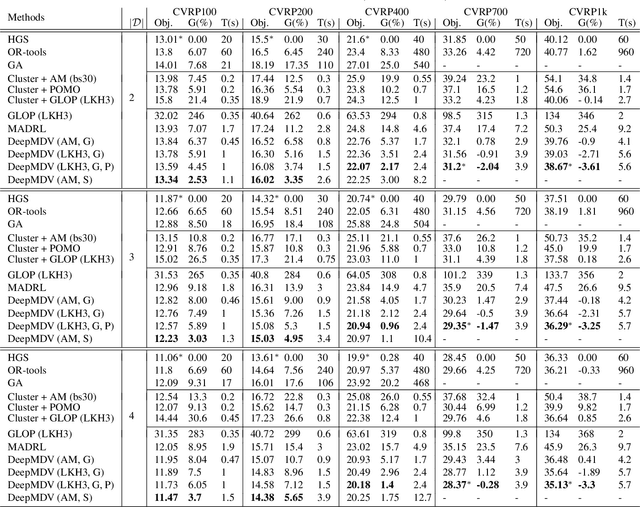
Due to the substantial rise in online retail and e-commerce in recent years, the demand for efficient and fast solutions to Vehicle Routing Problems (VRP) has become critical. To manage the increasing demand, companies have adopted the strategy of adding more depots. However, the presence of multiple depots introduces additional complexities, making existing VRP solutions suboptimal for addressing the Multi-depot Vehicle Routing Problem (MDVRP). Traditional methods for solving the MDVRP often require significant computation time, making them unsuitable for large-scale instances. Additionally, existing learning-based solutions for the MDVRP struggle with generalizability and fail to deliver high-quality results for scenarios involving a large number of customers. In this paper, we propose a novel solution for MDVRP. Our approach employs an attention mechanism, featuring a decoder with two key layers: one layer to consider the states of all vehicles and learn to select the most suitable vehicle based on the proximity of unassigned customers, and another layer to focus on assigning a customer to the selected vehicle. This approach delivers high-quality solutions for large-scale MDVRP instances and demonstrates remarkable generalizability across varying numbers of customers and depots. Its adaptability and performance make it a practical and deployable solution for real-world logistics challenges.