 Add to Chrome
 Add to Firefox
 Add to Edge
FFE-Hallu:Hallucinations in Fixed Figurative Expressions:Benchmark of Idioms and Proverbs in the Persian Language
Jan 27, 2026
Figurative language, particularly fixed figurative expressions (FFEs) such as idioms and proverbs, poses persistent challenges for large language models (LLMs). Unlike literal phrases, FFEs are culturally grounded, largely non-compositional, and conventionally fixed, making them especially vulnerable to figurative hallucination. We define figurative hallucination as the generation or endorsement of expressions that sound idiomatic and plausible but do not exist as authentic figurative expressions in the target language. We introduce FFEHallu, the first comprehensive benchmark for evaluating figurative hallucination in LLMs, with a focus on Persian, a linguistically rich yet underrepresented language. FFEHallu consists of 600 carefully curated instances spanning three complementary tasks: (i) FFE generation from meaning, (ii) detection of fabricated FFEs across four controlled construction categories, and (iii) FFE to FFE translation from English to Persian. Evaluating six state of the art multilingual LLMs, we find systematic weaknesses in figurative competence and cultural grounding. While models such as GPT4.1 demonstrate relatively strong performance in rejecting fabricated FFEs and retrieving authentic ones, most models struggle to reliably distinguish real expressions from high quality fabrications and frequently hallucinate during cross lingual translation. These findings reveal substantial gaps in current LLMs handling of figurative language and underscore the need for targeted benchmarks to assess and mitigate figurative hallucination.

A Comparative Study of LLMs, NMT Models, and Their Combination in Persian-English Idiom Translation
Dec 13, 2024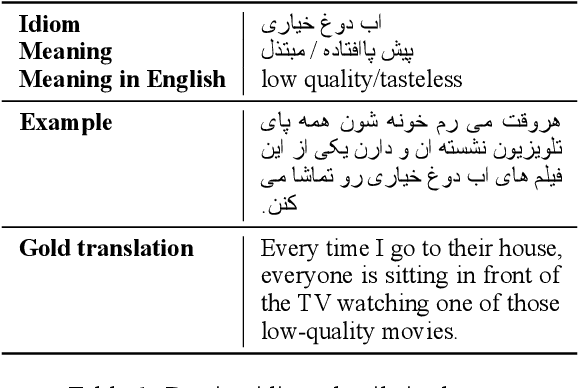
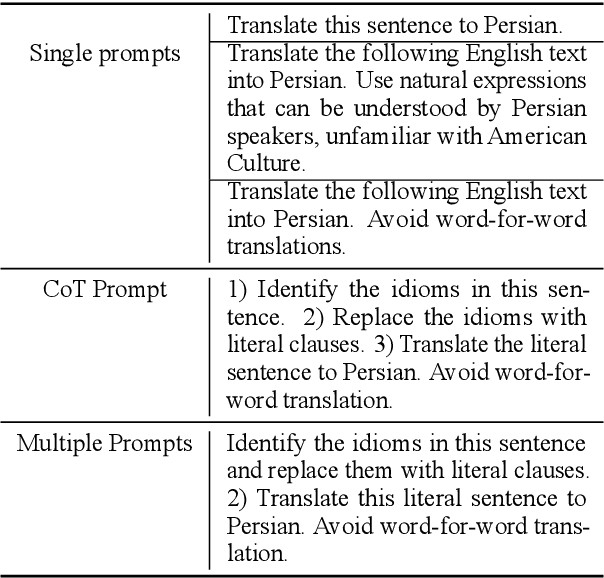
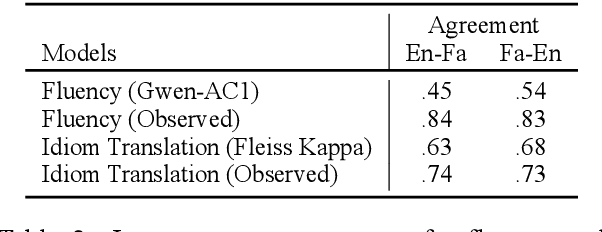
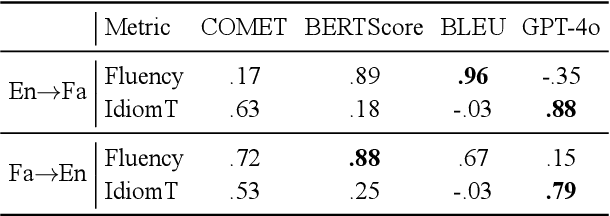
Large language models (LLMs) have shown superior capabilities in translating figurative language compared to neural machine translation (NMT) systems. However, the impact of different prompting methods and LLM-NMT combinations on idiom translation has yet to be thoroughly investigated. This paper introduces two parallel datasets of sentences containing idiomatic expressions for Persian$\rightarrow$English and English$\rightarrow$Persian translations, with Persian idioms sampled from our PersianIdioms resource, a collection of 2,200 idioms and their meanings. Using these datasets, we evaluate various open- and closed-source LLMs, NMT models, and their combinations. Translation quality is assessed through idiom translation accuracy and fluency. We also find that automatic evaluation methods like LLM-as-a-judge, BLEU and BERTScore are effective for comparing different aspects of model performance. Our experiments reveal that Claude-3.5-Sonnet delivers outstanding results in both translation directions. For English$\rightarrow$Persian, combining weaker LLMs with Google Translate improves results, while Persian$\rightarrow$English translations benefit from single prompts for simpler models and complex prompts for advanced ones.