 Add to Chrome
 Add to Firefox
 Add to Edge
Engineering AI Agents for Clinical Workflows: A Case Study in Architecture,MLOps, and Governance
Jan 31, 2026
The integration of Artificial Intelligence (AI) into clinical settings presents a software engineering challenge, demanding a shift from isolated models to robust, governable, and reliable systems. However, brittle, prototype-derived architectures often plague industrial applications and a lack of systemic oversight, creating a ``responsibility vacuum'' where safety and accountability are compromised. This paper presents an industry case study of the ``Maria'' platform, a production-grade AI system in primary healthcare that addresses this gap. Our central hypothesis is that trustworthy clinical AI is achieved through the holistic integration of four foundational engineering pillars. We present a synergistic architecture that combines Clean Architecture for maintainability with an Event-driven architecture for resilience and auditability. We introduce the Agent as the primary unit of modularity, each possessing its own autonomous MLOps lifecycle. Finally, we show how a Human-in-the-Loop governance model is technically integrated not merely as a safety check, but as a critical, event-driven data source for continuous improvement. We present the platform as a reference architecture, offering practical lessons for engineers building maintainable, scalable, and accountable AI-enabled systems in high-stakes domains.

A Novel Two-Step Fine-Tuning Pipeline for Cold-Start Active Learning in Text Classification Tasks
Jul 24, 2024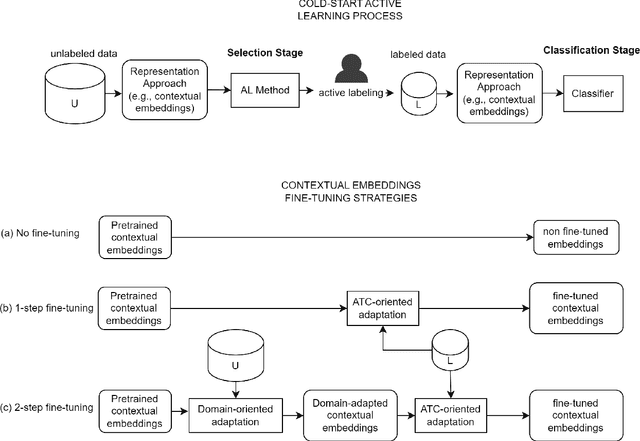
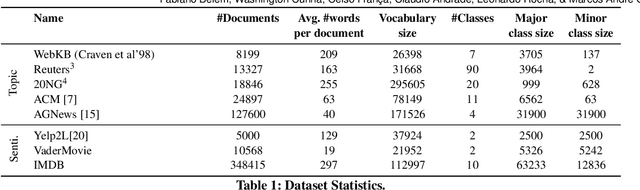
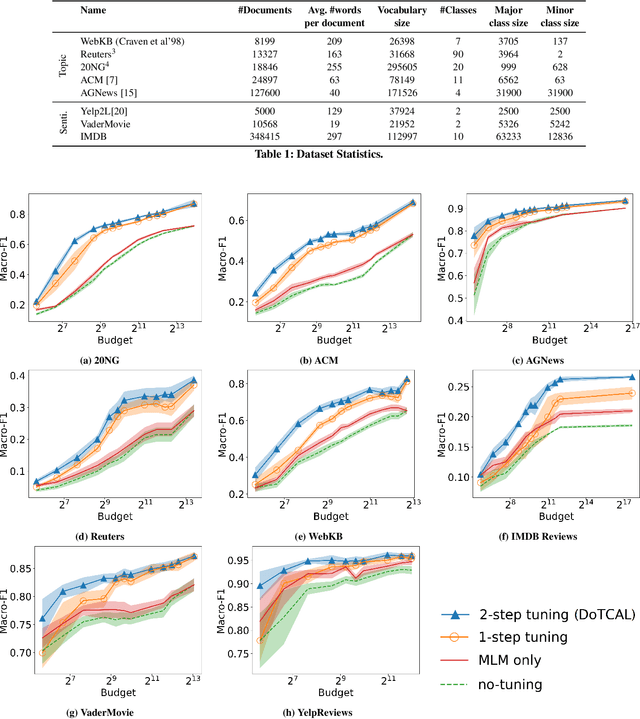
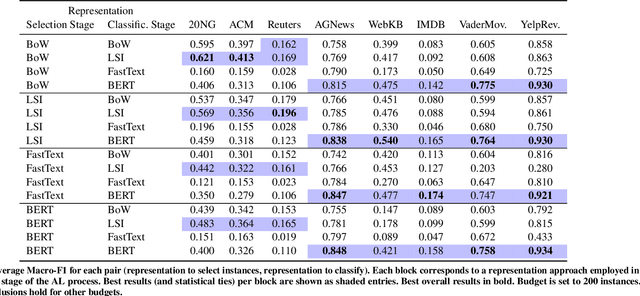
This is the first work to investigate the effectiveness of BERT-based contextual embeddings in active learning (AL) tasks on cold-start scenarios, where traditional fine-tuning is infeasible due to the absence of labeled data. Our primary contribution is the proposal of a more robust fine-tuning pipeline - DoTCAL - that diminishes the reliance on labeled data in AL using two steps: (1) fully leveraging unlabeled data through domain adaptation of the embeddings via masked language modeling and (2) further adjusting model weights using labeled data selected by AL. Our evaluation contrasts BERT-based embeddings with other prevalent text representation paradigms, including Bag of Words (BoW), Latent Semantic Indexing (LSI), and FastText, at two critical stages of the AL process: instance selection and classification. Experiments conducted on eight ATC benchmarks with varying AL budgets (number of labeled instances) and number of instances (about 5,000 to 300,000) demonstrate DoTCAL's superior effectiveness, achieving up to a 33% improvement in Macro-F1 while reducing labeling efforts by half compared to the traditional one-step method. We also found that in several tasks, BoW and LSI (due to information aggregation) produce results superior (up to 59% ) to BERT, especially in low-budget scenarios and hard-to-classify tasks, which is quite surprising.