 Add to Chrome
 Add to Firefox
 Add to Edge
Memory-Efficient FPGA Implementation of Stochastic Simulated Annealing
Jan 25, 2026
Simulated annealing (SA) is a well-known algorithm for solving combinatorial optimization problems. However, the computation time of SA increases rapidly, as the size of the problem grows. Recently, a stochastic simulated annealing (SSA) algorithm that converges faster than conventional SA has been reported. In this paper, we present a hardware-aware SSA (HA- SSA) algorithm for memory-efficient FPGA implementations. HA-SSA can reduce the memory usage of storing intermediate results while maintaining the computing speed of SSA. For evaluation purposes, the proposed algorithm is compared with the conventional SSA and SA approaches on maximum cut combinatorial optimization problems. HA-SSA achieves a convergence speed that is up to 114-times faster than that of the conventional SA algorithm depending on the maximum cut problem selected from the G-set which is a dataset of the maximum cut problems. HA-SSA is implemented on a field-programmable gate array (FPGA) (Xilinx Kintex-7), and it achieves up to 6-times the memory efficiency of conventional SSA while maintaining high solution quality for optimization problems.

Local Energy Distribution Based Hyperparameter Determination for Stochastic Simulated Annealing
Apr 24, 2023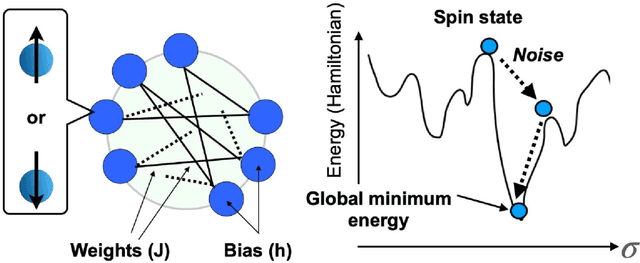
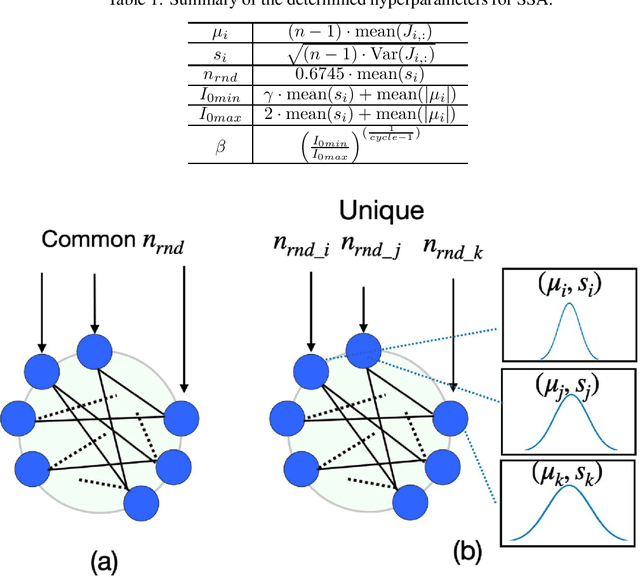
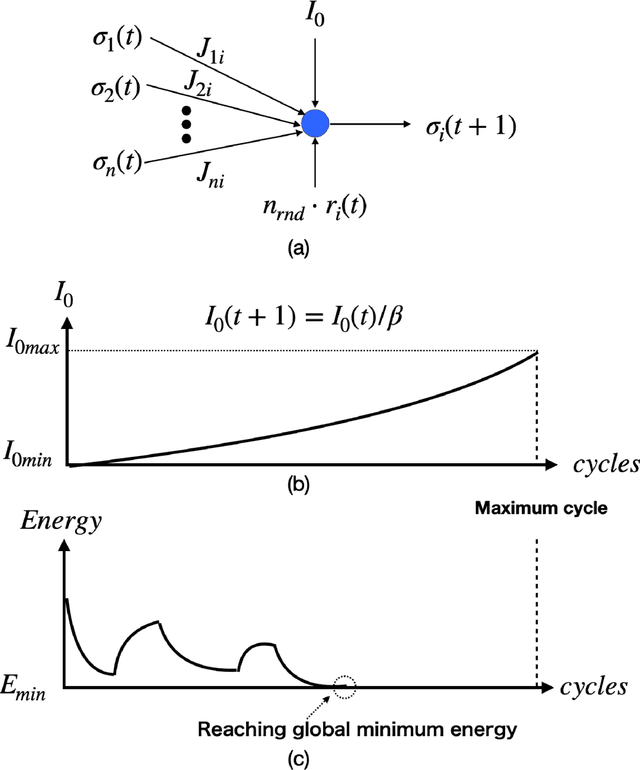
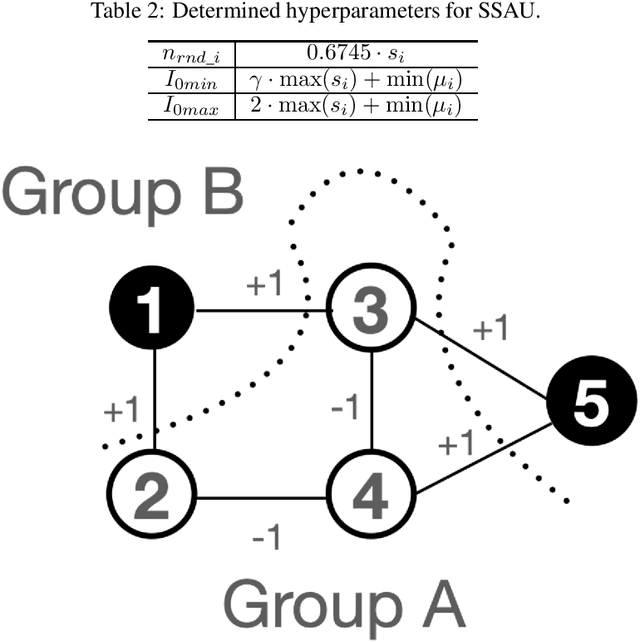
This paper presents a local energy distribution based hyperparameter determination for stochastic simulated annealing (SSA). SSA is capable of solving combinatorial optimization problems faster than typical simulated annealing (SA), but requires a time-consuming hyperparameter search. The proposed method determines hyperparameters based on the local energy distributions of spins (probabilistic bits). The spin is a basic computing element of SSA and is graphically connected to other spins with its weights. The distribution of the local energy can be estimated based on the central limit theorem (CLT). The CLT-based normal distribution is used to determine the hyperparameters, which reduces the time complexity for hyperparameter search from O(n^3) of the conventional method to O(1). The performance of SSA with the determined hyperparameters is evaluated on the Gset and K2000 benchmarks for maximum-cut problems. The results show that the proposed method achieves mean cut values of approximately 98% of the best-known cut values.