 Add to Chrome
 Add to Firefox
 Add to Edge
Toward Controllable Catalyst Inverse Design via Large-Scale Autoregressive Pretraining
Jun 16, 2026
Inverse design of heterogeneous catalysts remains challenging because catalyst surfaces exhibit substantial structural complexity with coupled surface-adsorbate interactions across a vast chemical space that is difficult to explore efficiently through conventional screening alone. Although machine learning-based high-throughput screening has accelerated catalyst discovery, its efficiency inevitably declines as the search space grows, motivating the development of generative models that can directly construct catalysts with target properties. Here, we present a conditional catalyst generative model based on the Generative Pretrained Transformer architecture with a numerical embedding layer that enables the generation of catalyst structures conditioned on both categorical and continuous properties within a single autoregressive framework. The model was pretrained on 133 million catalyst structures and subsequently fine-tuned on approximately 460,000 optimized structures with associated categorical properties and binding energies for conditional generation. The resulting model achieved 98% structural validity, 95% optimization validity, and high categorical condition fidelity, with a 93 % joint match rate for adsorbate type and composition. For binding energy conditioning, the match rate of approximately 20% represents a four-fold improvement over the baseline training distribution, and the generated distributions shift systematically toward the target values, enabling a 1.5 to 4-fold improvement in screening efficiency for reaction-targeted catalyst discovery without additional fine-tuning. These results show that large-scale autoregressive pre-training, combined with explicit property conditioning, provides a practical route toward controllable catalyst generation and accelerated catalysts discovery.

Reasoning-Driven Design of Single Atom Catalysts via a Multi-Agent Large Language Model Framework
Feb 25, 2026Large language models (LLMs) are becoming increasingly applied beyond natural language processing, demonstrating strong capabilities in complex scientific tasks that traditionally require human expertise. This progress has extended into materials discovery, where LLMs introduce a new paradigm by leveraging reasoning and in-context learning, capabilities absent from conventional machine learning approaches. Here, we present a Multi-Agent-based Electrocatalyst Search Through Reasoning and Optimization (MAESTRO) framework in which multiple LLMs with specialized roles collaboratively discover high-performance single atom catalysts for the oxygen reduction reaction. Within an autonomous design loop, agents iteratively reason, propose modifications, reflect on results and accumulate design history. Through in-context learning enabled by this iterative process, MAESTRO identified design principles not explicitly encoded in the LLMs' background knowledge and successfully discovered catalysts that break conventional scaling relations between reaction intermediates. These results highlight the potential of multi-agent LLM frameworks as a powerful strategy to generate chemical insight and discover promising catalysts.
Generative Language Model for Catalyst Discovery
Jul 19, 2024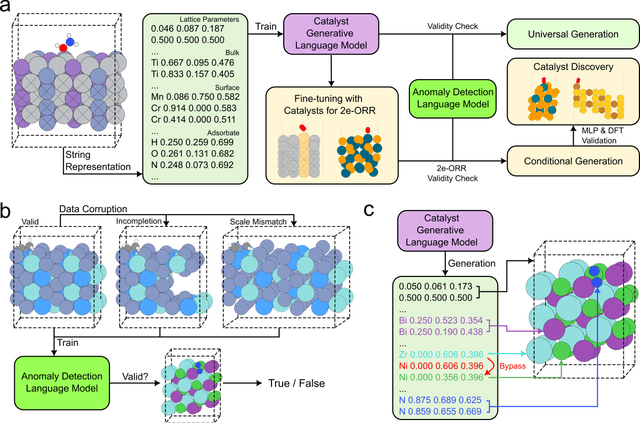


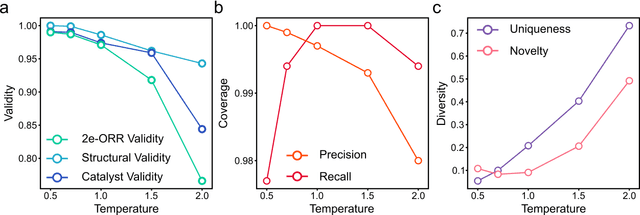
Discovery of novel and promising materials is a critical challenge in the field of chemistry and material science, traditionally approached through methodologies ranging from trial-and-error to machine learning-driven inverse design. Recent studies suggest that transformer-based language models can be utilized as material generative models to expand chemical space and explore materials with desired properties. In this work, we introduce the Catalyst Generative Pretrained Transformer (CatGPT), trained to generate string representations of inorganic catalyst structures from a vast chemical space. CatGPT not only demonstrates high performance in generating valid and accurate catalyst structures but also serves as a foundation model for generating desired types of catalysts by fine-tuning with sparse and specified datasets. As an example, we fine-tuned the pretrained CatGPT using a binary alloy catalyst dataset designed for screening two-electron oxygen reduction reaction (2e-ORR) catalyst and generate catalyst structures specialized for 2e-ORR. Our work demonstrates the potential of language models as generative tools for catalyst discovery.