 Add to Chrome
 Add to Firefox
 Add to Edge
SAR-RAG: ATR Visual Question Answering by Semantic Search, Retrieval, and MLLM Generation
Feb 04, 2026
We present a visual-context image retrieval-augmented generation (ImageRAG) assisted AI agent for automatic target recognition (ATR) of synthetic aperture radar (SAR). SAR is a remote sensing method used in defense and security applications to detect and monitor the positions of military vehicles, which may appear indistinguishable in images. Researchers have extensively studied SAR ATR to improve the differentiation and identification of vehicle types, characteristics, and measurements. Test examples can be compared with known vehicle target types to improve recognition tasks. New methods enhance the capabilities of neural networks, transformer attention, and multimodal large language models. An agentic AI method may be developed to utilize a defined set of tools, such as searching through a library of similar examples. Our proposed method, SAR Retrieval-Augmented Generation (SAR-RAG), combines a multimodal large language model (MLLM) with a vector database of semantic embeddings to support contextual search for image exemplars with known qualities. By recovering past image examples with known true target types, our SAR-RAG system can compare similar vehicle categories, achieving improved ATR prediction accuracy. We evaluate this through search and retrieval metrics, categorical classification accuracy, and numeric regression of vehicle dimensions. These metrics all show improvements when SAR-RAG is added to an MLLM baseline method as an attached ATR memory bank.

Infrared Computer Vision for Utility-Scale Photovoltaic Array Inspection
Jun 29, 2024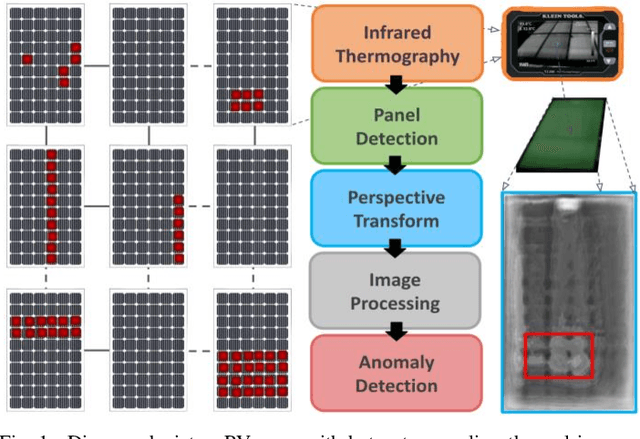
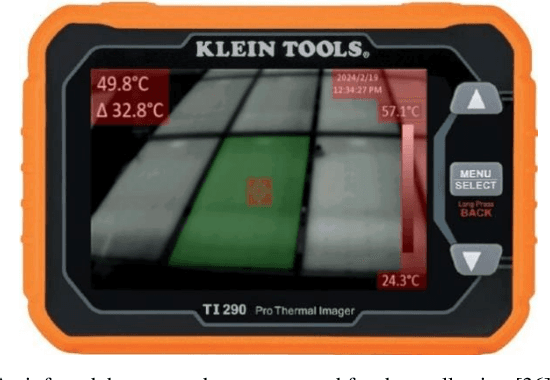
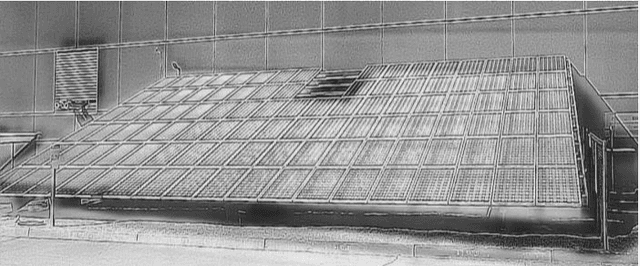
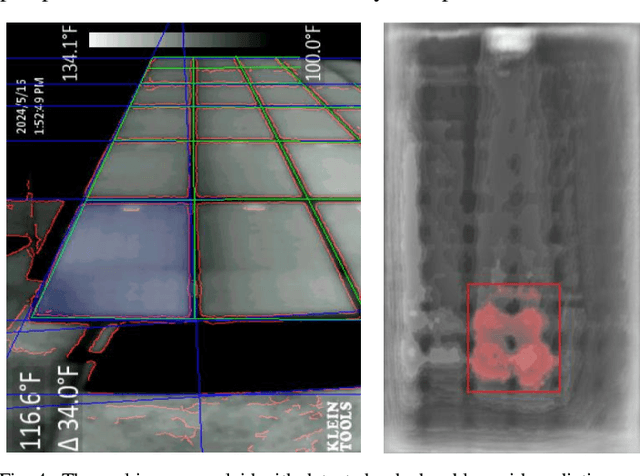
Utility-scale solar arrays require specialized inspection methods for detecting faulty panels. Photovoltaic (PV) panel faults caused by weather, ground leakage, circuit issues, temperature, environment, age, and other damage can take many forms but often symptomatically exhibit temperature differences. Included is a mini survey to review these common faults and PV array fault detection approaches. Among these, infrared thermography cameras are a powerful tool for improving solar panel inspection in the field. These can be combined with other technologies, including image processing and machine learning. This position paper examines several computer vision algorithms that automate thermal anomaly detection in infrared imagery. We demonstrate our infrared thermography data collection approach, the PV thermal imagery benchmark dataset, and the measured performance of image processing transformations, including the Hough Transform for PV segmentation. The results of this implementation are presented with a discussion of future work.