 Add to Chrome
 Add to Firefox
 Add to Edge
Anomaly detection in satellite imagery through temporal inpainting
Dec 30, 2025
Detecting surface changes from satellite imagery is critical for rapid disaster response and environmental monitoring, yet remains challenging due to the complex interplay between atmospheric noise, seasonal variations, and sensor artifacts. Here we show that deep learning can leverage the temporal redundancy of satellite time series to detect anomalies at unprecedented sensitivity, by learning to predict what the surface should look like in the absence of change. We train an inpainting model built upon the SATLAS foundation model to reconstruct the last frame of a Sentinel-2 time series from preceding acquisitions, using globally distributed training data spanning diverse climate zones and land cover types. When applied to regions affected by sudden surface changes, the discrepancy between prediction and observation reveals anomalies that traditional change detection methods miss. We validate our approach on earthquake-triggered surface ruptures from the 2023 Turkey-Syria earthquake sequence, demonstrating detection of a rift feature in Tepehan with higher sensitivity and specificity than temporal median or Reed-Xiaoli anomaly detectors. Our method reaches detection thresholds approximately three times lower than baseline approaches, providing a path towards automated, global-scale monitoring of surface changes from freely available multi-spectral satellite data.

Diffusion Models for Interferometric Satellite Aperture Radar
Aug 31, 2023Probabilistic Diffusion Models (PDMs) have recently emerged as a very promising class of generative models, achieving high performance in natural image generation. However, their performance relative to non-natural images, like radar-based satellite data, remains largely unknown. Generating large amounts of synthetic (and especially labelled) satellite data is crucial to implement deep-learning approaches for the processing and analysis of (interferometric) satellite aperture radar data. Here, we leverage PDMs to generate several radar-based satellite image datasets. We show that PDMs succeed in generating images with complex and realistic structures, but that sampling time remains an issue. Indeed, accelerated sampling strategies, which work well on simple image datasets like MNIST, fail on our radar datasets. We provide a simple and versatile open-source https://github.com/thomaskerdreux/PDM_SAR_InSAR_generation to train, sample and evaluate PDMs using any dataset on a single GPU.
Autonomous Detection of Methane Emissions in Multispectral Satellite Data Using Deep Learning
Aug 21, 2023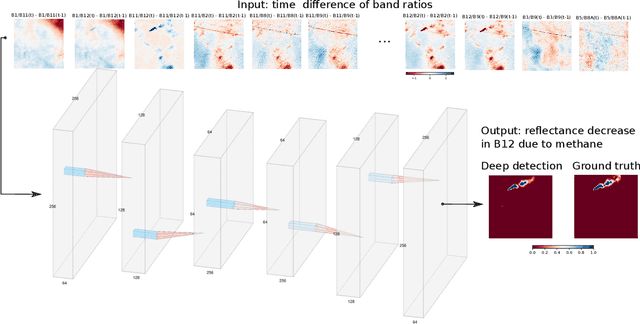
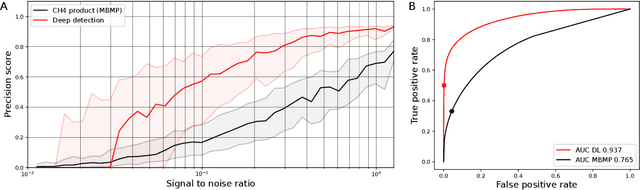
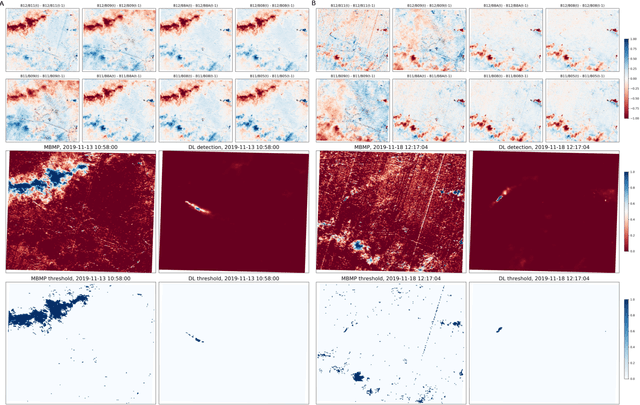
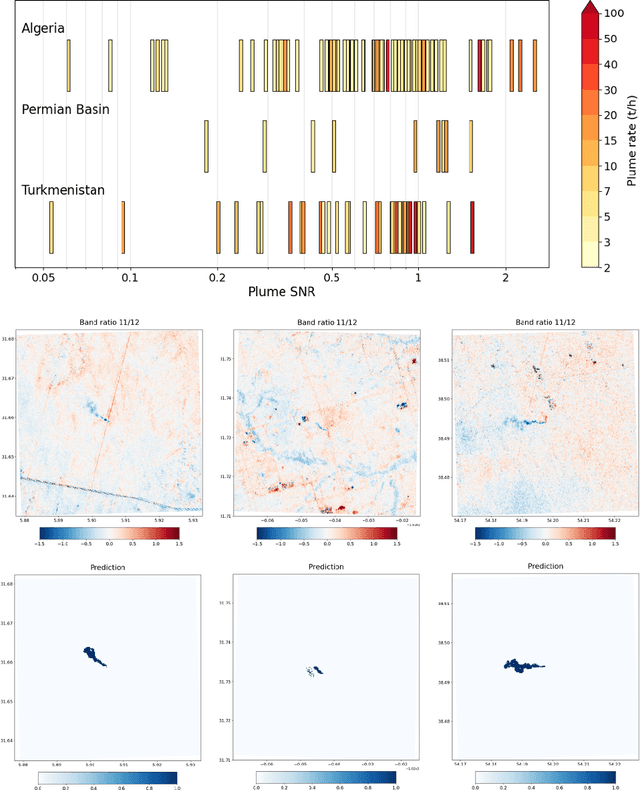
Methane is one of the most potent greenhouse gases, and its short atmospheric half-life makes it a prime target to rapidly curb global warming. However, current methane emission monitoring techniques primarily rely on approximate emission factors or self-reporting, which have been shown to often dramatically underestimate emissions. Although initially designed to monitor surface properties, satellite multispectral data has recently emerged as a powerful method to analyze atmospheric content. However, the spectral resolution of multispectral instruments is poor, and methane measurements are typically very noisy. Methane data products are also sensitive to absorption by the surface and other atmospheric gases (water vapor in particular) and therefore provide noisy maps of potential methane plumes, that typically require extensive human analysis. Here, we show that the image recognition capabilities of deep learning methods can be leveraged to automatize the detection of methane leaks in Sentinel-2 satellite multispectral data, with dramatically reduced false positive rates compared with state-of-the-art multispectral methane data products, and without the need for a priori knowledge of potential leak sites. Our proposed approach paves the way for the automated, high-definition and high-frequency monitoring of point-source methane emissions across the world.