 Add to Chrome
 Add to Firefox
 Add to Edge
Wireless Traffic Prediction with Large Language Model
Dec 19, 2025
The growing demand for intelligent, adaptive resource management in next-generation wireless networks has underscored the importance of accurate and scalable wireless traffic prediction. While recent advancements in deep learning and foundation models such as large language models (LLMs) have demonstrated promising forecasting capabilities, they largely overlook the spatial dependencies inherent in city-scale traffic dynamics. In this paper, we propose TIDES (Traffic Intelligence with DeepSeek-Enhanced Spatial-temporal prediction), a novel LLM-based framework that captures spatial-temporal correlations for urban wireless traffic prediction. TIDES first identifies heterogeneous traffic patterns across regions through a clustering mechanism and trains personalized models for each region to balance generalization and specialization. To bridge the domain gap between numerical traffic data and language-based models, we introduce a prompt engineering scheme that embeds statistical traffic features as structured inputs. Furthermore, we design a DeepSeek module that enables spatial alignment via cross-domain attention, allowing the LLM to leverage information from spatially related regions. By fine-tuning only lightweight components while freezing core LLM layers, TIDES achieves efficient adaptation to domain-specific patterns without incurring excessive training overhead. Extensive experiments on real-world cellular traffic datasets demonstrate that TIDES significantly outperforms state-of-the-art baselines in both prediction accuracy and robustness. Our results indicate that integrating spatial awareness into LLM-based predictors is the key to unlocking scalable and intelligent network management in future 6G systems.

Federated Radio Frequency Fingerprinting with Model Transfer and Adaptation
Feb 22, 2023

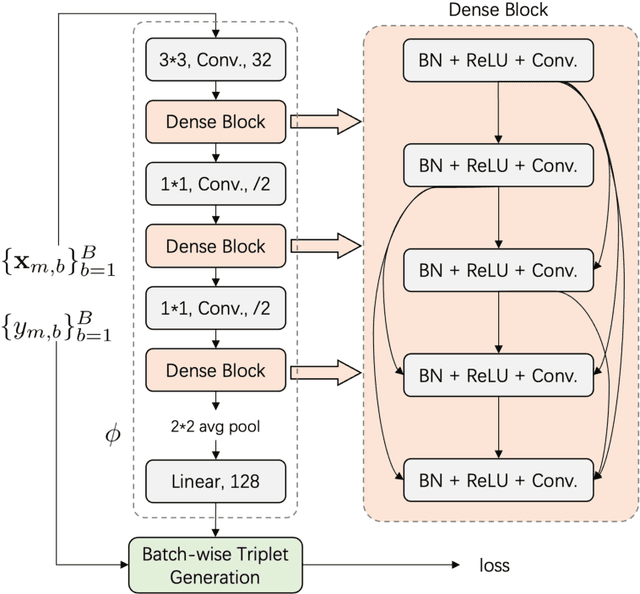

The Radio frequency (RF) fingerprinting technique makes highly secure device authentication possible for future networks by exploiting hardware imperfections introduced during manufacturing. Although this technique has received considerable attention over the past few years, RF fingerprinting still faces great challenges of channel-variation-induced data distribution drifts between the training phase and the test phase. To address this fundamental challenge and support model training and testing at the edge, we propose a federated RF fingerprinting algorithm with a novel strategy called model transfer and adaptation (MTA). The proposed algorithm introduces dense connectivity among convolutional layers into RF fingerprinting to enhance learning accuracy and reduce model complexity. Besides, we implement the proposed algorithm in the context of federated learning, making our algorithm communication efficient and privacy-preserved. To further conquer the data mismatch challenge, we transfer the learned model from one channel condition and adapt it to other channel conditions with only a limited amount of information, leading to highly accurate predictions under environmental drifts. Experimental results on real-world datasets demonstrate that the proposed algorithm is model-agnostic and also signal-irrelevant. Compared with state-of-the-art RF fingerprinting algorithms, our algorithm can improve prediction performance considerably with a performance gain of up to 15\%.